
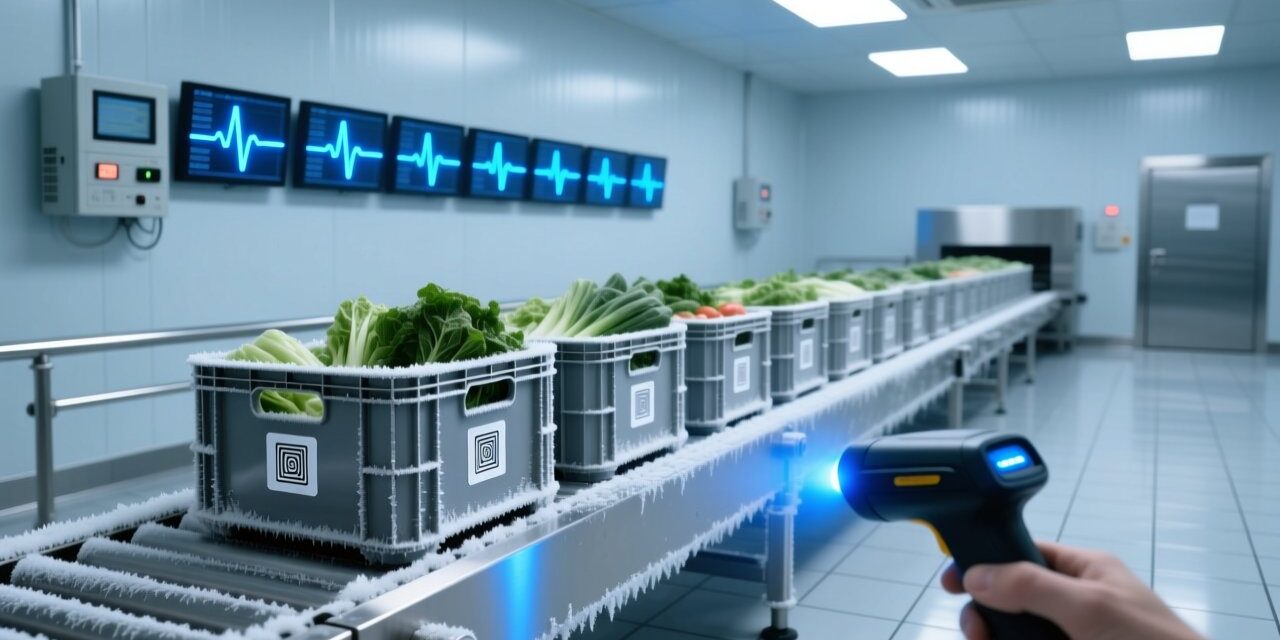
Navigating EU Food Safety Regulations: Why Traceability Is Non-Negotiable
For any business handling fresh food destined for European markets, compliance with the EU General Food Law (EC 178/2002) וה Hygiene of Foodstuffs Regulation (EC 852/2004) is mandatory. These frameworks mandate full traceability at every stage of production, עיבוד, and distribution. The recent Farm to Fork Strategy further tightens demands for digital traceability, requiring operators to provide accurate, real-time data on a product’s origin, אצווה, cold chain conditions, and shelf life. Non-compliance can lead to border rejections, costly recalls, and lasting brand damage.
Traditional paper-based or barcode systems fall short when faced with thousands of temperature-sensitive shipments. This is where תגי RFID – especially those with integrated temperature sensors – become a game-changer. By embedding a small, passive UHF RFID inlay into packaging or pallets, logistics managers gain automated, hands-free visibility across the entire cold chain.
The Role of RFID in Food Traceability: From Farm to Fork
זיהוי בתדר רדיו (RFID) uses electromagnetic fields to automatically identify and capture data about tagged objects. For food traceability, תגי UHF RFID are the workhorses, offering read ranges of up to 10 metres, high-speed bulk scanning, and the ability to store critical data such as batch numbers, production dates, and temperature logs. When combined with thermal sensors, these become RFID temperature tags – a pivotal technology for fresh produce, meat, dairy, and seafood.
A typical traceability flow might involve:
- Farm / Catch Point: A worker affixes an RFID tag to each crate or pallet, encoding the origin, harvest date, and initial temperature.
- Processing Plant: Handheld RFID scanners verify incoming batches and log process steps automatically.
- Cold Storage & Transport: קבוע RFID reader modules at dock doors and inside refrigerated trucks continuously monitor temperature and send alerts if thresholds are breached.
- קמעונאי / Point of Sale: Smart shelves or handheld devices read tags to ensure freshness and enable dynamic pricing for near-expiry items.
Technical Specifications That Matter for EU Compliance
Not all RFID tags are created equal, especially when moisture, metal surfaces, and extreme cold come into play. Here are the key parameters to evaluate for fresh food applications:
| מפרט | Requirement for Fresh Food | Typical Solution |
|---|---|---|
| תדירות | UHF (860–960 מגה-הרץ) for long read range and bulk scanning; HF NFC tags for consumer engagement | גשם RFID (UHF) for pallet/case-level; NFC for item-level marketing |
| זיכרון | At least 512 bits user memory to store batch ID, timestamp, temperature logs | Impinj Monza or NXP UCODE chips with extended EPC and user memory |
| Sensor Integration | On-chip temperature logging or external sensor interface | Battery-assisted passive (BAP) tags or specialist sensor chips like Asygn AS321X |
| Environmental Resistance | לחות, condensation, -25°C to +40°C operating range | IP67 rated RFID epoxy tags or food-grade flexible inlays |
| Read Reliability | Near 100% on high-speed conveyors, through cardboard and thin plastic | Specialised antenna design, e.g., dual-dipole for orientation insensitivity |
Deploying a system that captures temperature data at regular intervals and stores it on the tag itself (or instantly shares it to the cloud via a fixed UHF RFID reader) creates an immutable digital passport for each shipment. This directly satisfies the EU’s requirement for “one step back – one step forward” traceability and the need for documented cold chain integrity.
Practical Deployment Tips for Cold Chain Excellence
1. Start with a Pilot: Identify High-Risk Products
Focus first on items with the strictest temperature controls, such as fresh fish, poultry, or leafy greens. A small-scale pilot with a few hundred UHF RFID stickers will help validate read ranges in your specific packaging environment and uncover any interference from liquids or metal foils.
2. Choose the Right Tag for Your Packaging
For plastic crates, standard UHF inlays often suffice. For cardboard boxes containing high-moisture goods, consider RFID metal tags or on-metal designs if refrigeration units are metal-lined. גמיש, thin inlays are ideal for film-wrapped pallets. Always test readability after condensation cycles – some tags delaminate or lose sensitivity.
3. Integrate with Existing Cold Chain IoT Platforms
RFID alone is powerful, but when combined with cloud-based traceability software, it becomes transformative. Ensure your RFID middleware can export data in GS1 EPCIS format, the standard accepted by most EU food safety regulators. This allows seamless sharing of batch-level temperature history along the supply chain.
4. Train Staff and Automate Data Capture
Reduce human error by using fixed readers at key decision gates – receiving, dispatch, and staging areas. Equip quality control teams with handheld RFID scanners capable of reading temperature tags and instantly uploading data via Wi-Fi or 4G.
EU Regulatory Alignment: How RFID Simplifies Audits
Under EC 178/2002, food business operators must be able to identify any person from whom they have been supplied and any businesses to which their products have been supplied. RFID enables a fully digital recall system: if a contaminated lot is detected, a query by batch number retrieves all shipped pallets and their current location in seconds. Compare that to manual logbooks which could take days and still miss isolated boxes.
יתר על כן, for high-risk categories, the new Official Controls Regulation (האיחוד האירופי) 2017/625 empowers authorities to request complete digital records. RFID-generated data, time-stamped and geo-referenced, provides auditable proof of due diligence – significantly reducing the administrative burden during inspections.
מסקנה: Future-Proofing Your Food Supply Chain
As the EU moves towards mandatory digital product passports and tighter sustainability reporting, RFID-based traceability is no longer optional – it’s a competitive necessity. The technology not only safeguards compliance but also reduces waste by enabling smarter inventory rotation and can enhance consumer transparency when linked with מדבקות NFC on retail packs. Whether you export South American beef to Germany or Mediterranean produce to Scandinavia, the right RFID solution keeps your products safe, your data trustworthy, and your brand protected.
FAQ
- How does RFID help meet the EU’s “farm to fork” traceability requirement?
- RFID tags automatically record every movement and temperature event as products travel through the supply chain. This creates a digital trail from origin to retail, fulfilling the EC 178/2002 demand for full traceability without gaps.
- Can RFID temperature tags store a complete cold chain log?
- כן, advanced sensor-inlay combinations can log temperature readings at programmed intervals directly into the tag’s user memory. When read by any handheld RFID scanner or fixed reader, the full temperature history is uploaded to the cloud, meeting legal recording requirements.
- Are RFID tags reusable for returnable containers?
- הרבה UHF flexible tags ו RFID epoxy tags are designed for multi-use. They resist washing and harsh cold storage conditions, making them ideal for reusable crates and pallets circulating in the fresh food supply chain.
- What’s the difference between using UHF and NFC for food traceability?
- UHF is used for back-end logistics – pallet tracking, dock door scanning, and temperature monitoring over long distances. מדבקות NFC are consumer-facing, allowing shoppers to tap a smartphone for provenance and freshness information. Both can coexist in a layered traceability strategy.
- Does RFID comply with GS1 standards for food supply chains?
- Absolutely. RAIN RFID tags can encode SGTIN-96 or other GS1 identifiers, and RFID-generated event data can be formatted in EPCIS standard for direct integration with EU food safety databases and retailer requirements.
Ready to Strengthen Your EU Food Traceability System?
ב RFIDHY, we design and manufacture high-performance RFID tags, industrial RFID readers, and complete traceability solutions tailored to the fresh food and cold chain industries. Our experts can guide you through tag selection, reader integration, and software compliance with EU regulations. Contact us today for a free consultation or to request sample tags for your specific product packaging.