Two Mainstream Encapsulations for Embedded Tags
In industrial asset traceability for pipes, צמיגים, and similar assets, the encapsulation form of a passive UHF RFID tag directly determines its readability in harsh environments. The two most common schemes on engineering sites are: spring-embedded RFID chips, and adhesive PET after-market labels. Both belong to the ’embedded/industrial-grade’ tag family, but differ sharply in implantation method, protection level, and applicable process. RFIDHY, as a manufacturer of passive UHF embedded RFID tags/chips, supplies both encapsulation types for project selection.
Spring-Embedded: ‘Planting’ the Chip into the Pipe Body
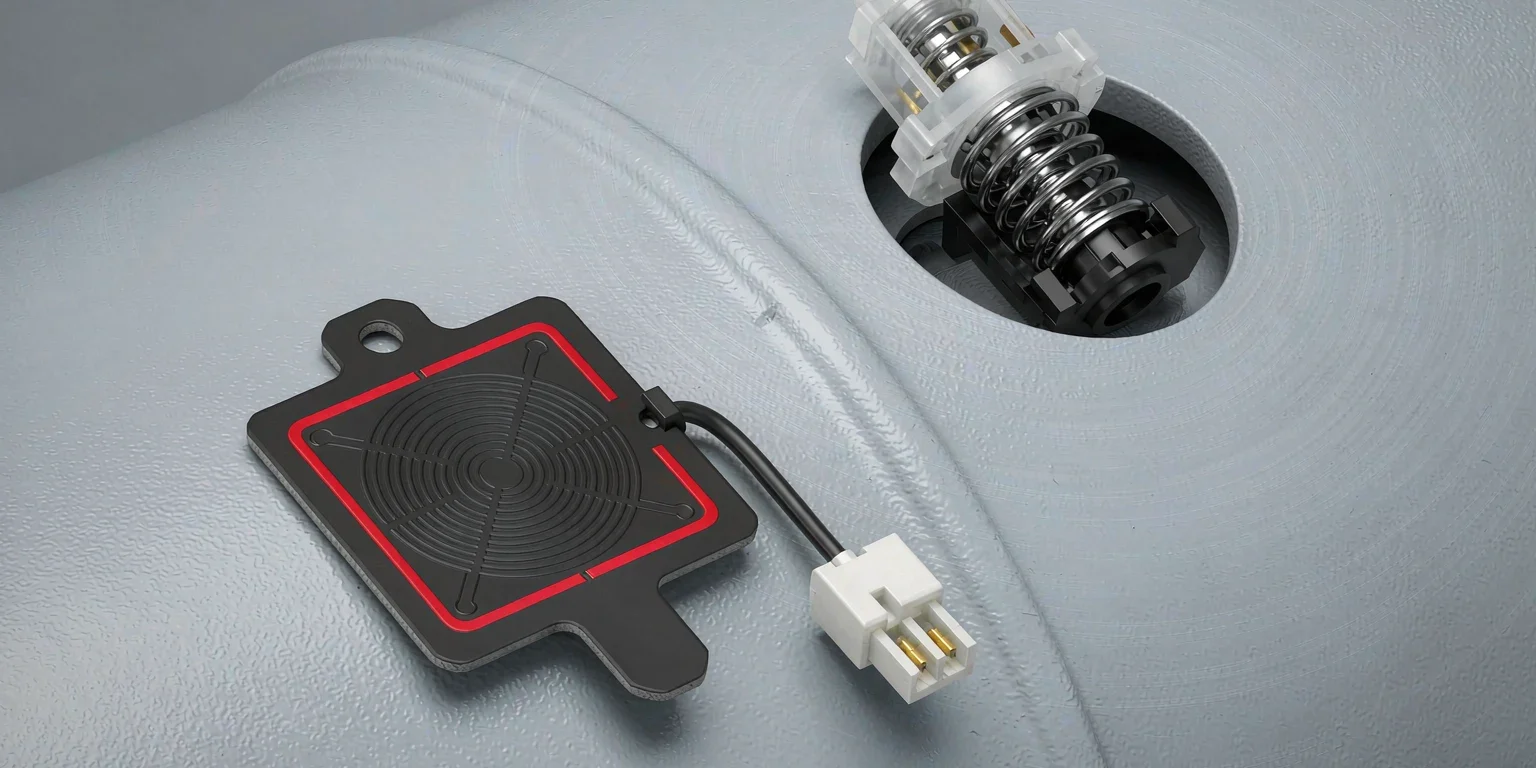
Spring-embedded RFID chips use an elastic metal coil encapsulation that can be directly implanted inside the pipe body during pipe extrusion or fitting injection molding, or pre-buried integrally with electrofusion fittings. Its biggest advantage is ‘same lifespan as the pipe’ — the chip is wrapped by the pipe wall, unaffected by surface mud, ללבוש, or UV aging, and even after backfill a handheld PDA can still detect and read it at a certain burial depth. As seen on RFIDHY’s UHF spring-embedded RFID tag, this process is the same as that used for tire implantation and suits scenarios demanding full-lifecycle traceability.
Adhesive PET Label: Low-Cost After-Market Option
An adhesive PET label bonds a finished RFID inlay to the pipe or fitting surface with industrial adhesive. It is flexible to apply and low to retrofit, suiting intake re-labeling of already-shipped pipes. But its shortcomings are clear: it depends on surface cleanliness, and under yard weathering, slurry, or backfill friction the adhesive layer and label may detach or soil, without the internal protection of ‘same lifespan as the pipe.’ Thus it is mostly used for batch-level flow marking rather than the primary identity of high-reliability hidden works.
Cross-Industry Proof: The Same Process Behind Tire Implantation
Spring-embedded process is not unique to pipes. In tire asset management, implanting RFID chips inside the tire body has been scaled up, proving elastic coil encapsulation can withstand high-temperature vulcanization and remain readable long term. RFIDHY migrates this same process to pipes and fittings, keeping a consistent reliable foundation for industrial asset traceability tags across industries. This also explains why the same spring-embedded tag can serve both pipe and tire scenarios.
Full Comparison: From Protection to Cost
In protection level, spring-embedded beats adhesive PET; in construction flexibility, adhesive PET is easier for existing lines or on-site re-labeling; in cost, adhesive PET is lower per unit, while spring-embedded has higher upfront investment due to embedding process yet saves later label maintenance.
Electrofusion Fitting Pre-Burial: The High-Reliability Anchor for Spring Embedding
In PE gas and water pipes, electrofusion fittings are the key nodes of network jointing and the objects ISO 12176-4 requires to carry a unique traceability code. Pre-burying spring-embedded RFID chips integrally with electrofusion fittings at the factory gives every joint an unpeelable hardware identity, readable by handheld before and after electrofusion welding, fundamentally preventing substandard joints and cross-segment transfer. By contrast, adhesive PET stuck on fitting surfaces fails more easily under welding heat and handling friction, so high-reliability nodes prioritize embedded process.
Selection Conclusion: Decide by Pipe Process and Burial Depth
The core basis for selection is pipe diameter, installation process, and backfill depth. For electrofusion fittings and municipal networks with high embedding requirements, prioritize spring embedding; for fast re-labeling of existing pipes and batch flow, adhesive PET is more cost-effective. Objectively, passive UHF signals attenuate in wet clay, deep backfill, or metal shielding, so sample tag-read tests must be done before concealment. If you need to evaluate both encapsulation options, get a custom quote.
Total Cost of Ownership
Comparing the two encapsulations purely on unit price is misleading. Adhesive PET wins on upfront tag cost and retrofit speed, but its failure rate in harsh or buried conditions can trigger re-labeling campaigns and disputed assets that erode those savings. Spring-embedded carries a higher initial process cost yet delivers a maintenance-free identity for the pipe’s service life, which for PE networks can exceed fifty years. For asset owners, the lower total cost of ownership usually favors embedding at the joints that matter most, supplementing with PET where flexibility is needed.