
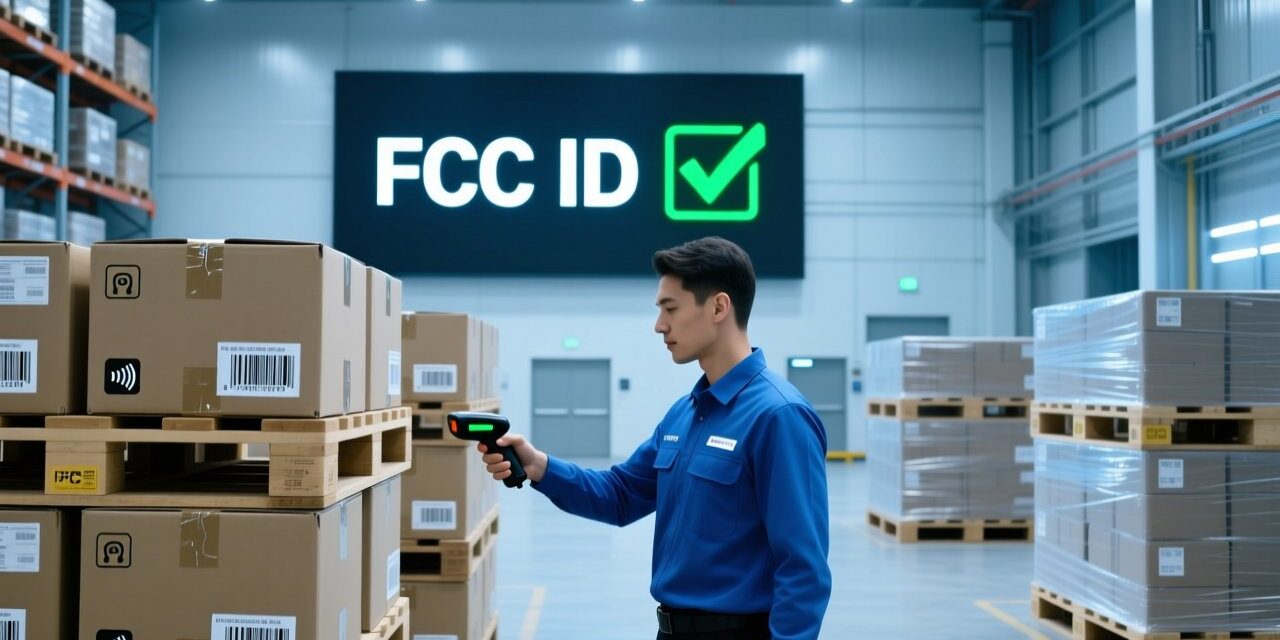
Why FCC Certification Is the Gatekeeper to the U.S. RFID Market
For Chinese RFID manufacturers, the North American market represents both immense opportunity and stringent regulatory scrutiny. Every year, États-Unis. Customs and Border Protection (CBP) intercepts thousands of RFID shipments that lack proper Federal Communications Commission (FCC) certification. Without an FCC ID, your RFID tags, lecteurs, and modules can be denied entry, leading to costly delays, returns, or even blacklisting. Dans 2024 alone, plus de 3,000 RFID-related shipments were flagged at U.S. ports for non-compliance, according to CBP trade data.
Un FCC-certified RFID manufacturer provides the essential passport for your products to clear customs smoothly and operate legally across the United States. Whether you are shipping Étiquettes RFID UHF for retail inventory management, RFID reader modules for access control, ou NFC inlays for smart packaging, Pièce FCC 15 compliance is non-negotiable.
This roadmap explains the technical landscape, certification process, and practical steps for Chinese RFID suppliers to navigate U.S. customs, build trust with American buyers, and scale their business with confidence.
The North American RFID Landscape: Growth and Regulation
Les États-Unis. RFID market is projected to reach $10.3 billion by 2028, driven by sectors like supply chain logistics, soins de santé, and industrial IoT. Major retailers like Walmart now require RFID tagging at the item level, while industrial operators in oil and gas, minier, and manufacturing rely on RFID for asset tracking and safety compliance. For a Chinese supplier, this demand is a golden opportunity—but only if your products meet FCC requirements.
FCC regulations, specifically Part 15, govern intentional radiators in the radio frequency spectrum. RFID devices operating in the 902–928 MHz (UHF) et 13.56 MHz (HF) bands must comply with emission limits, frequency tolerance, and labeling rules. Without a valid FCC ID, your RFID equipment cannot be legally marketed or used in the U.S. This includes everything from a tiny RFID embedded chip to a high-power fixed reader.
Pièce FCC 15: What Chinese Suppliers Must Know
Frequency Bands and Power Limits
- RFID UHF (902-928 MHz): Maximum conducted output power typically 1 watt (30 dBm) for spread‐spectrum systems. Antenna gain must be considered to meet EIRP limits (jusqu'à 4 watts EIRP for certain hopping systems).
- HF RFID (13.56 MHz): Limits are based on field strength, Généralement 15,848 µV/m at 30 mètres. Most HF NFC devices operate well below this threshold, but intentional radiators still require verification.
Equipment Authorization Procedures
- Certification (ID): Required for most RFID transmitters, especially UHF readers and active tags. Testing must be performed by an FCC-recognized accredited lab (par exemple, TCB). The manufacturer receives a unique FCC ID.
- Supplier’s Declaration of Conformity (SDoC): Applicable to some passive HF tags that fall under Part 15.231(E) or Part 15.225, but many importers still obtain certification to avoid CBP scrutiny.
- Verification: Rarely used for complete RFID systems; mostly for subassemblies that do not contain an intentional radiator.
Labeling and Documentation
Every FCC-certified RFID device must bear a physical label with the FCC ID. For small tags like RFID inlays, the ID may be placed on the packaging or user manual if the tag is too small. When shipping to the U.S., the commercial invoice should clearly list the FCC ID for each product line. CBP officers cross-check these IDs against the FCC database. A missing or invalid ID can result in a detention or seizure.
Technical Specifications and Key Considerations
Selecting an FCC-certified RFID manufacturer means looking beyond a paper certificate. The quality of compliance engineering directly affects performance, fiabilité, and customs clearance speed. Below are the critical technical factors:
| Technical Parameter | Impact on Compliance | RFIDHY Recommendation |
|---|---|---|
| Frequency Stability | Deviation outside 902-928 MHz can cause interference and fail certification. | Use Impinj or NXP chips with calibrated frequency tolerance of ±10 ppm. |
| Spurious Emissions | Harmonics and out-of-band emissions must not exceed limits; primary cause of certification failure. | Optimized antenna design and matching network; pre-compliance testing. |
| Modulation Scheme | FHSS or spectrum-spreading techniques reduce peak power density, easing FCC limits. | All UHF products use ISO 18000-6C with PR-ASK modulation; tested under worst-case data patterns. |
| EIRP Calculation | Conducted power + antenna gain must stay within 4 W EIRP (UHF). | We supply integrated antenna solutions pre-certified for North America. |
| Temperature Range | Drift at extreme temperatures can shift frequency; FCC testing may include environmental extremes. | Industrial-grade components rated from -40°C to +85°C, verified in anechoic chambers. |
All RFIDHY products are designed with FCC compliance from the ground up, not retrofitted. Notre on-metal RFID tags, par exemple, maintain stable frequency response even when mounted on metallic surfaces, a common trouble spot for uncertified tags.
Practical Deployment Tips for Chinese Suppliers and U.S. Importers
1. Vet Your Manufacturer’s FCC Documentation
Request the FCC grant of equipment authorization—not just a test report. The grant (often a one-page document) lists the FCC ID, frequency range, power levels, and applicable rule parts. Cross-reference the FCC ID on the FCC OET database. A legitimate manufacturer will provide this without hesitation.
2. Bundle FCC-Certified Components
If you are assembling a custom RFID solution (par exemple, a handheld terminal with a UHF module), ensure every intentional radiator in the system carries its own FCC ID or is covered by a modular grant. Using a pre-certified RFID reader module simplifies the final product’s authorization and often allows a limited modular approval route.
3. Prepare Customs-Ready Shipments
- Include a Product Compliance Statement in the shipment, listing each product’s FCC ID and rule part.
- Affix the FCC logo and ID visibly on the product or its retail packaging.
- For bulk shipments of tag reels, ensure the reel label displays the FCC ID alongside the batch number.
- Keep a digital copy of the FCC grant accessible for your freight forwarder.
4. Leverage Section 2.933 for Minor Changes
If you are integrating an already-certified module into a new enclosure, FCC rules under Section 2.933 allow you to change certain components without a new certification as long as the module’s grant permits it. This can save months in testing time. Always confirm with your FCC-certified RFID manufacturer that the modular approval supports your intended integration.
5. Stay Updated on 5G Interference Mitigation
With the 5G rollout in the U.S., the FCC has issued new adjacent-band coexistence requirements for devices operating near 3.7–3.98 GHz. While UHF RFID is far from this band, it influences spectrum monitoring and enforcement. Future rulemaking could affect certification procedures. Partner with a manufacturer that actively tracks regulatory changes.
Why Choose an FCC-Certified RFID Manufacturer from China?
Many Chinese RFID factories claim FCC certification but rely on test reports from uncertified labs or share a single FCC ID across multiple product lines, which violates FCC rules. Working with a reputable FCC-certified manufacturer like RFIDHY offers distinct advantages:
- Customs Clearance Certainty: Our FCC IDs are registered with the FCC and recognized by CBP, reducing the risk of holds or exams.
- Engineering Support: We provide pre-compliance testing, design reviews, and guidance for integrating our RFID components into your final products, saving you thousands in iterative lab costs.
- Scalable Quality: Our manufacturing facilities follow ISO 9001 quality management and produce RFID tags and readers that consistently meet FCC emission limits, batch after batch.
- End-Customer Confidence: American end-users—from Walmart suppliers to oil and gas contractors—require proof of FCC compliance before deploying RFID systems. Buying from an FCC-certified source eliminates one of the biggest barriers to adoption.
En outre, RFIDHY’s product portfolio is designed for North American industrial environments. Par exemple, notre RFID PPS tags are engineered to withstand harsh chemicals and extreme temperatures while staying within FCC spectrum masks—a critical requirement for PPE tracking in the oil and gas sector.
Case in Point: Streamlining U.S. Entry for a Chinese RFID Tag Exporter
A mid-size Chinese RFID supplier previously faced three consecutive CBP detentions because their passive UHF RFID labels lacked documented FCC authorization. After switching to RFIDHY as their OEM partner, they received reel‑ready labels with pre‑printed FCC IDs and a comprehensive compliance folder for their shipping documents. Their next six containers cleared customs in under 48 heures, and they secured a long-term contract with a U.S. logistics provider. (Remarque: Specific customer names are confidential.)
FAQ: FCC Certification for RFID Manufacturers
1. Does my passive UHF RFID tag need FCC certification?
Oui, if it is intended to be used in the United States. While battery-free passive tags operate by backscatter, they are still classified as intentional radiators under FCC Part 15.231(E) and require an FCC ID test report. Even if the tag itself doesn’t contain a transmitter, it is part of the intentional radiator system when powered by a reader. Always use tags from an FCC-certified RFID manufacturer.
2. How long does FCC certification take for a new RFID reader?
Typical lead times range from 4 À 8 Semaines, including test lab scheduling, emissions testing, and administrative review. Pre-certified modules can shorten this to days if the integrator qualifies for a modular approval. RFIDHY offers several pre-certified UHF reader modules with valid FCC IDs that can be integrated immediately.
3. Can I use the same FCC ID for different form factors of RFID tags?
Only if the radio frequency characteristics remain identical. Changing antenna dimensions, chip type, or substrate can alter radiated emissions and invalidate the original test data. The FCC generally requires a permissive change (Class II) filing or a new certification. We assist OEMs in determining the right certification path for each variant.
4. What happens if my shipment is seized by CBP due to lack of FCC certification?
CBP will issue a Notice of Detention. You have the opportunity to provide proof of FCC compliance (the FCC ID grant). If unable, the goods may be excluded, destroyed, or exported. You may also face fines and increased scrutiny on future shipments. It is far less expensive to source from an FCC-certified RFID manufacturer from the start.
5. Is FCC certification enough for the entire North American market?
FCC covers the United States and its territories. For Canada, you need Innovation, Science and Economic Development Canada (ISED) certification, which often accepts FCC test data but requires separate registration. Mexico has its own IFETEL certification. RFIDHY can supply dual FCC/ISED certified products for seamless North American distribution.
Ready to Avoid U.S. Customs Delays with FCC-Certified RFID?
Don’t let missing paperwork or uncertified components derail your RFID business in North America. Contact RFIDHY today to discuss your product requirements, request FCC documentation, or schedule a compliance consultation. Whether you need a turnkey solution or a pre-certified OEM module, we help Chinese RFID suppliers navigate the complexities of FCC Part 15 and clear U.S. customs with confidence.
Request Your FCC Compliance Packet Now
We respond within 24 hours with technical specifications, sample availability, and a tailored compliance roadmap.