
The Regulatory Wave Reshaping Recycling
The European Union’s ambitious circular economy action plan is compelling industries to rethink waste as a resource. Landmark regulations such as the EU Digital Product Passport (DPP), the revised Waste Electrical and Electronic Equipment (WEEE) Directive, and extended producer responsibility (EPR) schemes for packaging are mandating greater transparency across product lifecycles. For recycling facilities, this means an urgent need to accurately identify, Sorte, and track materials at scale. Circular economy RFID tag technology has emerged as the linchpin for meeting these requirements, enabling automated data capture that manual processes simply cannot achieve.
Recent legislation, including the Packaging and Packaging Waste Regulation (PPWR), sets ambitious recycling targets and demands that packaging carry digital IDs by 2030. These digital IDs, often in the form of RFID or NFC tags, must withstand harsh waste streams while providing actionable data on material composition and disposal instructions. Ainsi, demand is surging for rugged, high-readability RFID tags that can survive the journey from curbside bin to sorting line and beyond.
How RFID Drives the Circular Economy
RFID technology closes the information gap between product design and end-of-life recovery. By embedding RFID tags into products, emballage, or reusable containers, stakeholders gain real-time visibility into material flows. For recycling operators, this translates directly into higher sorting purity, reduced contamination, and increased recovery of valuable secondary raw materials. Unlike barcodes, RFID does not require line-of-sight and can read hundreds of tagged items simultaneously, making it ideal for high-speed sorting lines.
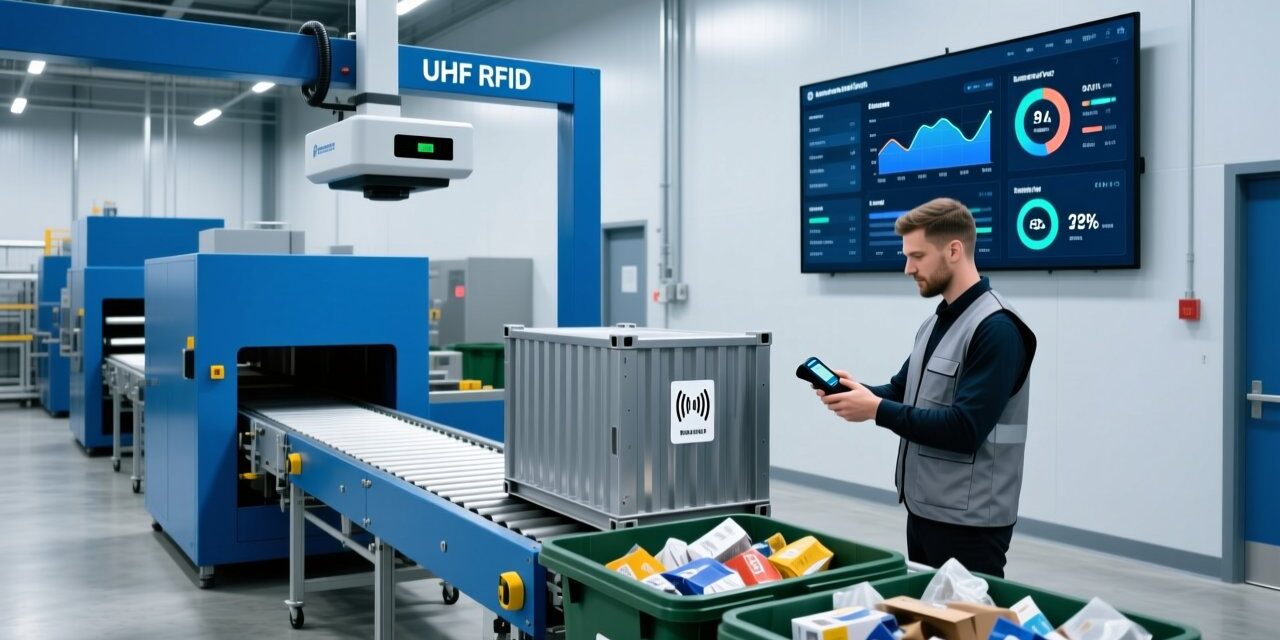
A typical recycling facility today uses a combination of fixed RFID readers mounted over conveyor belts and handheld devices for spot checks. When a waste bin embedded with an RFID waste bin tag is lifted, the reader automatically records the bin ID, Poids, and collection route. Inside the plant, UHF readers scan incoming bulk material, identifying tagged packaging items at speeds exceeding 500 units per minute. The data is instantly fed into an enterprise resource planning (ERP) système, enabling precise billing, material accounting, and regulatory reporting.
Regulatory Drivers of Tag Innovation
The regulatory landscape is not static—it is actively shaping the technical specifications of next-generation RFID tags. Key requirements include:
- Material purity: Tags must not contaminate recycling streams. This has spurred the development of RFID tags with minimal metal content, or those easily separable during the mechanical recycling process.
- Durability across environments: Tags must survive compaction, humidité, high temperatures, and exposure to chemicals in sorting facilities. This has accelerated the adoption of encapsulated and overmolded designs.
- On-metal readability: Many recycled goods—appliances, automotive parts, metal packaging—require tags that perform reliably on metal surfaces.
- Normes relatives aux données: GS1’s Global Trade Item Number (GTIN) and Electronic Product Code (CBE) formats are becoming de facto requirements for interoperable circular economy systems. Tags must support these standards and offer sufficient user memory for recycling-specific instructions.
These demands are reshaping how RFIDHY and other manufacturers approach tag design. Par exemple, the need for recyclable-friendly tags has led to the development of frangible inlays that detach cleanly from packaging during pulping. De la même façon, on-metal RFID tags with ferrite shielding now achieve read ranges of up to 10 meters even when attached to steel containers.
Technical Specifications for Recycling Applications
Selecting the right RFID technology for a circular economy project requires a detailed understanding of the operating environment. The table below summarizes critical parameters:
| Paramètre | Recommended Specification | Rationale |
|---|---|---|
| Fréquence | UHF (860–960 MHz) | Long read range (jusqu'à 15 m), high anti-collision rates, and global availability make UHF the preferred choice for bulk sorting. |
| Puce | Impinj M730/M750, NXP UCODE 9 | Haute sensibilité (-24 dBm) and robust anti-collision algorithms ensure reliable reads in dense tag populations. |
| Mémoire | 128-bit CBE + 96-mémoire utilisateur de bit | Sufficient for unique identifier plus recycling codes, material type, and disposal instructions. |
| IP Rating | IP68 or IP69K | Protection against dust, water immersion, and high-pressure washdowns common in recycling plants. |
| Température de fonctionnement | -40°C à +85°C (survival -40°C to +150°C) | Withstand extreme conditions in refuse collection vehicles and industrial drying processes. |
| Pièce jointe | Permanent adhesive or mechanical fastening | Adhesive must be UV-resistant and bond well to various substrates; mechanical options (rivets, screws) ensure retention on metal bins. |
For sorting lines where tagged items pass under a reader gate at high speed, the tag’s read sensitivity and the reader’s antenna configuration are paramount. A typical installation might use a fixed UHF RFID reader with four circular-polarized antennas to create a dense read zone. This setup captures tags regardless of orientation, achieving read rates above 99.5% in real-world tests.
Practical Deployment and Selection Tips
Implementing an RFID system in a recycling environment is not a plug-and-play exercise. Based on RFIDHY’s experience in industrial projects, the following steps can mitigate risks and accelerate ROI:
- Conduct a site survey: Map out the facility’s layout, identify metal interference sources, and measure ambient RF noise. This data guides antenna placement and reader sensitivity tuning.
- Choose the right tag for each substrate: Plastic, verre, métal, and paper each require different tag form factors. A mixed-recycling stream often demands a portfolio approach—combining flexible inlays for cardboard with rigid on-metal tags for metal containers.
- Pilot with a representative sample: Before full-scale rollout, test tags on actual waste materials under real conveying speeds. Validate read rates, collision handling, and data accuracy.
- Integrate with waste management software: Ensure your RFID middleware can communicate seamlessly with existing ERP or recycling-specific platforms. Standard interfaces like MQTT or REST APIs simplify integration.
- Plan for tag lifecycle: If tags are reusable (par exemple, on returnable containers), implement a check-in/check-out process to monitor tag health and battery levels if using battery-assisted tags. For single-use tags, factor in the cost of tag disposal or material recovery.
- Stay compliant with evolving standards: Participate in industry consortia such as RAIN Alliance or GS1’s circular economy workgroups to keep abreast of data format requirements.
RFIDHY offers a range of Étiquettes RFID specifically engineered for recycling applications. From compact disc tags that fit under bottle caps to high-temperature ceramic tags for industrial waste, the portfolio addresses the full spectrum of circular economy needs. For facilities handling waste electrical and electronic equipment (WEEE), our tamper-proof and on-metal tags provide a reliable audit trail from collection to final dismantling.
The Future of Smart Recycling
As the EU moves toward a digitally tracked circular economy, RFID will become as ubiquitous in recycling as it is in retail. Innovations such as RFID-enabled smart bins that weigh and identify waste at the point of disposal are already being piloted in cities like Barcelona and Amsterdam. These systems use Tags NFC for consumer interaction and UHF for infrastructure-level communication, creating a multi-layered data ecosystem. The rise of AI-assisted optical sorters further complements RFID by handling untagged fractions, while RFID provides the deterministic data that enables closed-loop recycling.
For manufacturers and waste management companies, the message is clear: investing in circular economy RFID tag infrastructure today is a strategic move that aligns with both regulatory mandates and the growing demand for sustainable products. By partnering with an experienced RFID solution provider like RFIDHY, businesses can navigate the technical complexities and build a future-proof system that turns waste into value.
How does RFID help in recycling sorting?
RFID enables automated identification of items as they pass through sorting lines. By reading tags on products or packaging, recyclers can instantly determine material type, brand, and disposal instructions, significantly reducing manual sorting errors and contamination rates.
What types of RFID tags are best for recycling containers?
For waste bins and reusable containers, robust RFID waste bin tags with IP68 rating and high impact resistance are ideal. Pour bacs métalliques, specialized on-metal tags with ferrite backing ensure consistent performance.
Are RFID tags themselves recyclable?
Conventional RFID tags contain silicon chips and aluminum antennas which can be problematic in some recycling processes. Cependant, new eco-designed tags use frangible structures that separate during pulping, and the metal content is often recoverable. Tag manufacturers are actively developing fully compostable or biodegradable alternatives for certain applications.
How do you attach RFID tags to recyclable items without contaminating the recycling stream?
Tag attachment methods are moving toward recyclable-compatible adhesives or mechanical fastening. For paper and cardboard, water-soluble adhesives are used so tags release during the pulping process. For plastic containers, tags can be integrated into the label or cap during manufacturing, ensuring they travel with the item through the recycling chain without introducing new materials.
Can RFID tags survive the harsh conditions in a recycling facility?
Oui. Industrial-grade RFID tags are built to withstand extreme temperatures, humidité, vibration, and chemical exposure. Tags rated IP68 or IP69K are commonly used, and some are encased in ceramic or epoxy to endure shredding and washing processes. It is essential to select tags tested for the specific environment.
What frequency is best for recycling sorting—HF or UHF?
UHF (860–960 MHz) is the standard for recycling because it offers longer read ranges, faster data rates, and better anti-collision performance, all critical for high-speed conveyor sorting. HF is sometimes used for close-range consumer interaction or small item tracking, but UHF dominates industrial recycling applications.
Ready to modernize your recycling operations with circular economy RFID technology? RFIDHY provides end-to-end solutions—from rugged RFID waste bin tags et on-metal RFID tags to high-performance fixed UHF RFID readers. Our engineers work closely with your team to design a system that meets regulatory demands and maximizes material recovery. Contact us today for a free consultation and discover how RFID can turn your circular economy goals into measurable results.