Three Technical Routes for Asset Identity Traceability
In industrial asset traceability — especially pipes and municipal networks — asset identity traceability typically faces three routes: Codes QR, point RFID, and a ‘QR code + passive UHF RFID’ dual-channel system. They are not mutually exclusive; each has its applicable boundary. Understanding their pros and cons is the first step to sound selection.
QR Code: Low Threshold but Field Limitations
QR codes are lightweight and convenient; supervisors and workers can view inspection reports with an ordinary smartphone at minimal deployment cost. But at pipe network sites, pipes weathered in storage yards, splashed with slurry, or backfilled into trenches easily wear or soil QR codes, which also require close lens alignment. In a dense yard of hundreds of sections, hunting and aligning to scan each one is inefficient and hard to support batch acceptance.
Passive UHF RFID: Penetration and Batch Reading
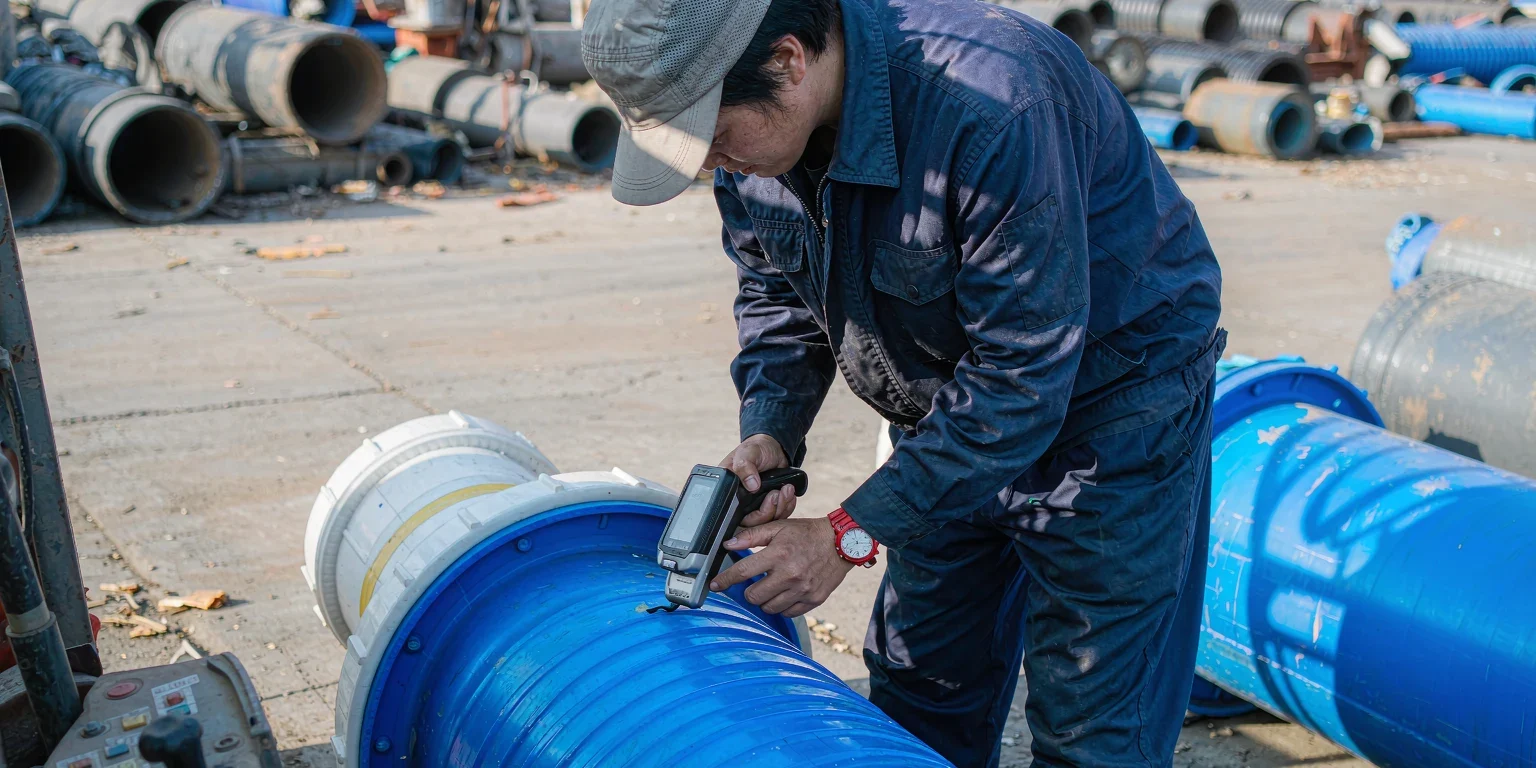
Passive UHF RFID chips need no battery; they are energized by RF signals from a handheld PDA and offer alignment-free sensing and second-level batch inventory. During yard acceptance and lifting-into-trench steps, a single sweep reads multiple chips instantly. Plus important encore, under soil meeting material and burial-depth conditions, RFID provides a physical-detection digital gateway for hidden works. RFIDHY supplies a spring-embedded encapsulation that can be implanted with fittings, staying readable under mud cover.
Dual-Channel System: Phone Scanning Complements Handheld RF
Taking a third-party pipe network traceability system as an example, its ‘one-pipe-one-chip, dual-channel complement’ architecture is representative: an 8-digit EPC traceability code is printed on the pipe-body QR code for phones to check batch and inspection with one scan; a 24-digit globally unique TID hardware chip code is bound to a single pipe section at the factory or intake, attached via adhesive PET label or embedded by spring, and read by handheld sensing. Whether entering via phone scan or PDA RF, the same tamper-proof cloud record is retrieved.
It is worth emphasizing that RFIDHY, as a manufacturer of passive UHF embedded RFID tags/chips, provides the hardware foundation of the ‘chip asset code’ in the above dual channel — including both spring-embedded and adhesive PET encapsulation forms — for integrators to select by process. See RFIDHY’s UHF spring-embedded RFID tag.
Typical Pain: Why QR Alone Cannot Sustain Pipe Network Traceability
Municipal hidden works have four chronic ills: non-standard or diverted stock is hard to spot by eye, hidden-image records are easily backfilled and faked, spatial positions rely on drawings and memory, and ledgers are hastily patched by hand before completion. QR codes can carry inspection info but cannot read stably under mud or backfill, nor verify batches in dense yards. Introducing passive UHF RFID gives the data foundation for batch checking on intake, forced on-site geo-stamped evidence, and pipe/manhole topology anchoring. Ainsi, choosing an asset identity traceability plan is essentially choosing a quality-control closed loop.
Selection Advice: Combine by Scenario, Not Either-Or
If the site relies mainly on manual inspection and low-threshold phone verification, QR codes suffice; if it involves yard batch acceptance, hidden-work detection, and full-lifecycle traceability, introduce passive UHF RFID; for high-reliability municipal networks, the dual-channel system is most robust. Note that passive UHF signals attenuate in wet clay, deep backfill, or metal shielding, so sample tag-read tests should precede selection. If you need to evaluate a tag encapsulation solution, get a custom quote.
Making the Business Case
The business case for the right traceability route is straightforward: rework from misidentified or substandard pipe, disputed warranty claims, and slow emergency excavation all carry hard costs. A dual-channel design costs little more than QR alone at the tag level yet removes the single point of failure when labels are buried or soiled. RFIDHY’s contribution is keeping the chip readable across that lifecycle; the integrator’s system turns reads into audit-ready evidence. Specifying the encapsulation early — before the pipe leaves the mill — is the lowest-cost point to act.