
‘One-Pipe-One-Chip’: Giving Buried Pipes a Digital Identity
Underground pipelines are often called the ‘invisible arteries’ of a city, yet once buried they become a black box — a challenge shared by utilities worldwide, where excavation often relies on luck. As city lifeline safety programs accelerate, a ‘one-pipe-one-chip’ approach to digital asset delivery is taking hold: by physically binding a passive ultra-high-frequency (UHF) RFID chip to each individual pipe, every pipe section carries a traceable digital identity throughout its full lifecycle — from factory, to site intake, to laying, to completion.
An important distinction: RFIDHY is a manufacturer of passive UHF embedded RFID tags/chips, focused on the tag and chip itself. For industrial asset traceability scenarios such as pipes and tires, RFIDHY supplies spring-embedded RFID encapsulation solutions that can be implanted into the pipe body.
From Storage Yard to Trench: RFID Tags Span the Pipe Lifecycle
In pipe storage yards, hundreds or thousands of pipe sections are stacked densely. The traditional method of visually checking certificates is easily fooled by non-standard or diverted pipe stock. When each pipe is bound to a passive UHF RFID chip at the factory or upon intake, an industrial handheld PDA can read them in batches within seconds — no alignment needed, no rummaging. Each chip carries a unique TID burned at manufacture and an EPC that the operator can encode with batch number, date de production, and mill ID; working in the global 860–960 MHz UHF band, a reader can inventory a stacked pallet of pipes without line-of-sight, while the TID acts as a tamper-proof hardware serial that prevents cloning or replay. This both improves acceptance efficiency and provides a data anchor for later de-duplication and flow control.
The Digital Gateway for Buried Works: Why Embedded, Not Surface-Stuck
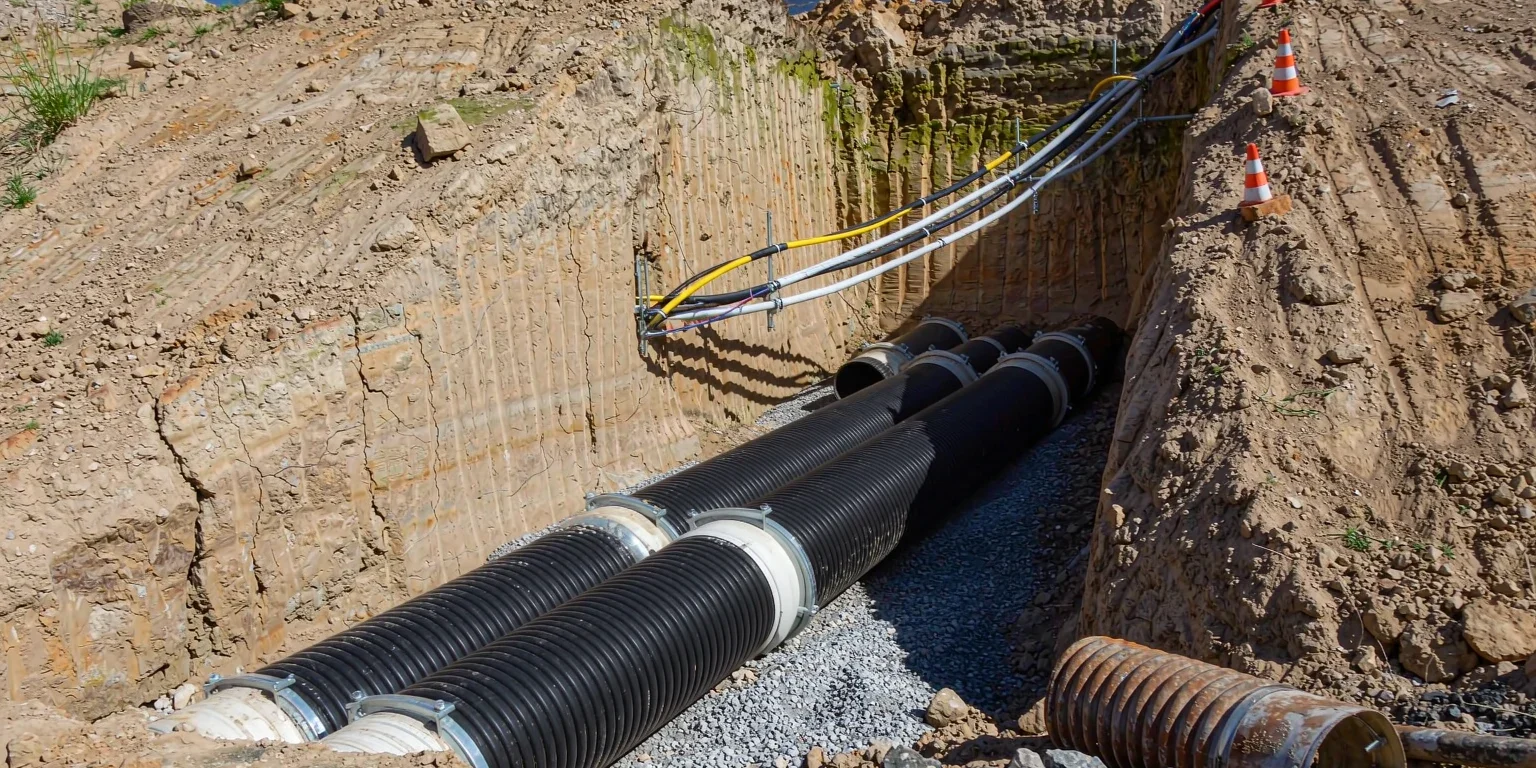
Pipe networks are hidden works; once backfilled, QR codes easily wear out, get soiled, and require close-up lens alignment. Embedding the RFID chip into the pipe body or fitting via a spring-in mechanism is like pre-installing a ‘physical ID card’ inside the pipe. Even when covered by mud, a handheld reader can still detect and read it under a certain burial depth. In practice, a spring-embedded UHF tag can typically be read through several centimeters to tens of centimeters of soil and pipe wall with a suitable handheld antenna — far beyond what a surface QR code can offer once buried or coated. See RFIDHY’s UHF spring-embedded RFID tag for the same spring-in encapsulation process used for both pipes and tires.
Industry Evidence: Huichang Piping’s Pipe Network Traceability Practice
According to Huichang Piping’s publicly disclosed underground pipe network RFID traceability case, it deployed a ‘one-pipe-one-chip’ dual-channel system to provide a lightweight solution for municipal pipe material traceability. Dans ce cas, a QR code printed on the pipe body lets phones scan batch inspection data, while the embedded passive UHF RFID chip allows handheld batch sensing; both ultimately converge to the same tamper-proof digital pipe record in the cloud. Such practices confirm that embedded RFID tags, as the ‘hard foundation’ of industrial asset traceability, deliver value by making pipe identity transparent and recoverable.
How the Tag Data Becomes Actionable
The chip alone does not equal traceability; its value is realized when a system ‘catches’ the reads. Once a pipe’s TID and EPC are registered against its mill certificate, every subsequent scan — at intake, at lay, at inspection — appends a timestamped event to that pipe’s record. Integrators then surface this as a queryable ‘one-pipe-one-file’ view, while GIS platforms place each pipe on a map with its depth and material. RFIDHY’s role ends at delivering a reliable, consistently readable chip; the analytics layer belongs to the system integrator.
Selection Advice: Encapsulation Should Fit Local Conditions
Objectively, passive UHF RF signals attenuate in wet clay, deep backfill, or metal-shielded environments. C’est pourquoi, before starting hidden works, you should select a typical cross-section to conduct sample tag-read tests based on pipe diameter, méthode d’installation, and backfill depth, scientifically determining the chip encapsulation form and read/write specifications. If your project needs to evaluate an embedded tag solution, get a custom quote.