Smart Parking in the Middle East: A Data-Driven Imperative
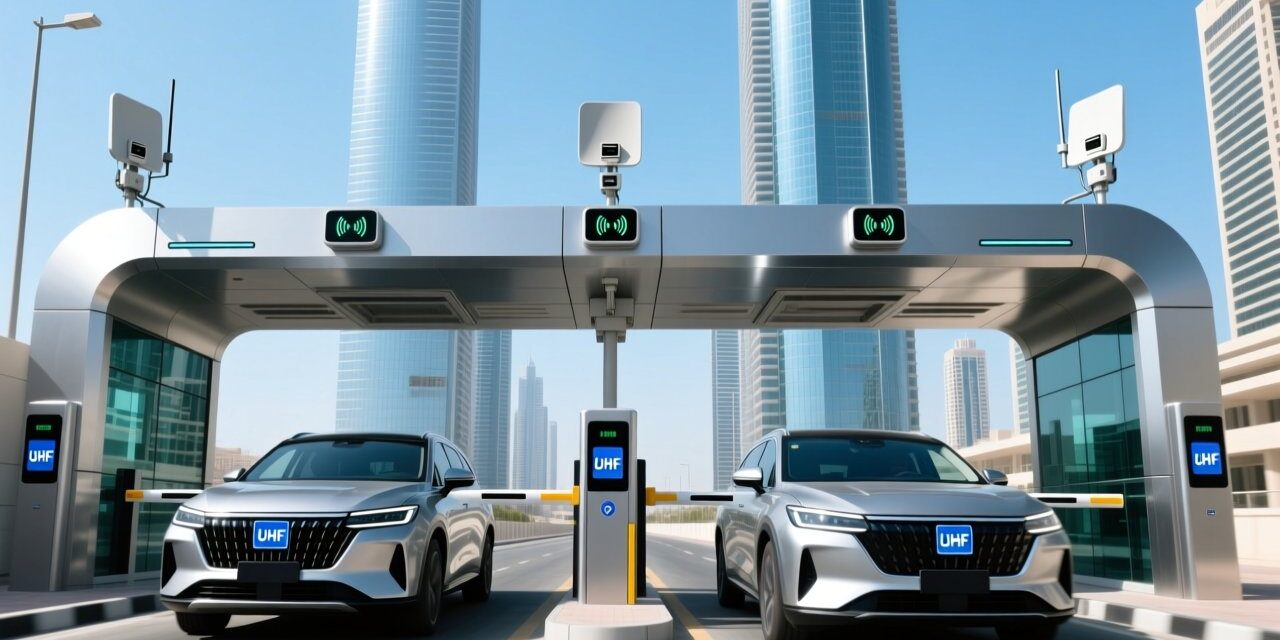
Across the Gulf Cooperation Council (GCC), governments are accelerating smart city projects that reduce congestion and improve operational efficiency. Dubai, with a vehicle density among the highest in the region, has become a live laboratory for intelligent transportation systems. Automated parking and toll collection, once dependent on physical tickets and manual booths, is now being transformed by passive UHF windshield tags. These Gen2-compliant labels enable contactless vehicle identification from up to 10 meters, allowing drivers to pass through gated entry and exit points without stopping.
The scale of deployment is significant. A single integrated system managing multiple parking zones in Dubai now processes over 50,000 vehicles per day. This volume demands robust hardware, real-time data processing, and tag readability rates exceeding 99.9% — a benchmark achieved through careful selection of RFID components and system architecture.
Industry Context: Why UHF RFID for Parking Automation
Traditional parking management in the Middle East faces harsh environmental challenges: extreme heat, sand, and UV exposure degrade conventional barcodes and magnetic stripes. Meanwhile, municipal revenue collection requires tamper-proof, prepaid or postpaid vehicle identification. UHF RFID reader modules coupled with windshield tags offer a proven alternative, already validated in UAE tolling systems like Salik (DSRC) and regional fuel retail automation.
- Contactless operation eliminates driver interaction, crucial for hygiene and speed.
- Passive tags require no battery, lowering maintenance and replacement costs.
- UHF frequency (860–960 MHz) delivers a read range of 8–12 meters, far exceeding HF or NFC alternatives.
- Encrypted chip options (Impinj Monza, Alien Higgs) support secure data exchange and anti-cloning measures.
Technical Specifications: The Core of Reliable Vehicle Identification
A municipal-grade RFID parking system demands components engineered for outdoor, high-cycle use. The key element — the windshield tag — must adhere permanently to glass and withstand interior cabin temperatures exceeding 80°C. RFIDHY’s portfolio includes UHF windshield labels with the following typical specifications:
| Parameter | Specification |
|---|---|
| Frequency | 860–960 MHz (global UHF band) |
| Protocol | EPCglobal Gen2 (ISO 18000-6C) |
| Read Range | Up to 12 meters (fixed reader, 9dBi antenna) |
| Memory | 128-bit EPC + 512-bit user memory (configurable) |
| Material | PET face stock with permanent acrylic adhesive |
| Operating Temp | -20°C to +85°C |
| Dimensions | 100 × 30 mm (compact windshield strip) |
| Special Feature | Tamper-evident; destructs upon removal |
On the infrastructure side, fixed RFID readers with 4 antenna ports are installed at each gate lane. These readers use dense reader mode (DRM) to avoid interference when multiple lanes operate in parallel. Antennas are typically mounted overhead to capture tags from a wide vehicle profile, while control software handles redundant reads and filters duplicate entries within milliseconds.
Deployment & Selection Tips for Municipalities
Tag Positioning Matters
For consistent reads, the windshield tag must be placed behind the rear-view mirror on the passenger side, where no metallic coating obstructs RF signals. Test campaigns in Dubai confirmed that off-center placement reduces angle variation and improves first-read success by 2–3% compared to bottom corner positions.
Reader Configuration & Integration
Modern fixed readers support POE+ and can interface directly with parking management software via MQTT or HTTP API. When integrating with existing ERP or municipal payment gateways, a middleware layer translates EPC data into account balances or access permissions. It is advisable to use readers that offer GPIO triggering for barrier control, minimizing third-party controller latency.
Environmental Hardening
Enclosures should be IP65-rated to withstand sandstorms and occasional rain. Antenna radomes must be UV-stabilized; otherwise, long-term exposure can degrade gain. In Dubai, readers are housed in climate-controlled kiosks with active cooling during summer peak hours.
Real-World Results: Data from a 50,000-Vehicle Deployment
After a 12-month operation review, the Dubai smart parking system reported the following aggregated metrics:
| Key Performance Indicator | Value |
|---|---|
| Average daily transactions | 53,120 vehicles |
| Read reliability | 99.93% (single-pass first read) |
| Average gate-open latency | 0.8 seconds (from tag detection) |
| Revenue leakage reduction | Estimated 14% increase vs. manual ticketing |
| Maintenance calls (reader failure) | < 2 per 1,000 gate-hours |
These figures translated into a measurable return on investment within 18 months, attributed primarily to labor savings, reduced cash handling, and a sharp drop in unauthorized parking. Operators also reported a 30% decrease in peak-hour congestion at exit lanes, as automated payments — linked via the RFID tag — replaced manual payment kiosks.
Scalability and Future-Proofing
The Dubai deployment serves as a blueprint for other GCC cities. By adopting modular reader-and-tag architectures, municipalities can expand coverage to on-street parking, residential permit zones, and toll gateways without replacing core infrastructure. Evolving standards such as RAIN RFID further ensure interoperability with future vehicle identity services.
For decision-makers, the lesson is clear: UHF windshield tags combined with well-engineered fixed readers deliver the throughput, accuracy, and durability required by modern Middle Eastern metropolises.
How do UHF windshield tags differ from traditional RFID access cards?
UHF windshield tags operate at a longer frequency band (860–960 MHz) and are designed for vehicle identification at distances up to 12 meters. Unlike access cards that require close proximity, windshield tags enable hands-free, drive-through authentication, making them ideal for high-throughput parking and toll environments.
Can these tags survive Dubai’s extreme summer temperatures?
Yes. Industrial-grade UHF windshield tags are tested to withstand continuous exposure from -20°C to +85°C, which covers interior temperatures even during peak Gulf summer. The adhesive is formulated to prevent softening or bubble formation on car windshields.
What happens if a windshield is replaced or the tag is removed?
The tag is tamper-evident; any attempt to peel it off will destroy the inlay, rendering it inoperable. For legitimate replacements, a new tag is issued and the old EPC is deactivated in the back-end system, maintaining security and accurate billing.
Is the system compatible with existing toll collection platforms in the UAE?
Yes, provided the middleware supports EPC integration. Most modern parking management systems can correlate the unique tag ID with a user account, enabling seamless connectivity with municipal payment portals and existing RFID toll collection networks.
RFIDHY designs and manufactures industrial-grade UHF windshield tags and fixed reader infrastructure trusted in smart parking deployments across the Middle East. Whether you are planning a municipal pilot or expanding an existing network, our engineering team can guide you from chip selection to full system integration.