
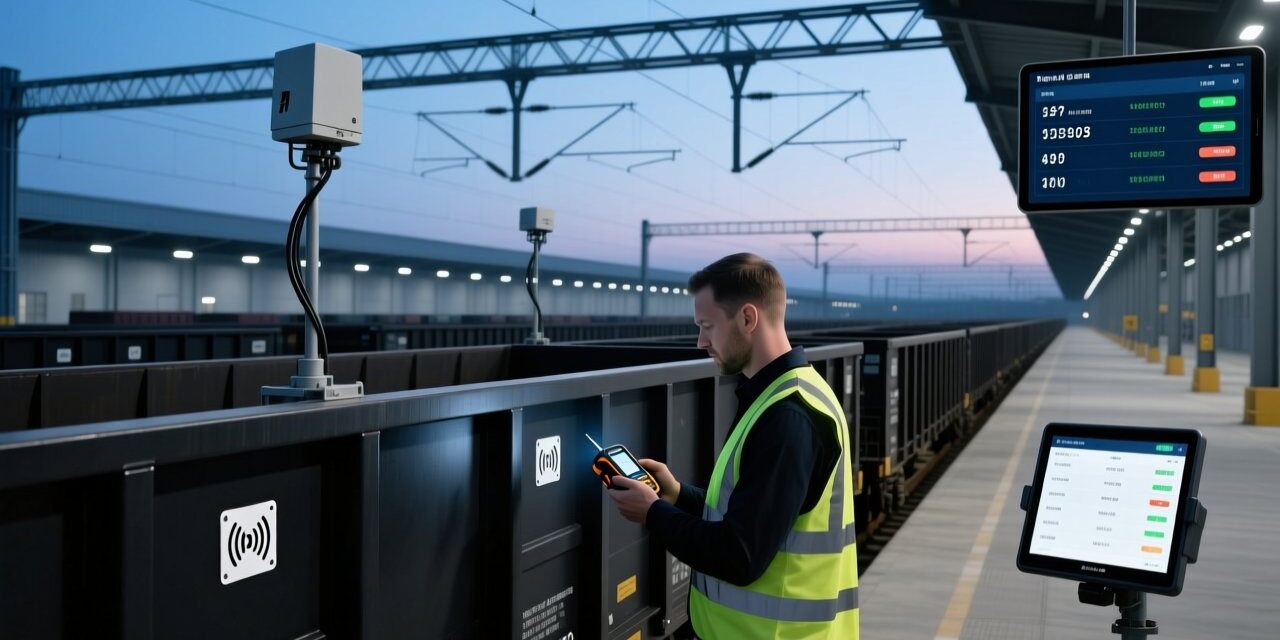
Why European Rail Freight Needs a Digital Leap
The European Union’s ambition to shift 30% of road freight to rail by 2030 puts immense pressure on existing infrastructure. Every day, thousands of freight wagons cross borders, yet many yards still rely on manual checks and handwritten logs to track assets. The result? Average dwell times in marshalling yards can exceed 6–12 hours, with misrouted wagons costing operators millions annually. Digitalization is no longer optional—it’s a competitive necessity. At the heart of this shift lies a proven technology: RFID tags and readers that bring real-time visibility to every railcar.
Recent EU-funded initiatives like the European Rail Traffic Management System (ERTMS) and the Digital Automatic Coupling (DAC) project underscore the industry’s push toward automation. However, these systems primarily address signaling and mechanical coupling. For yard and fleet management, passive UHF RFID offers a cost-effective, scalable layer that is already changing how operators like DB Cargo and Lineas handle wagons. By equipping each freight wagon with a durable, on-metal RFID tag, yards can automatically capture wagon numbers, maintenance status, and loading information without stopping operations.
Market Context: The Rising Demand for Wagon Visibility
European rail freight tonnage exceeded 400 billion tonne-kilometers in 2022, and the EU’s “Green Deal” fuels further growth. Major corridors—Rotterdam–Genoa, Betuweroute, and the Scandinavian–Mediterranean axis—demand seamless handovers. Yet, each interchange risks data entry errors. Industry studies suggest that RFID-based automatic identification can reduce gate processing time by up to 80% and virtually eliminate manual transcription mistakes. Moreover, the European Union Agency for Railways (ERA) is updating Technical Specifications for Interoperability (TAF TSI) to encourage electronic data exchange, making RFID a future-proof investment.
Several rail undertakings now mandate RFID-tagged wagons for accessing key terminals. For example, port railway operators in Antwerp and Rotterdam use RFID gates to log arrivals and departures automatically. This trend aligns with RAIN Alliance’s global push for UHF RFID in industrial logistics, where the technology has proven its worth in container tracking, automotive manufacturing, and warehousing. In rail, the unique challenge is the harsh environment: steel bodies, extreme weather, long reading distances, and the need to integrate with legacy telematics like GPS and odometry.
Technical Specifications: UHF RFID for Wagons and Yards
Not all RFID is created equal. For freight wagon tracking, UHF (860–960 MHz) is the dominant choice due to its read range of up to 15 meters, fast multi-tag reading, and affinity for the European ETSI band (865–868 MHz). The following table breaks down key specifications:
| Parameter | Typical Value | Remarks |
|---|---|---|
| Frequency | 865–868 MHz (ETSI) | Use certified readers to avoid interference |
| Read Range (on-metal tag) | 8–15 m | Depends on reader power & antenna gain |
| Tag Memory | 96–512 bit EPC + user memory | Store wagon ID, owner, maintenance dates |
| Tag Attachment | Welded bracket, high-bond adhesive, or rivet | Must withstand vibration & corrosion |
| Environmental Rating | IP68, -40°C to +85°C | Essential for Nordic winters & Mediterranean summers |
| Standards | ISO 18000-63, GS1 EPC Gen2v2 | Interoperability across Europe |
For yard readers, fixed portals using industrial-grade devices like the fixed RFID reader with high-gain antennas can capture entire trains moving at up to 30 km/h. In shunting areas, handheld scanners such as the handheld UHF RFID scanner provide flexibility for spot checks and coupling verification. Key tag characteristics include an anti-metal design—wagons are essentially large metal reflectors—so we recommend specialized on-metal RFID tags that use a ceramic or foam spacer to ensure consistent reads. For wagons with composite materials, standard inlays may work, but metal proximity demands careful evaluation.
Integration with Yard Management Systems
Data captured by RFID readers must flow into existing Yard Management Systems (YMS) or Transportation Management Systems (TMS). Modern architectures use middleware that translates EPC codes into wagon identifiers, enriches them with time stamps and reader location, and publishes via MQTT or REST API. This enables real-time dashboards showing wagon location, dwell time alerts, and predictive maintenance scheduling. Some European yards also integrate RFID with optical character recognition (OCR) cameras to cross-verify wagon numbers, achieving near 100% accuracy.
When selecting a system, prioritize readers with Power over Ethernet (PoE+) and industrial protocol support (EtherNet/IP, Profinet). Ruggedized antennas like the RFID antenna designed for outdoor use minimize signal loss in rainy conditions. For yards without wired connectivity, LTE/5G routers can relay data to the cloud, although care must be taken to meet GDPR requirements if location data is personal.
Practical Deployment Tips
Deploying RFID in a rail yard is a phased journey. Start with a pilot on one yard section—perhaps the inbound gate—using a single lane portal. Define the wagon population to be tagged, preferably standardized across your fleet. Attach tags to a consistent location on the wagon chassis (e.g., bolster beam) using rugged screw-fixed tags to survive shock loads. Test read reliability under different weather conditions, wagon configurations, and speeds. Use the pilot data to build a business case for full rollout.
Common pitfalls include tag collision when many wagons are read simultaneously; modern Gen2 anti-collision algorithms handle over 100 tags per second, but your reader configuration must be tuned. Also, ensure that your tag encoding follows GS1 standards to share data with partners. Finally, train yard staff on the new workflow—handheld readers dramatically reduce manual inspection time, but only when operators trust the technology.
For existing fleets, retrofitting is straightforward: select a tag with a universal mounting bracket that can be welded or drilled without compromising structural integrity. New wagon builds should incorporate RFID tag pockets into the design, a practice already common in intermodal and automotive railcars. As the European DAC initiative rolls out, integrated RFID could become a standard feature, further lowering adoption barriers.
FAQ
- What is the maximum reading distance for UHF RFID on metal freight wagons?
- With ETSI-compliant fixed readers and 9 dBi antennas, reads up to 15 meters are achievable on stationary wagons and up to 8 meters on slow-moving trains. Range decreases in heavy rain or if the tag is mounted near a metal edge. Always perform a site survey to determine optimal antenna placement.
- Can RFID tags withstand extreme weather and physical impacts in rail environments?
- Yes. Industrial-grade on-metal RFID tags are encased in UV-stabilized thermoplastic or ceramic housings rated IP68, tested for -40°C to +85°C. High-shock mounting kits (screw or weld) resist vibration and ballast strikes. In Nordic conditions, tags with wide temperature tolerance are a must.
- How does RFID integrate with existing railway telematics systems?
- RFID readers connect to edge gateways that format tag reads into standard telemetry protocols (e.g., MQTT, XML over TCP). This data can merge with GPS coordinates, wheel impact sensors, and brake system status within your fleet management software. Most YMS platforms support direct API ingestion of RAIN RFID data.
- Is RFID mandatory under current or upcoming EU regulations?
- While not yet mandatory for all wagons, the EU’s TAF TSI framework encourages automatic identification to improve information exchange. Several rail corridors and large terminals already require tagged wagons. Early adoption gives you a competitive edge and ensures compliance ahead of future mandates.
- Can the same RFID tag be used for both yard tracking and maintenance logging?
- Absolutely. Tags with user memory (up to 512 bits) can store maintenance dates, brake pad status, or tank inspection records. Handheld readers can update this data on the spot, making condition-based maintenance more efficient without relying on central databases.
- What is the typical ROI period for a rail yard RFID deployment?
- Most yards recoup investment within 12–18 months through reduced demurrage fees, fewer lost wagons, and labor savings. A mid-sized yard processing 200 wagons per day can save hundreds of thousands of euros annually by cutting manual inspection time by 75% and eliminating paper-based processes.
Future-Proof Your Rail Yard with RFID
RFIDHY Tech is a trusted partner for European rail freight operators seeking to modernize wagon tracking. From anti-metal UHF tags to durable handheld scanners and fixed portal readers, we supply components tested under the toughest conditions. Our engineering team can help you design a phased deployment plan, integrate with your YMS, and ensure seamless interoperability across European corridors.
Contact us today for a free consultation and discover how RFID can cut yard dwell times by half while boosting asset utilization.