
Why Tool Tracking Technology Choice Matters in 2026
Manufacturing operations leaders face mounting pressure to reduce tool loss, optimize maintenance cycles, and meet ISO 55000 asset management standards. مع أكثر 73% of Tier-1 suppliers now piloting real-time tool tracking (McKinsey 2025), the choice between RFID, بلوتوث منخفض الطاقة (بلي), and Ultra-Wideband (يو دبليو بي) directly impacts uptime, labor efficiency, and audit readiness.تتبع أصول RFID
Core Performance Dimensions Compared
1. دقة & Localization Precision
UWB leads with ±10 cm indoor accuracy — ideal for locating tools within complex assembly cells. BLE beacons offer ±3–5 m range, sufficient for zone-level tracking but inadequate for bin-level reconciliation. Passive UHF RFID tags provide presence-only detection (read range up to 12 m), excelling in gate-based check-in/out but not fine-grained positioning.
2. Infrastructure Cost & قابلية التوسع
RFID requires fixed readers (UHF desktop readers) or handheld scanners, with zero per-tag power cost. BLE demands battery-powered beacons (replacing every 18–24 months) and gateway infrastructure. UWB’s dense anchor network increases CAPEX by 3–5× versus RFID. For plants managing 5,000+ أدوات, RFID delivers fastest TCO breakeven.
3. Metal & Harsh Environment Resilience
Tool cabinets, CNC machines, and coolant exposure challenge wireless performance. On-metal RFID tags are engineered for direct attachment to steel assets without shielding loss. BLE and UWB suffer multipath distortion and signal attenuation near conductive surfaces — requiring costly re-engineering of mounting points and shielding.
Integration Readiness for Industrial Systems
RFID integrates natively with MES (e.g., Siemens Opcenter, Rockwell FactoryTalk) via standard EPCIS protocols. BLE/UWB often require custom middleware to map beacon IDs to ERP asset records — adding development time and validation overhead. RFID’s deterministic read cycle also simplifies compliance reporting for AS9100 or IATF 16949 audits.
When Each Technology Fits Best
- وتتفاعل: High-volume tool check-in/out, tool crib management, preventive maintenance scheduling, and audit-ready traceability — especially where tools are routinely exposed to metal, الحراره, or chemicals.
- بلي: Supplemental personnel proximity alerts (e.g., ‘tool left behind’ notifications) or low-frequency usage logging where battery replacement is operationally feasible.
- يو دبليو بي: Mission-critical, high-value tool tracking in R&D labs or prototype assembly where centimeter-level location enables automated digital twin synchronization.
RFIDHY’s Industrial-Grade Tool Tracking Solutions
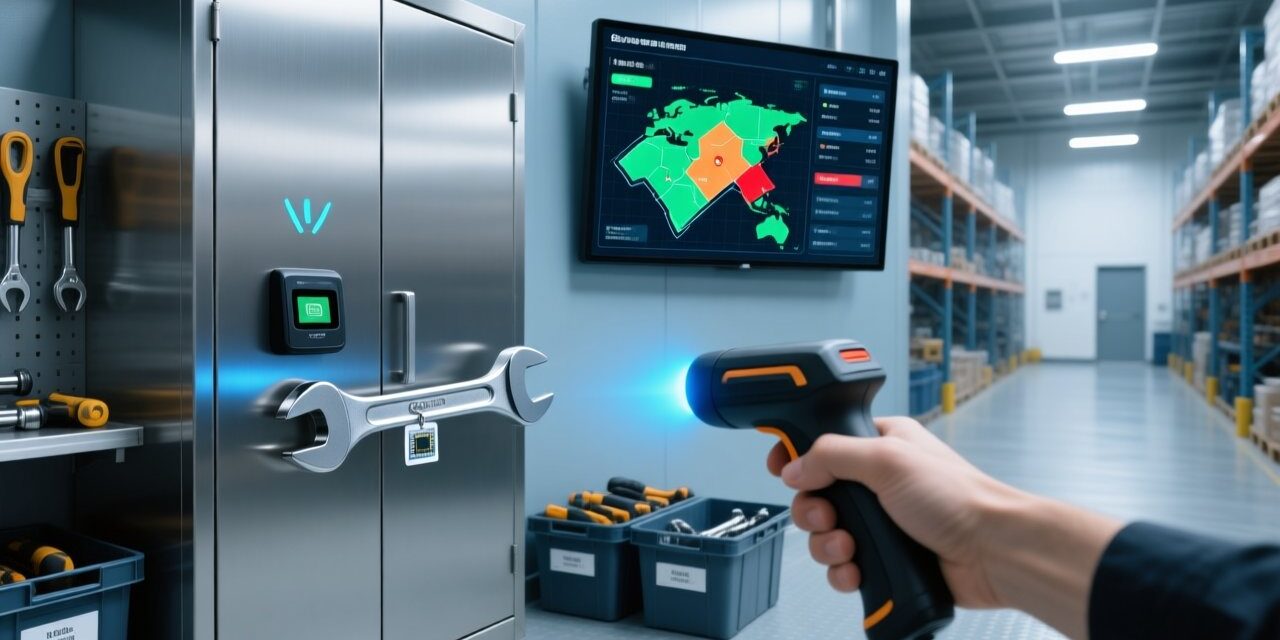
في RFIDHY, our RFID metal tags are validated for 200,000+ read cycles on stainless steel tools and withstand 150°C sterilization and IP68 submersion. Paired with ruggedized handheld RFID scanners, they form a complete, vendor-agnostic tool tracking system compatible with SAP EAM, Infor EAM, and IBM Maximo.
Frequently Asked Questions
- Can RFID track tools inside metal cabinets? Yes — our on-metal RFID tags use ferrite-backed antennas designed for direct attachment to ferrous surfaces without detuning.
- Do BLE or UWB tags require charging or battery replacement? All BLE beacons and UWB anchors require batteries or PoE; passive RFID tags have no power source and last the lifetime of the tool.
- Is RFID compatible with existing factory networks? RFID readers output standard TCP/IP or RS232 data streams and integrate seamlessly with SCADA, مس, and CMMS platforms using Modbus or REST APIs.
- How quickly can we deploy RFID tool tracking? Pilot deployments (50–200 tools) typically go live in under 3 weeks, including tag encoding, reader installation, and software configuration.
Ready to Optimize Your Tool Management Strategy?
Download our free 2026 Industrial Tool Tracking Deployment Checklist — covering hardware selection, tag placement guidelines, MES integration paths, and ROI calculation templates.
Request Technical Consultation with our manufacturing solutions engineers today.