
Why Tool Tracking Technology Choice Matters in 2026
Manufacturing operations leaders face mounting pressure to reduce tool loss, optimize maintenance cycles, and meet ISO 55000 asset management standards. С над 73% of Tier-1 suppliers now piloting real-time tool tracking (McKinsey 2025), the choice between RFID, Bluetooth с низким энергопотреблением (Бле), and Ultra-Wideband (СШП) directly impacts uptime, labor efficiency, and audit readiness.Отслеживание RFID-активов
Core Performance Dimensions Compared
1. Точность & Localization Precision
UWB leads with ±10 cm indoor accuracy — ideal for locating tools within complex assembly cells. BLE beacons offer ±3–5 m range, sufficient for zone-level tracking but inadequate for bin-level reconciliation. Passive UHF RFID tags provide presence-only detection (read range up to 12 m), excelling in gate-based check-in/out but not fine-grained positioning.
2. Infrastructure Cost & Масштабируемость
RFID requires fixed readers (UHF desktop readers) or handheld scanners, with zero per-tag power cost. BLE demands battery-powered beacons (replacing every 18–24 months) and gateway infrastructure. UWB’s dense anchor network increases CAPEX by 3–5× versus RFID. For plants managing 5,000+ инструменты, RFID delivers fastest TCO breakeven.
3. Metal & Harsh Environment Resilience
Tool cabinets, CNC machines, and coolant exposure challenge wireless performance. On-metal RFID tags are engineered for direct attachment to steel assets without shielding loss. BLE and UWB suffer multipath distortion and signal attenuation near conductive surfaces — requiring costly re-engineering of mounting points and shielding.
Integration Readiness for Industrial Systems
RFID integrates natively with MES (Например, Siemens Opcenter, Rockwell FactoryTalk) via standard EPCIS protocols. BLE/UWB often require custom middleware to map beacon IDs to ERP asset records — adding development time and validation overhead. RFID’s deterministic read cycle also simplifies compliance reporting for AS9100 or IATF 16949 audits.
When Each Technology Fits Best
- RFID: High-volume tool check-in/out, tool crib management, preventive maintenance scheduling, and audit-ready traceability — especially where tools are routinely exposed to metal, Тепла, or chemicals.
- Бле: Supplemental personnel proximity alerts (Например, ‘tool left behind’ notifications) or low-frequency usage logging where battery replacement is operationally feasible.
- СШП: Mission-critical, high-value tool tracking in R&D labs or prototype assembly where centimeter-level location enables automated digital twin synchronization.
RFIDHY’s Industrial-Grade Tool Tracking Solutions
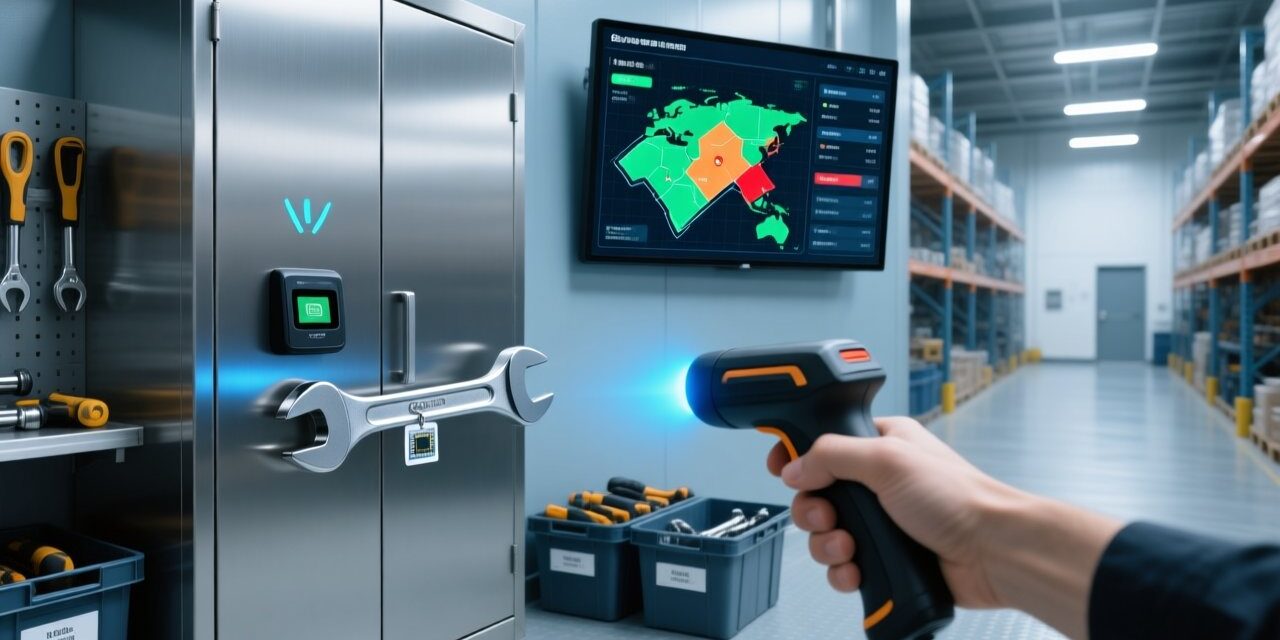
В RFIDHY, our RFID metal tags are validated for 200,000+ read cycles on stainless steel tools and withstand 150°C sterilization and IP68 submersion. Paired with ruggedized handheld RFID scanners, they form a complete, vendor-agnostic tool tracking system compatible with SAP EAM, Infor EAM, and IBM Maximo.
Frequently Asked Questions
- Can RFID track tools inside metal cabinets? Yes — our on-metal RFID tags use ferrite-backed antennas designed for direct attachment to ferrous surfaces without detuning.
- Do BLE or UWB tags require charging or battery replacement? All BLE beacons and UWB anchors require batteries or PoE; passive RFID tags have no power source and last the lifetime of the tool.
- Is RFID compatible with existing factory networks? RFID readers output standard TCP/IP or RS232 data streams and integrate seamlessly with SCADA, МЧС, and CMMS platforms using Modbus or REST APIs.
- How quickly can we deploy RFID tool tracking? Pilot deployments (50–200 tools) typically go live in under 3 Недель, including tag encoding, reader installation, and software configuration.
Ready to Optimize Your Tool Management Strategy?
Download our free 2026 Industrial Tool Tracking Deployment Checklist — covering hardware selection, tag placement guidelines, MES integration paths, and ROI calculation templates.
Request Technical Consultation with our manufacturing solutions engineers today.