
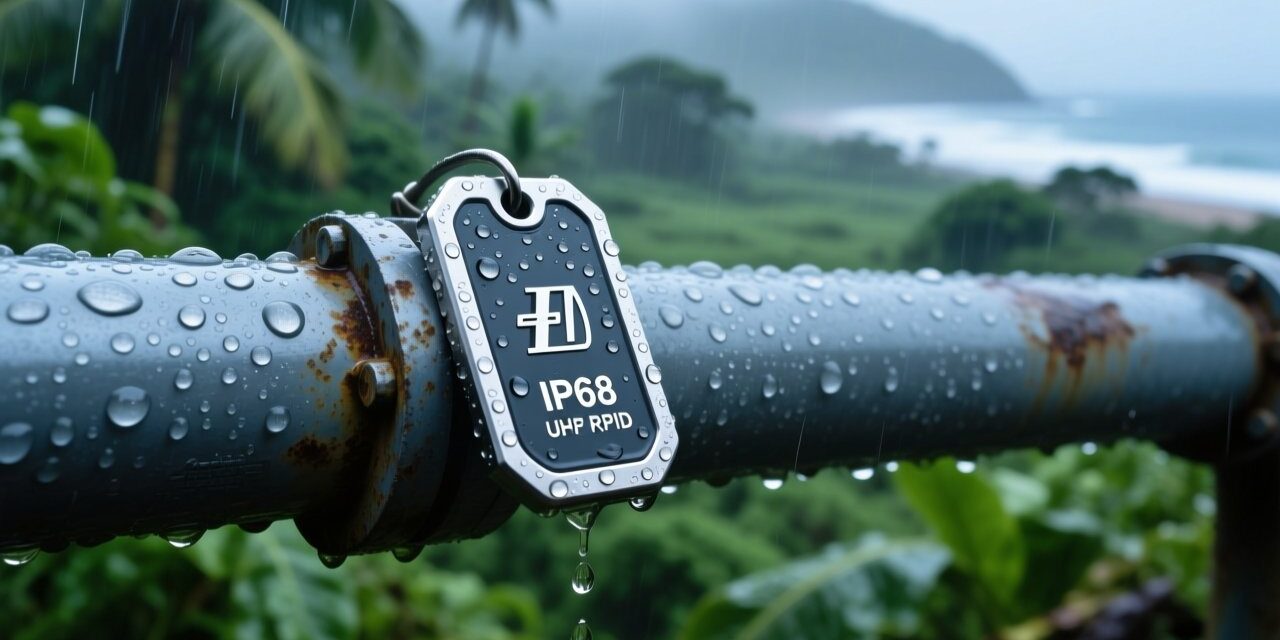
Why RFID Tags Fail in Tropical Environments
East Africa’s equatorial climate presents unique challenges for Tags RFID. With average humidity levels exceeding 80% and frequent heavy rainfall, standard RFID labels and inlays quickly degrade. Condensation seeps into non-hermetic housings, causing corrosion on antenna traces and chip connections. Simultaneamente, relentless UV exposure embrittles common plastics, leading to cracking and tag detachment. In coastal areas, salt-laden air accelerates corrosion, while inland dust and wide temperature swings further stress tag materials. These factors make IP68 and UV resistance not optional luxuries but fundamental requirements for any outdoor RFID deployment in the region.
Understanding IP68 and UV Resistance
What the IP68 Rating Really Means
The IP68 rating, defined by IEC 60529, indicates complete dust ingress protection (first digit 6) and long-term water immersion capability (second digit 8). For RFID tags, an IP68 certification means the tag can survive submersion in water beyond 1 meter depth for extended periods—typically 24 hours or more depending on the manufacturer’s specific test conditions. In practice, this translates to resistance against torrential rain, pressure washing, and even temporary flooding without internal water penetration. Tags with epoxy RFID tags often achieve this sealing level because the entire chip and antenna assembly is encapsulated in a solid polymer block, leaving no gaps for moisture ingress.
UV Resistance: More Than Just Sunblock
UV degradation attacks polymer chains, turning flexible plastics brittle and causing surface cracking. In tropical outdoor installations, RFID tags must withstand UV indexes frequently above 10. Materials like PolyPhenylene Sulfide (PPS RFID tags) offer innate UV stability without requiring additional coatings. PPS maintains mechanical strength and dimensional stability even after thousands of hours of UV exposure, making it ideal for direct sunlight in countries like Kenya or Tanzania. Other UV-resistant options include ceramic-filled composites and specially stabilized ABS blends. Always request accelerated aging test data—QTUV (QUV accelerated weathering) reports following ASTM G154 can provide reliable performance predictions for your specific location.
Selecting the Right RFID Tag for East Africa
| Criteria | Recommended Tag Type | Key Advantage |
|---|---|---|
| Full submersion / limpeza | Epoxy-encapsulated UHF tag | Hermetic seal, no water ingress |
| Continuous sun exposure | PPS or ceramic UHF tag | No UV bleaching or cracking |
| Metal surface mounting | On-metal RFID tag | Designed to counteract detuning |
| Flexible attachment | Flexible UHF label with outdoor adhesive | Conforms to curved assets |
| Long read range >10m | Hard tag with high-gain antenna | Maximizes backscatter power |
When mounting on metal outdoor assets such as storage tanks or heavy machinery, a specialized on-metal RFID tag is essential. These tags incorporate a spacer or a ferrite backing to neutralize the metal effect and maintain consistent read range. For livestock tracking in the tropical highlands, small IP68 ear tags with UV-stable polyurethane outperform standard plastic tags that warp within a single dry season.
Deployment Best Practices
- Surface preparation: Clean all mounting surfaces with isopropyl alcohol to remove oils and dust. For concrete or wood, use a primer before adhesive application to prevent moisture-induced delamination.
- Adhesive selection: Choose 3M™ VHB™ or equivalent high-performance acrylic adhesives rated for outdoor use. Silicone-based adhesives often degrade under UV unless specifically formulated for exterior bonding.
- Periodic inspection: Schedule semi-annual visual checks for cracking, discoloration, or peeling. Use a handheld RFID scanner to verify tag reads and detect silent failures early.
- Redundancy: For critical assets, dual-tag strategies—one on each side—improve overall system reliability, compensating for potential blind spots due to foliage or unexpected shadowing.
- Reader protection: In fixed installations, house fixed RFID reader units in IP65 or IP66 enclosures and use sealed cable glands to prevent internal condensation.
Perguntas Freqüentes
- What is the difference between IP67 and IP68 in RFID tags?
- IP67 guarantees immersion up to 1 meter for 30 minutos. IP68 extends that to deeper depths and longer times, typically 2–3 meters for 24 horas, making it far more suitable for prolonged rain and flooding in tropical zones.
- Can RFID tags survive the equatorial sun for years?
- Sim, if constructed with UV-resistant materials like PPS or certain ceramics. Standard ABS or polycarbonate tags may crack within 12–18 months, while PPS tags can last 5+ years without significant degradation.
- How do I prevent condensation inside a tag housing?
- Select tags with vacuum or potting encapsulation (por exemplo, epoxy-filled). Avoid mechanical assemblies with O-rings unless they are verified IP68 through testing, as temperature cycling can pump moisture into the cavity.
- Will a metal mount reduce the read range of an IP68 tag?
- Potentially, Sim. No entanto, purpose-designed on-metal RFID tags incorporate a spacing layer or ferrite core that almost entirely mitigates the detuning effect. Always specify whether the tag will be on metal when sourcing.
- How often should outdoor tags be replaced in a tropical climate?
- With IP68 and UV-rated tags, a 5–7 year lifespan is achievable. OEM specifications and accelerated aging data should inform replacement cycles. Annual read audits help catch early failures.
Need IP68 RFID Tags for Your Tropical Deployment?
RFIDHY engineers custom outdoor RFID solutions proven in Southeast Asia, África, and Latin America. From material selection to reader integration, we help you avoid costly field failures. Contact our specialists today to discuss your East Africa project requirements.