
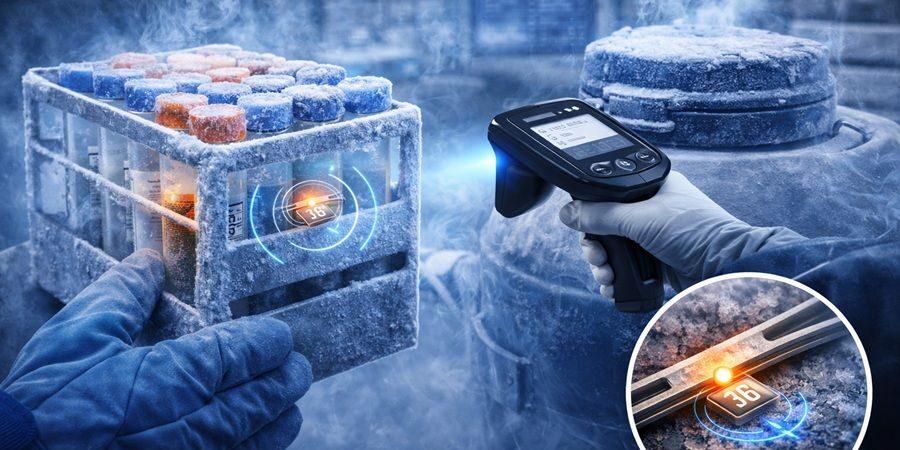
The -196°C Memory: Revolutionizing Liquid Nitrogen Biobanks with Ultra-Low Temp RFID
In the world of precision medicine and genomic research, the biobank is the vault of the future. No entanto, storing millions of genetic samples in Liquid Nitrogen at -196°C presents a catastrophic challenge for traditional identification. Standard adhesive labels become brittle and “pop off,” while 2D barcodes often become unreadable due to frost or condensation during the retrieval process.
The industry is now transitioning toward a “frozen memory” Solução: Cryogenic RFID tags. These sub-miniature identifiers are engineered to maintain both physical integrity and RF performance while submerged in LN2, enabling the transition from manual searching to fully automated biobank automation.
1.The Cryogenic Pain Point: Material Science vs. Absolute Zero
At -196°C, standard plastics and adhesives reach their glass transition point, leading to structural failure. For a tracking system to be viable in a high-throughput facility, such as the UK Biobank or major North American research hospitals, the tag must be:
- Thermally Stable: Capable of surviving rapid “thermal shock” when moving from -196°C to room temperature.
- Frost-Penetrating: Unlike optical barcodes, cryogenic RFID tags do not require line-of-sight, meaning they can be read through layers of frost or inside capped cryovials.
- Automated-Ready: Miniature enough to be embedded in the base of a 2.0ml cryovial or a 96-well rack.
2.Strategic Solutions from RFIDHY
To ensure 100% data fidelity in the coldest environments on Earth, rfidtaghy.com provides specialized hardware designed for extreme thermal endurance:
- HY-MOΦ5 / Φ8 Series: These ultra-miniature tags are explicitly rated for working temperatures as low as -197°C. Encapsulated in high-performance epoxy-PCB, they are the gold standard for liquid nitrogen sample tracking. Their circular form factor allows them to be press-fitted or glued into the bottom “well” of standard cryovials, ensuring they never detach.
- HY-HF0303: For facilities utilizing drawer-style storage or 2D-racks, this high-frequency (13.56MHz) tag allows for rapid, near-field batch scanning. It is ideal for linking patient consent data and genomic metadata directly to the sample container.
3.Data-Driven Biobanking: Accuracy and Compliance
According to a report by the International Society for Biological and Environmental Repositories (ISBER), manual transcription errors and label detachment account for significant sample loss in large-scale repositories (Source: ISBER Best Practices).
- Error Elimination: RFID-enabled “Pick-to-Light” systems ensure that the wrong sample is never pulled, a critical requirement for clinical trials and FDA-regulated research.
- Full Lifecycle Audit: Every time a vial is moved, the cryogenic RFID tags automatically update the Laboratory Information Management System (LIMS), providing a timestamped audit trail of the sample’s “Chain of Custody.”
4.Extended Insight: Scaling for the “Omics” Era
As we enter the era of large-scale proteomics and transcriptomics, the volume of samples is scaling beyond human capability. The integration of RFID at the vial level is a prerequisite for Automated Storage and Retrieval Systems (ASRS). By embedding a digital identity that survives the deep freeze, biobanks can achieve retrieval speeds 300% faster than manual methods while ensuring the thermal stability of the remaining samples is never compromised.
Conclusão
By adopting cryogenic RFID tags, biobanks are no longer just storing tubes; they are securing the “digital genes” of humanity. These microscopic survivors ensure that even at absolute zero, your data remains unfrozen.
Would you like a technical white paper on the signal performance of HY-MOΦ5 tags when submerged in liquid nitrogen? Connect with our laboratory specialists at rfidtaghy.com.