
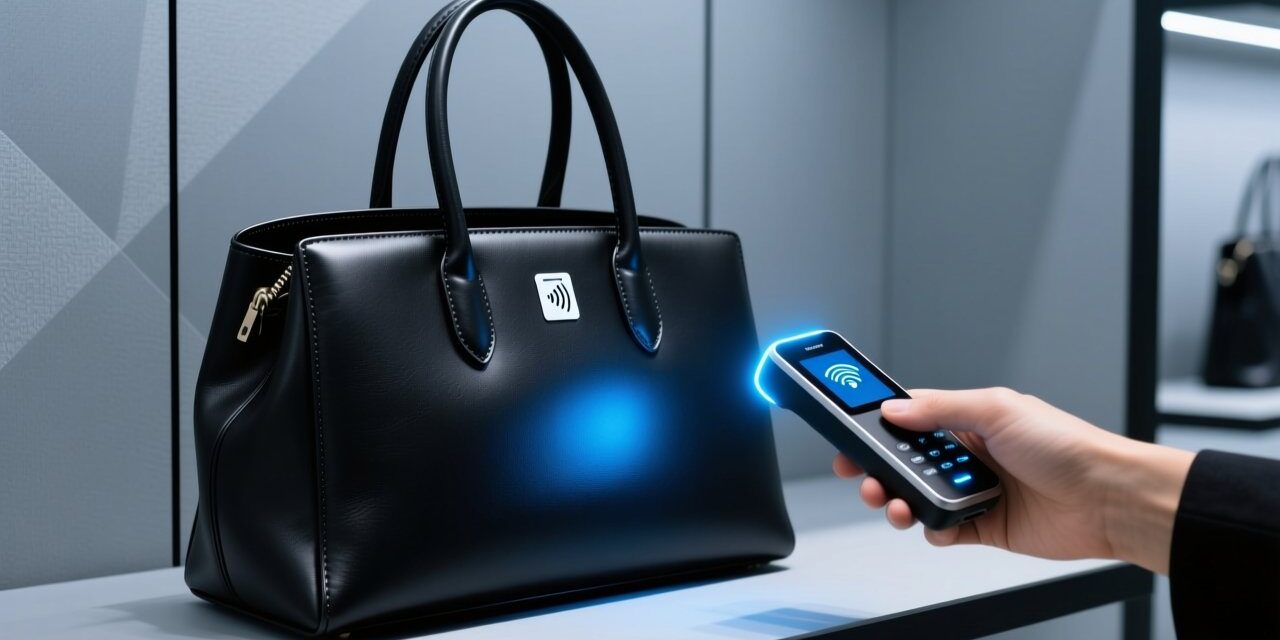
The $4.5 Trillion Counterfeit Crisis Demands New RFID Strategies
By 2025, the global trade in counterfeit luxury goods is projected to surpass $4.5 trillion, according to the OECD. European fashion houses, watchmakers, and leather goods manufacturers are on the front line—every counterfeit handbag, watch, or garment not only erodes revenue but undermines decades of brand equity. Traditional holograms and QR codes are easily cloned; a more robust, multi-layered authentication system is essential. This is why dual-frequency UHF RFID tags and NFC tags are being adopted as a complete security envelope, from factory floor to consumer’s closet.
What Is Dual-Frequency RFID and How It Works for Luxury Authentication
A dual-frequency RFID tag integrates two distinct radio frequency protocols—Near Field Communication (NFC) at 13.56 MHz and Ultra-High Frequency (UHF) at 860–960 MHz—onto a single substrate or into a single embeddable inlay. NFC operates at short range (up to 10 cm) and is natively readable by most modern smartphones, making it the consumer-facing authentication interface. UHF, with read ranges up to 15 meters, enables rapid bulk scanning in warehouses, distribution centers, and retail backrooms. This combination bridges the gap between supply chain visibility and end-user product verification.
For luxury brands, the dual-frequency approach means one tag can serve multiple functions: batch-level shipping validation via UHF at the logistics hub, and item-level authenticity confirmation via an NFC tap from a customer’s phone. When combined with a secure chip and cryptographic encoding, this creates a virtually unforgeable digital identity for each product.
Why Not Single Frequency?
High-end goods often involve metal components, foil stamping, or metallic leather coatings that degrade RFID signals. Single-frequency HF or UHF tags may fail on such materials. Dual-frequency solutions are designed with a shared antenna architecture that optimizes performance on challenging surfaces, including RFID metal tags and high-density packaging.
Industry Drivers: Digital Product Passports and EU Regulations
The European Union’s Digital Product Passport (DPP) regulation, rolling out from 2026, will require sustainability and authenticity data to be accessible for a range of products, including textiles and luxury accessories. Dual-frequency RFID is the ideal carrier for DPP data because the NFC interface can serve a web link to a brand-controlled passport page, while the UHF side integrates with enterprise resource planning (ERP) systems for automated inventory.
Brands such as LVMH, Kering, and Richemont are already piloting hybrid tag programs. The need is not only anti-counterfeiting but also consumer engagement: an NFC tap can deliver provenance stories, care instructions, and even exclusive content, building loyalty while confirming authenticity.
Technical Specifications and Key Selection Criteria
Choosing the right dual-frequency tag requires matching the tag form factor, chip, and attachment method to the product. Below are critical technical considerations:
| Parameter | NFC (13.56 MHz) | UHF (860–960 MHz) |
|---|---|---|
| Read range | Up to 10 cm | Up to 15 m |
| Typical chip | NTAG 424 DNA, NTAG 424 | Impinj Monza R6, NXP UCODE 9 |
| Memory | 416–888 bytes | 128–512 bits EPC, up to 1280 bits user |
| Security features | AES authentication, SUN message, originality signature | Password-protected kill/access, optional EAS |
| Smartphone compatibility | iOS & Android native | iOS only with app, Android with NFC-UHF bridging |
When selecting a dual-frequency inlay, ensure the manufacturer can provide tuned performance on the exact material to be tagged. For example, a leather handbag may require a NFC on-metal label that also operates effectively at UHF, or a thin, flexible UHF flexible on-metal RFID label that includes an HF coil. Off-the-shelf labels often underperform on curved or metallized surfaces, so customized antenna design is common for luxury applications.
Key Chip Features for Anti-Counterfeiting
- Secure Unique NFC (SUN) Message: Each tap generates a cryptographically unique URL, preventing simple URL copying.
- AES Mutual Authentication: The tag and reader authenticate each other, thwarting relay attacks.
- Originality Signature: Factory-programmed elliptic curve signature verifiable off-line by any app.
- Tamper Evidence: A frangible antenna or destructible inlay design that physically breaks upon removal, preventing tag reuse.
Practical Deployment: Embedding Dual-Frequency Tags in Luxury Goods
Successful implementation is as much about manufacturing integration as it is about chip selection. Luxury brands need to embed tags without compromising aesthetics or product integrity. Common methods include:
- Sewn-in fabric tags: Thin, flexible inlays sandwiched between fabric layers, ideal for garments and handbag linings.
- Adhesive labels hidden under care labels: A subtle placement behind the main brand label or inside a product booklet.
- Embedding into hardware: Very small RFID embedded tags placed inside zipper pulls, buttons, or metal clasps.
- RFID-enabled care labels: A single sewn-in label containing both human-legible washing instructions and a dual-frequency inlay.
During production, UHF readers at each manufacturing milestone record process data, creating an immutable digital chain of custody. At the point of sale, a handheld RFID reader module can scan a shelf of items in seconds for inventory count, while consumers verify via NFC. Post-sale, the NFC link can serve personalized aftercare, reorder ancillary products, or even pre-authenticate items for resale platforms.
Data-Driven Insights: Reducing Returns and Grey Market Diversion
Beyond counterfeit prevention, dual-frequency RFID provides data that directly impacts profitability. Brands using item-level RFID have reported a 20–30% reduction in return fraud, as the tag proves conclusively whether the returned item is the original. In parallel, tracking UHF read events across distribution channels pinpoints where grey market diversion occurs—a chronic issue for luxury brands selling in different regions at varied price points.
Integrating RFID data with a cloud-based analytics platform allows real-time alerts when an item appears at an unauthorized retailer or when a tag is cloned. Such visibility, combined with the cryptographic security of the NFC interface, makes dual-frequency RFID the strongest anti-counterfeit weapon available today.
FAQ
What is the difference between NFC and UHF for luxury anti-counterfeiting?
NFC (13.56 MHz) is used for short-range, consumer-facing authentication via smartphones, while UHF (860–960 MHz) enables rapid, bulk reading across supply chains. A dual-frequency tag combines both, offering seamless factory-to-consumer security and visibility.
Can dual-frequency RFID tags be hidden inside luxury watches or jewelry?
Yes. Ultra-small inlays, often measuring just a few millimeters, can be embedded into watch buckles, jewelry clasps, or beneath leather straps. Special RFID metal tags and on-metal designs ensure reliable performance even in close proximity to metallic materials.
Do consumers need a special app to verify a product with an NFC tap?
Modern iPhones (XS and later) and most Android devices can read NFC natively without any app. For UHF, consumers typically rely on brand-provided apps, but the primary consumer verification is via NFC, needing no extra software.
How does dual-frequency RFID support the EU Digital Product Passport?
The NFC interface can deliver a URL to a secure webpage containing the digital passport—sustainability data, origin, authenticity proof—while the UHF side automates compliance reporting during warehouse and retail processing.
Are dual-frequency tags more expensive than single-frequency ones?
Yes, they cost more to produce due to dual-antenna designs and advanced chips, but the premium is a fraction of the value of a luxury item. The return on investment comes from reduced counterfeit losses, lower return fraud, and enhanced consumer trust.
Secure Your Luxury Brand with Custom Dual-Frequency RFID Solutions
RFIDHY designs and manufactures purpose-built dual-frequency tags for luxury brands requiring uncompromising aesthetics and security. From ultra-thin on-metal labels to fully customized embedded NFC/UHF inlays, our engineering team works with your designers to create invisible, tamper-proof authentication. Contact us for a free feasibility assessment and sample kit tailored to your product line.