
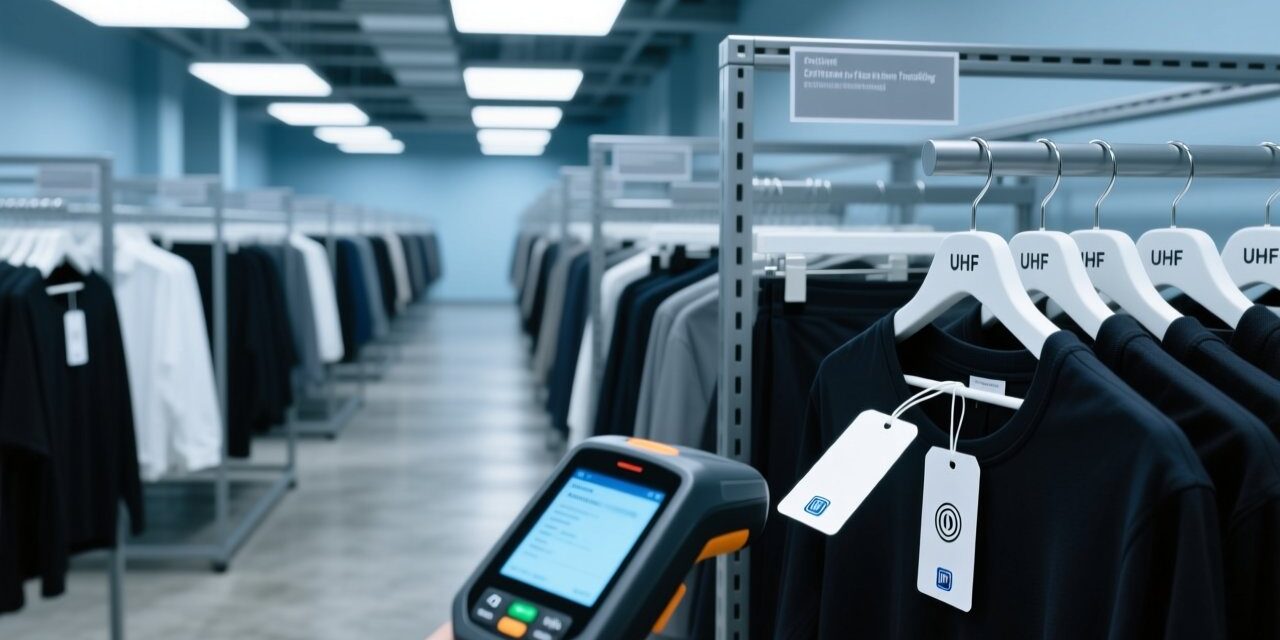
The Rise of Item-Level Tagging in Fashion Retail
The global fashion industry is racing toward end-to-end digitization. Item-level Tag RFID UHF have become the backbone of modern retail operations, driving inventory accuracy from an average of 65% to over 98% according to industry reports. But supply chain efficiency is only half the story. Forward-thinking brands are now layering Tag NFC into the same garment, creating a dual-tag strategy that serves both operational and customer-facing goals.
This article compares UHF hang tags and NFC inlays across cost, Prestazione, and deployment complexity — and outlines how fashion supply chain leaders can evaluate a retail dual frequency RFID tag approach for maximum return on investment.
UHF Hang Tags: Powering Supply Chain Automation
Frequenza ultra-alta (UHF) RFID operates in the 860–960 MHz band and is the de facto standard for retail item-level tagging. A typical UHF hang tag consists of an antenna printed on a flexible substrate, bonded to an IC such as Impinj Monza or NXP UCODE, and enclosed in a paper or plastic casing. Its long read range — up to 10 meters — enables batch reading of hundreds of items per second, making it ideal for backroom receiving, warehouse put-away, store shelf scanning, e magazzinaggio Applicazioni.
Performance and Cost Profile
UHF hang tags are extremely cost-effective in volumes above 100,000 Unità, often falling below $0.05 per inlay. They meet GS1 EPC Gen2v2 standards and integrate seamlessly with leading RFID printer encoders and UHF RFID reader integration such as fixed portal readers and handhelds. For fashion brands, sourcing pre-printed hang tags with RFID inlays embedded at the point of manufacture is the most common deployment model.
NFC Inlays: Unlocking Post-Purchase Engagement
Comunicazione Near Field (Nfc) operates at 13.56 MHz and is a subset of HF RFID, with a typical read range of just a few centimeters. Its short range is a design feature that ensures intentionality: a consumer must bring their smartphone within 2–4 cm to interact. This makes Tag NFC ideal for anti-counterfeiting, autenticazione del prodotto, digital customer experiences, and loyalty program check-ins.
Consumer Interaction and Authentication
Luxury and premium fashion brands increasingly embed NFC inlays into care labels or branded hang tags. When tapped, the tag can deliver a unique URL, promotional content, or a digital certificate of authenticity. The NTAG213/215/216 chip families offer NDEF message capabilities and protected memory, supporting tap-to-connect experiences without requiring a dedicated app. While NFC inlays cost slightly more per unit — typically $0.08–$0.15 in high volumes — they unlock direct consumer engagement that UHF cannot provide.
Cost Comparison: UHF Hang Tag vs NFC Inlay
Understanding the retail rfid tag cost per unit comparison is critical when building a business case. The table below breaks down typical costs and capabilities for item level tagging nfc vs uhf:
| Caratteristica | UHF Hang Tag | NFC Inlay |
|---|---|---|
| Frequenza | 860-960 MHz | 13.56 MHz |
| Intervallo di lettura | 0–10 meters | 0–4 cm |
| Typical Cost/Unit (100k+ vol.) | $0.04–$0.07 | $0.08–$0.15 |
| Data Speed | veloce, fino a 640 Kbps | Medium, 106 Kbps |
| Consumer Smartphone Compatibility | No (requires dedicated reader) | Sì (built-in NFC reader) |
| Primary Use Case | Supply chain, per inventario, logistica | Customer engagement, authentication |
| Standards | EPC Gen2v2, ISO 18000 - 6C | ISO 14443A, NFC Forum |
A dual-tag strategy at scale can increase total tag cost to $0.12–$0.22 per garment, but leading fashion brands report that the inventory accuracy gains alone deliver ROI within 12–18 months, with engagement benefits adding incremental value.
Implementing a Dual-Tag System: 4 Practical Steps
- Source dual‑capable hang tags or co‑locate tags. Many suppliers now offer printed hang tags with a UHF inlay on one side and a detachable NFC sticker, or one substrate carrying two chips. Work with your RFID tag supplier to validate read‑range and interference.
- Choose the right reader infrastructure. For UHF, deploy fixed RFID reader portals at dock doors, tunnels on conveyor belts, and handhelds in the store. NFC only requires a simple smartphone app or web‑based tap experience.
- Encode data separately for each air interface. The UHF tag stores an EPC (serialized GTIN) for inventory; the NFC tag can hold a unique URL, authentication token, or loyalty program ID. Avoid merging production lines: encoding two tags on one garment requires careful timing to prevent interference.
- Integrate with your ERP and CRM. Tie the UHF EPC to inventory management and the NFC UID to customer profiles. A unified platform enables “ship‑to‑store” visibility and post‑purchase re‑engagement from a single scan event.
Domande frequenti
Can UHF and NFC tags interfere with each other on the same garment?
No. They operate at vastly different frequencies and use different coupling mechanisms. Proper spacing (≥2 cm between inlays) is recommended, but modern dual‑tag designs coexist reliably.
Is a dual‑tag strategy cost‑justified for fast fashion?
For high‑volume, low‑margin garments, the additional $0.04–$0.08 per unit may be hard to absorb without process savings. però, brands report that even 2–3% inventory accuracy improvement covers the tag cost. A targeted pilot within a single category is advised to validate the ROI.
What chip options are recommended for UHF hang tags in apparel?
Impinj Monza R6‑P and NXP UCODE 8 are widely adopted for their sensitivity and encoding speed. For NFC, NTAG213 or 216 chips provide ample memory for a URL and product authenticity data.
Do consumers need a special app to read NFC hang tags?
No. Modern iOS and Android devices have built‑in NFC readers that automatically launch the URL or experience stored on the tag. This simplicity is a key driver for customer engagement strategies.
Start Your Dual‑Tag Deployment with Confidence
Choosing between a UHF hang tag and an NFC inlay is no longer an “either‑or” decision. The most agile fashion brands are adopting a retail dual frequency rfid tag approach, leveraging UHF for backstage speed and NFC for front‑of‑house connection. Whether you are exploring item level tagging nfc vs uhf for a pilot or scaling a full fashion brand rfid deployment, our team can help you benchmark retail RFID tag cost per unit and design a tag specification that meets your operational and branding requirements.
Contact our specialists at contattaci for a free consultation.
Ready to Deploy Your Dual‑Tag Strategy?
Our RFID engineering team provides end‑to‑end support — from tag selection and testing to reader integration and encoding workflows. Whether you are launching a pilot or scaling across thousands of stores, we help you optimize Tag RFID UHF, Tag NFC, Etichette RFID and reader hardware for maximum ROI.