
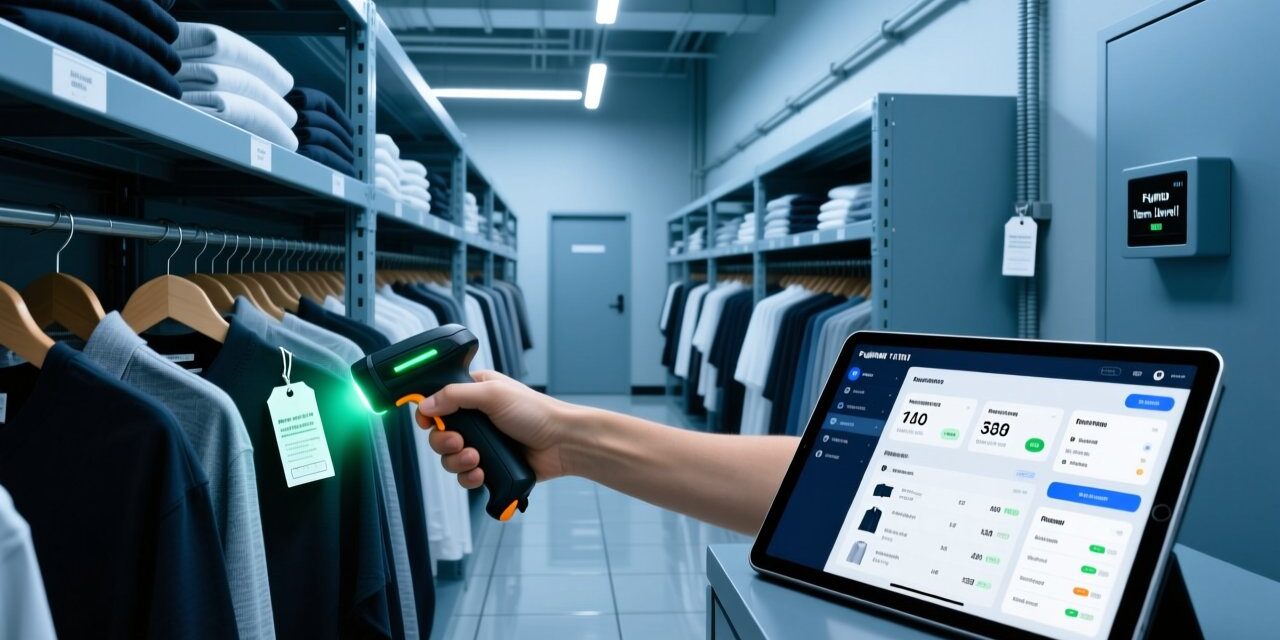
Why South Africa Retail RFID Surpasses Global Benchmarks
Item-level RFID in South Africa is no longer a future project—it is a present-day competitive advantage. While global retail still debates ROI timelines, major South African chains have already rolled out UHF RFID across hundreds of stores, achieving stock accuracy rates above 98% and cutting inventory counting time by over 90%. This speed of adoption is driven by a unique combination of market pressure, maturing technology costs, and a pragmatic approach to deployment.
Market Context: The South African Retail Imperative
South Africa’s retail market is projected to reach $120 billion by 2026, but profit margins remain under pressure from currency volatility, logistics complexities, and high shrinkage rates—some stores report losses of 1.5-2% of revenue from theft and administrative errors alone. Traditional barcode systems cannot deliver the real-time inventory visibility needed for omnichannel fulfillment or loss prevention at scale. UHF RFID inlays solve this by enabling bulk reading of hundreds of items per second, even without line-of-sight.
Local retailers are not just tagging high-value items; they are embracing full store-wide rollouts. One of the country’s largest fashion groups publicly confirmed a deployment exceeding 2,000,000 UHF RFID labels across its supply chain, from factory to point of sale. This scale is achievable because RFID tag costs have dropped below $0.04 for high-volume orders, while integrated circuit performance has improved significantly with chips like the Impinj M780 and NXP UCODE 9.
Technical Specifications for Retail RFID in South Africa
RFID implementations in South Africa operate within the ETSI regulatory framework, which defines the UHF band as 865–868 MHz. This differs from the FCC band (902–928 MHz) used in the Americas, so tag and reader hardware must be specifically tuned. Key technical considerations include:
- Frequency and read range: ETSI-compliant readers deliver up to 10 meters of read range for passive UHF tags in open air, but dense retail environments with metal fixtures or liquid products may require on-metal or tuned tags.
- Tag IC selection: Modern RAIN RFID chips offer auto-tuning, improved sensitivity, and faster read rates. The Impinj Monza R6-P and NXP UCODE 8/9 are widely used.
- Inlay design: Antenna geometry must match the merchandise. For apparel, thin flexible wet inlays with a 50×30 mm footprint are standard; for cosmetics or electronics, smaller form factors (as low as 12×12 mm) with dedicated on-metal design are required.
- Reader infrastructure: A mix of fixed portals at dock doors and point-of-sale, handheld readers for cycle counts, and overhead ceiling readers for continuous zone monitoring.
| Merchandise Type | Recommended Tag | Key Feature |
|---|---|---|
| Abbigliamento / Softlines | UHF flexible wet inlay (50×30 mm) | Cost-effective, bulk encoding |
| Cosmetics / Small items | Ultra-small ceramic or micro tag (12×12 mm) | On-liquid performance, tiny footprint |
| Electronics / Metal items | On-metal UHF tag with foam spacer | Absorbs detuning, reads up to 8 m |
| Footwear | Hang tag with integrated UHF inlay | Non-invasive attachment, EAS compatible |
Integration with existing enterprise resource planning (Erp) and warehouse management systems (Wms) is simplified by the GS1 EPC global standard. Many South African retailers leverage middleware that translates RFID tag reads into actionable stock-level adjustments within minutes.
Practical Deployment Tips from Early Adopters
Based on observable trends in the region, successful RFID programs share common implementation strategies:
- Start with a controlled pilot. A flagship store or single product category (ad es., denim or footwear) proves the concept before wider rollout. One retailer reduced stock-out events by 35% within two months of piloting item-level RFID in five stores.
- Tag at source. Apply UHF RFID inlays during manufacturing or at the distribution center. Pre-tagged merchandise eliminates in-store tagging labor and ensures 100% arrendevolezza.
- Invest in reliable handheld readers. Daily cycle counts using handheld RFID scanners replace manual barcode counting, taking minutes instead of hours. Staff adoption rises when they see immediate time savings.
- Layer inventory data with customer experience. RFID enables smart fitting rooms and self-checkout kiosks. A Johannesburg department store integrated RFID-enabled magic mirrors, which increased upsell conversion by 18%.
Why Local Chains Are Outpacing Multinationals
South African retailers have an agility advantage. They often operate with flatter organizational structures and can make rapid technology decisions. Inoltre, the country’s mobile-first consumer base demands accurate omnichannel inventory: 73% of shoppers check stock online before visiting a store, according to local surveys. RFID delivers the real-time data needed to support buy-online-pick-up-in-store (BOPIS (operazione DI BOPIS)) and ship-from-store models.
Loss prevention is another driver. Data from industry trials indicates that item-level RFID can shrink theft and fraud losses by up to 60% when integrated with electronic article surveillance (Eas) Sistemi. The ability to identify exactly which item was stolen and from which store enables targeted asset protection strategies.
Overcoming Implementation Challenges
Despite the momentum, retailers must address several hurdles: tag detuning on metallic products, RFID reader collision in dense layouts, and staff training. Comprehensive software, such as RFIDHY’s RFID inventory management starter kit, provides pre-configured settings and guided deployment workflows that reduce complexity. Partnering with a manufacturer that offers both RFID reader modules and pre-encoded tags simplifies procurement and ensures performance compatibility.
Guardando avanti, the convergence of RAIN RFID with IoT platforms will unlock automatic replenishment and predictive analytics. South African retailers are well positioned to lead this next wave given their existing infrastructure and data-driven mindsets.
For more on retail compliance mandates, see our Walmart RFID 2026 Item-Level Tagging Compliance Guide.
What is the regulatory frequency for UHF RFID in South Africa?
South Africa follows the ETSI standard, using the 865–868 MHz band for UHF RFID. Equipment must be certified for this range to ensure legal operation and peak performance.
How much does an item-level RFID tag cost for retail?
High-volume orders of UHF RFID inlays or labels typically cost between $0.03 e $0.06 per unit, depending on chip type, design dell'antenna, and substrate. Custom form factors or on-metal tags may be slightly higher.
Can RFID tags be reused or recycled?
Most apparel hang tags are designed for single use, but hard tags (like those for footwear or electronics) can be reused. Recycling is growing, with tag ICs often being recoverable, though local facilities may be limited.
How long does it take to deploy item-level RFID in a retail store?
A full store deployment—including reader installation, tagging, and staff training—can be completed in 2-4 settimane. A pilot store can be operational in days if source-tagged goods are used.
What is the typical ROI of item-level RFID?
Retailers often report payback within 9-12 months through reduced out-of-stocks (fino a 30% improvement), labor savings (fino a 80% faster inventory counts), and shrinkage reduction (fino a 60%). The exact timeline depends on store size and initial accuracy.
Ready to accelerate your retail RFID deployment in South Africa? Contatto RFIDHY’s experts for a free consultation and pilot project design. We offer a complete portfolio of ETSI-compliant UHF RFID tags, handheld and fixed readers, and integration support tailored to African retail environments.