
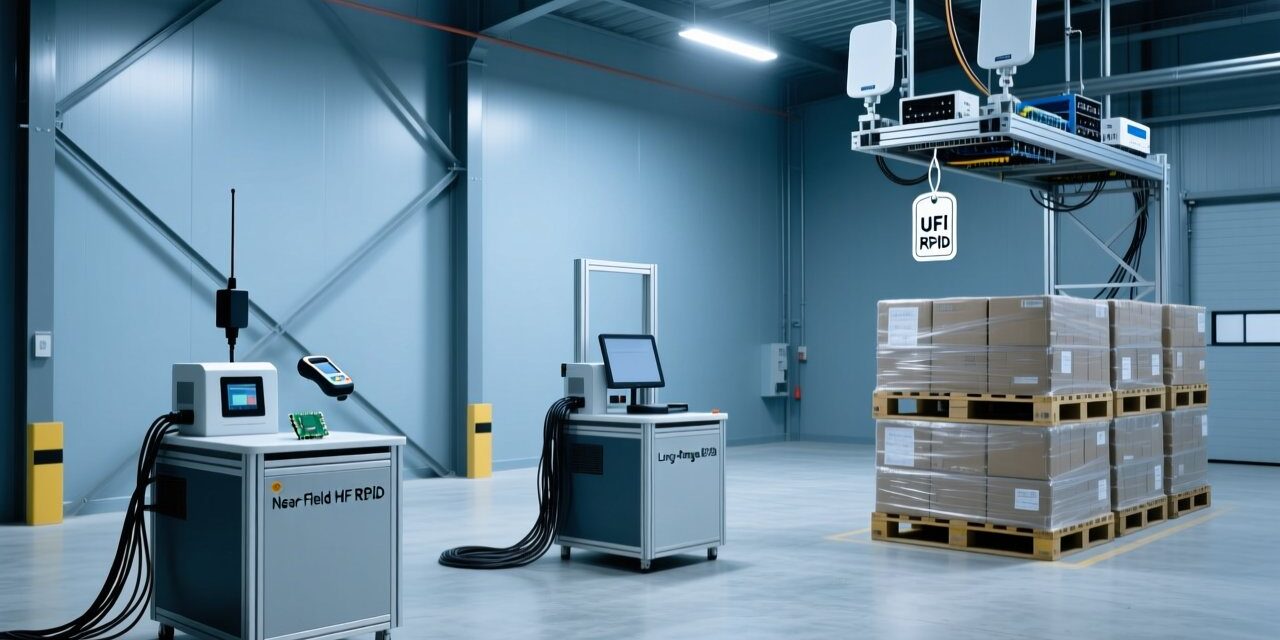
As RFID technology becomes a cornerstone of digital transformation in supply chain, manufacturing, healthcare, and access control, one question consistently sits at the top of the procurement checklist: should you deploy HF or UHF RFID? The answer directly shapes read range, tag cost, reader infrastructure, and overall system performance. In this comprehensive guide, we break down the technical fundamentals, compare real-world capabilities, and provide a framework to help you select the right frequency band for 2026 deployments.
Understanding the RFID Frequency Spectrum
Radio Frequency Identification operates across several frequency bands, each governed by different physical principles and international regulations. The three primary bands are Low Frequency (LF, 125–134 kHz), High Frequency (HF, 13.56 MHz), and Ultra-High Frequency (UHF, 860–960 MHz). While LF remains niche (animal identification, industrial environments with heavy metal), the battleground for most enterprise applications is between HF and UHF. HF operates in the globally harmonized ISM band and is the foundation of Near-Field Communication (NFC). UHF, dominated by the RAIN RFID alliance and EPCglobal Gen2 standard, offers long read ranges and fast multi-tag inventory. Understanding the physics behind each – inductive coupling for HF, backscatter radiation for UHF – is key to matching the technology with your operational requirements.
HF vs UHF RFID: Technical Comparison
| Parameter | HF RFID (13.56 MHz) | UHF RFID (860–960 MHz) |
|---|---|---|
| Read Range | 0.1–1 m (near-field) | 0.5–15 m (far-field) |
| Data Transfer Rate | Up to 424 kbps | Up to 640 kbps |
| Tag-to-Reader Coupling | Magnetic (inductive) | Electromagnetic backscatter |
| Interference Susceptibility | Low, works well near metals and liquids | Higher; requires tuning for metal/liquid environments |
| Primary Standards | ISO 15693, ISO 14443 (NFC) | EPCglobal Gen2v2 (ISO 18000-6C) |
| Multi-Tag Reading | Moderate (anti-collision supported) | Excellent (hundreds of tags/second) |
| Typical Applications | Access control, payment, library, healthcare, NFC marketing | Supply chain, logistics, retail inventory, asset tracking, vehicle identification |
| Tag Cost | Moderate | Low to moderate; specialty on-metal tags cost more |
Near-Field vs Far-Field: Why It Matters
HF RFID relies on inductive coupling – the reader coil generates a magnetic field that powers the tag’s coil when they are within one wavelength (typically a few centimetres). This near-field operation provides highly predictable read zones, making it ideal for secure access with RFID cards or RFID wristbands. UHF, by contrast, uses electromagnetic wave propagation in the far field, enabling bulk scanning of entire pallets from several meters away. However, far-field brings challenges: reflections, null zones, and sensitivity to materials. Choosing between near-field and far-field comes down to whether you need controlled, item-by-item authentication (hf rfid near field vs uhf far field) or high-speed, hands-free inventory capture.
Key Deployment Considerations
Selecting HF or UHF is rarely a one-size-fits-all decision. To make an informed choice, procurement and technical leaders should evaluate four critical factors:
- Read range and read zone shape: HF delivers a small, well-defined sweet spot – perfect for tap-to-pay or NFC product authentication. UHF creates a broader, sometimes irregular read field that excels in portal and conveyor applications.
- Item composition: Liquids and metals absorb/reflect UHF energy, degrading performance. In contrast, HF tags maintain consistent reads even when attached to bottles of water, pharmaceutical vials, or metallic equipment. For extreme environments, consider on-metal RFID tags specifically engineered for UHF.
- Data and security needs: HF, especially NFC, supports encryption, secure element storage, and peer-to-peer communication. UHF Gen2 offers basic password protection but is primarily designed for rapid identification, not cryptographic transactions.
- Global compliance: UHF frequency ranges differ by region (865–868 MHz in EU, 902–928 MHz in Americas). HF 13.56 MHz is universal, simplifying multinational rollouts.
Industry-Specific Selection Guide
Below we map common sectors to the recommended RFID band, based on performance data and practical deployment experience:
| Industry | Recommended Band | Rationale |
|---|---|---|
| Retail inventory & omnichannel | UHF | Fast bulk reading, real-time stock accuracy, low tag cost |
| Healthcare (patient tracking, pharma) | HF / NFC | Near-field biosafety, liquid-tolerant, secure data |
| Access control & hospitality | HF (MIFARE) | Predictable read range, encryption, NFC smartphone compatibility |
| Industrial asset & MRO tracking | UHF | Long range, high-speed inventory, harsh environment tags |
| Supply chain & logistics | UHF | Pallet-to-parcel visibility, dock door automation |
| Library & document management | HF | Item-level precision, ISO 15693 standard |
| Animal identification | LF / HF | LF for injectable microchips, HF for ear tags |
Practical Procurement Tips for 2026
1. Start with a proof-of-concept: Before committing to a frequency, run a pilot with representative items and environmental conditions. Many RFID reader module vendors offer evaluation kits that support both HF and UHF.
2. Factor in tag scalability: UHF label costs have dropped below USD 0.04 for high volumes, while HF NFC tags remain above USD 0.10. If you need to tag millions of items, RFID inlay & sticker economics will steer you toward UHF.
3. Design for growth: Choose readers and antennas that support future expansion. A fixed RFID reader with multiple antenna ports can cover multiple dock doors today and scale with your facility.
4. Leverage NFC compatibility: If consumer engagement matters (e.g., smart packaging, marketing), select HF tags that double as NFC tags. Businesses often combine NFC stickers on high-value items with UHF logistics labels on cartons – a hybrid strategy that balances speed and interaction.
Bridging HF and UHF with Multi-Frequency Readers
Modern integrated circuits and reader architectures increasingly support dual-frequency operation. For example, an RFID wristband used in a resort may carry an HF chip for room access and a UHF inlay for cashless payment at pool bars. Such hybrid approaches let you capture the best of both worlds – the security of hf rfid near field and the speed of uhf far field – without managing separate infrastructure. When planning a new deployment, discuss dual-mode hardware with your solution provider; many RFID products now come with chip combinations that support both standards.RFID labels
FAQ
What is the main difference between HF and UHF RFID?
HF (13.56 MHz) operates in the near-field using magnetic coupling, providing short, controlled read ranges up to 1 m. UHF (860–960 MHz) uses far-field electromagnetic waves, enabling long read distances up to 15 m and high-speed multi-tag inventory. This fundamental difference dictates which applications each band serves best.
Can UHF RFID work near metal or liquids?
Standard UHF tags suffer performance degradation near metals and aqueous materials. However, specialized on-metal RFID tags with foam spacers or ceramic substrates are designed to overcome these challenges. HF tags are inherently more tolerant of such environments.
Is NFC the same as HF RFID?
NFC is a subset of HF RFID operating at 13.56 MHz and based on ISO 14443 and ISO 18092 standards. It adds peer-to-peer communication and security features, making it suitable for smartphones, contactless payments, and consumer engagement. All NFC devices are HF, but not all HF tags support NFC protocols.
Which frequency is better for inventory management?
UHF is the clear choice for inventory management due to its long read range, fast anti-collision algorithms, and low tag cost. It allows bulk scanning of hundreds of items per second, making it ideal for retail, warehousing, and logistics. HF is typically used for item-level authentication and access control.
What factors should I consider when choosing an RFID frequency?
Evaluate read range requirements, item material composition, data security needs, global compliance, and total cost of ownership. A pilot with sample tags from a reliable RFID products manufacturer will confirm the optimal band for your specific use case.
Ready to choose the right RFID frequency for your project? Our team at RFIDHY can help you navigate the HF vs UHF decision with custom sample kits, technical consultation, and pilot support. Contact us today to discuss your requirements and accelerate your 2026 deployment.