
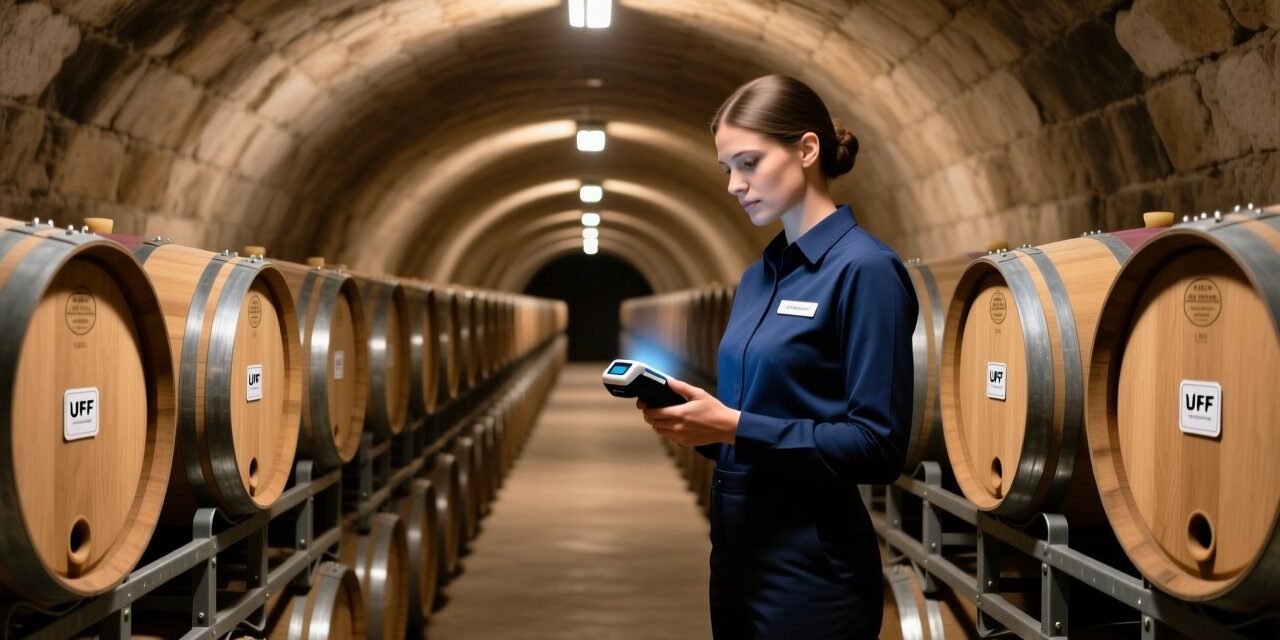
The Wine Industry’s Hidden Inventory Challenge
South America’s wine belt—particularly Chile and Argentina—has experienced a surge in premium exports, with demand for barrel-aged vintages climbing steadily. Yet beneath the romantic imagery of oak and terroir lies a gritty operational challenge: tracking thousands of individual barrels stored in dark, humid underground cellars. Manual barcode scanning proves nearly impossible in these conditions. Labels peel, barrels are rotated frequently, and cellar staff waste hours locating and identifying specific lots. . זה הכול on-metal RFID tags are changing that equation.
A large Chilean winery—exporting to over 30 countries—approached RFIDHY seeking a fully automated barrel tracking system. Their cellar, carved into the Andes foothills, maintains a constant 85–95% relative humidity and temperatures around 12°C. Barrels are stacked up to four high on metal racks, making traditional RFID solutions unreliable. After a 90-day pilot, the winery now achieves a 99% read rate on more than 8,000 barrels.
Technical Specifications That Made the Difference
The success of this deployment hinged on selecting the right combination of UHF RFID metal tags and readers purpose-built for harsh environments. The following table summarizes the key components:
| Component | מפרט | Purpose |
|---|---|---|
| תג RFID | UHF EPC Gen2v2, Impinj Monza R6 chip, PCB-based on-metal design, IP68 rated | Survive condensation, direct liquid contact, and repeated handling |
| Tag Mounting | Industrial adhesive + optional screw holes; placed on barrel head or bilge | Permanent attachment without damaging oak |
| Fixed Reader | 4-port UHF RFID reader with PoE, -25°C~65°C operating range | Ceiling-mounted antennas at rack ends for automatic batch scans |
| Handheld Terminal | Android-based UHF handheld RFID scanner with IP65 | Roaming validation and spot-checking during racking and blending |
| אנטנה | 9dBi circular-polarized, IP67 | Consistent read zone despite metal rack interference |
The chosen ultra-thin flexible on-metal RFID labels were critical because they conform to the barrel’s curved surface without lifting over time. The IP68 rating ensures continuous operation after years of cellar condensation and occasional alcohol splashes.
Deploying RFID in an Underground Cellar: Key Considerations
Wine cellar environments present three unique hurdles that generic RFID kits cannot address. The RFIDHY engineering team tailored the system to each one:
1. Humidity and Liquid Resistance
Standard inlays degrade quickly when exposed to 90%+ humidity or direct moisture. The selected tags use a hermetically sealed PCB core and a hydrophobic coating. את rugged RFID screw tag variant offers the same protection with mechanical fastening for barrels that undergo aggressive washing cycles.
2. Metal Rack Interference
Stacked metal shelving creates multipath reflections that confuse standard UHF readers. The deployment used circular-polarized antennas tuned to the cellar’s specific frequency band (902–928 MHz for Chile, per Subtel regulations) and positioned at a 45° downward angle. A proprietary anti-collision algorithm in the fixed reader firmware further boosted reliability.
3. Batch Reading and Inventory Workflow
Instead of scanning barrels one by one, cellar staff now wheel a trolley-mounted reader through the aisles. The system captures up to 200 tag EPCs per second, automatically reconciling with the winery’s SAP-based cellar management software. Daily barrel location reports that once took eight hours now take under 20 דקות, with zero transcription errors.
Results and Export Compliance Impact
Since going live, the winery has recorded these measurable improvements:
- Barrel inventory accuracy rose from 74% (ברקוד) כדי 99% (RFID).
- Time spent on physical stock counts dropped by 91%.
- Traceability from grape batch to final export bottling is now fully automated, satisfying EU and USDA organic certification audits.
- Real-time location data reduced barrel loss due to misplacement by 100%.
For other wineries considering a similar leap, RFIDHY offers a phased roadmap: start with a pilot zone of 500 barrels using RFID metal tags and a single fixed reader, then scale across the cellar once the read-rate target is confirmed. Integration with existing ERP systems is handled through standard APIs and middleware, usually deployed within three weeks.
Why use RFID for wine barrel tracking instead of barcodes?
Barcodes require precise line-of-sight and become unreadable when labels get wet, scratched, or covered in dust. תגי RFID can be read through moisture, עץ, and non-metallic racking without direct line-of-sight, enabling batch scans of hundreds of barrels in seconds.
What type of RFID tag works on metal wine barrels?
On-metal UHF RFID tags with a PCB or ceramic substrate are required. The metal barrel surface detunes standard inlays; purpose-built anti-metal designs compensate for this effect. Look for an IP68 rating to guarantee survival in high-humidity cellars.
How do underground cellar conditions affect RFID performance?
Humidity and temperature extremes alone do not impair RF performance noticeably, but condensation can damage unprotected tags. Using hermetically sealed on-metal RFID labels and fixed readers with conformal coating ensures reliability. Metal racking requires careful antenna placement and circular polarization to minimize dead zones.
Can RFIDHY’s solution integrate with our existing winery management software?
כן. RFIDHY’s fixed readers and handheld terminals communicate via standard LLRP, MQTT, or HTTP protocols. A middleware layer maps tag data to your ERP or cellar management system, supporting SAP, Microsoft Dynamics, and custom SQL-based platforms.
Ready to Modernize Your Barrel Yard?
RFIDHY’s engineering team can design a custom barrel tracking solution for your cellar—whether you manage 500 barrels or 50,000. We offer complimentary site evaluations and sample tags for pilot testing.
Contact our South American sales desk today to schedule a consultation.RFID compliance certification