
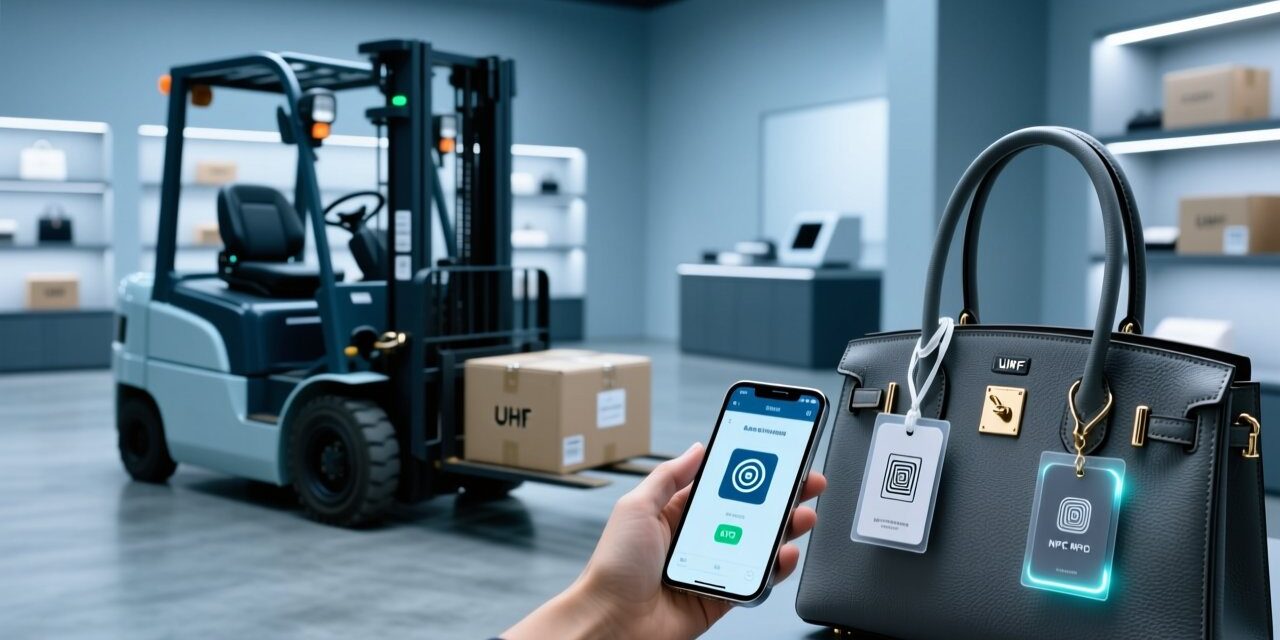
Why Authentication Technology Choice Matters for Luxury Brands
Dans 2026, counterfeit luxury goods cost the industry over $30 milliards par an. For anti-counterfeiting managers, selecting between RAIN RFID authentication et NFC product authentication is no longer theoretical—it directly impacts traceability integrity, consumer trust, and regulatory compliance. Unlike generic tracking, brand protection RFID requires tamper evidence, cryptographic capability, and seamless integration into existing ERP and CRM systems.
Core Technical Differences: Gamme, Puissance & Protocole
RAIN RFID (UHF, EPC Gen2) operates at 860–960 MHz with read ranges up to 12 meters—ideal for bulk pallet or carton-level verification at distribution centers. It uses passive tags powered by reader energy, enabling rapid scanning of hundreds of items simultaneously. En revanche, NFC product authentication (HF, ISO/IEC 14443) functions at 13.56 MHz with a maximum range of 10 cm. Its proximity requirement ensures intentional user engagement—critical for consumer-facing verification via smartphones.
Security Architecture: From Encryption to Tamper Resistance
Modern UHF RFID chips now support AES-128 encryption, secure key storage, and unique identifier binding—making cloning significantly harder than legacy HF systems. Pendant ce temps, NFC anti-counterfeiting tags leverage NTAG 213/216 or NXP ICODE SLI-X chips with dynamic URL rewriting and one-time-programmable memory to prevent replay attacks. Both technologies meet GS1 Digital Link and ISO/IEC 19762-5 standards—but NFC offers stronger out-of-the-box consumer interaction security.
Deployment Realities Across the Value Chain
For inbound logistics, Étiquettes RFID de métal embedded in packaging enable automated receiving without line-of-sight. At retail, UHF inlay stickers on garment hangtags support inventory audits while printable NFC stickers deliver QR-less authentication via tap-to-verify. In after-sales service, RFID thermal wristbands with embedded UHF chips allow instant serial validation during warranty claims—reducing fraud by 68% in pilot programs.
Compliance, Certification & Interoperability
Global luxury brands must align with EU ETSI EN 302 208-2, Pièce FCC 15, and China SRRC certification—requirements fully met by RFIDHY’s UHF flexible tags et HF Micro Tag portfolio. All products support GS1 EPCIS data models and integrate natively with leading brand protection platforms including Systech, OpSec, and Authentix—ensuring audit-ready traceability logs compliant with EU Digital Product Passport (DPP) mandates effective 2026.
Frequently Asked Questions
- Can RAIN RFID authentication be used for direct consumer verification? Yes—but it requires dedicated handheld readers or smartphone-integrated UHF modules (par exemple, HY-R6100 UHF handheld reader). Most consumers prefer NFC’s tap-to-verify simplicity.
- Do NFC tags support offline authentication? Certain NFC chips like NTAG 424 DNA offer serverless cryptographic verification via symmetric keys stored on-device—ideal for regions with limited connectivity.
- Are anti-counterfeit RFID tags recyclable? RFIDHY ’ s RFID textile laundry tags use PPS substrates and lead-free inks, meeting RoHS and REACH recycling guidelines.
- How do you prevent tag duplication across channels? By combining unique EPC identifiers with blockchain-anchored digital twins and time-bound cryptographic signatures—available via RFIDHY’s OEM API integrations.
Ready to Strengthen Your Brand Protection Strategy?
Download RFIDHY’s 2026 Brand Protection RFID Implementation Playbook—including vendor evaluation checklists, certification roadmap, and sample SOPs for luxury goods authentication.