
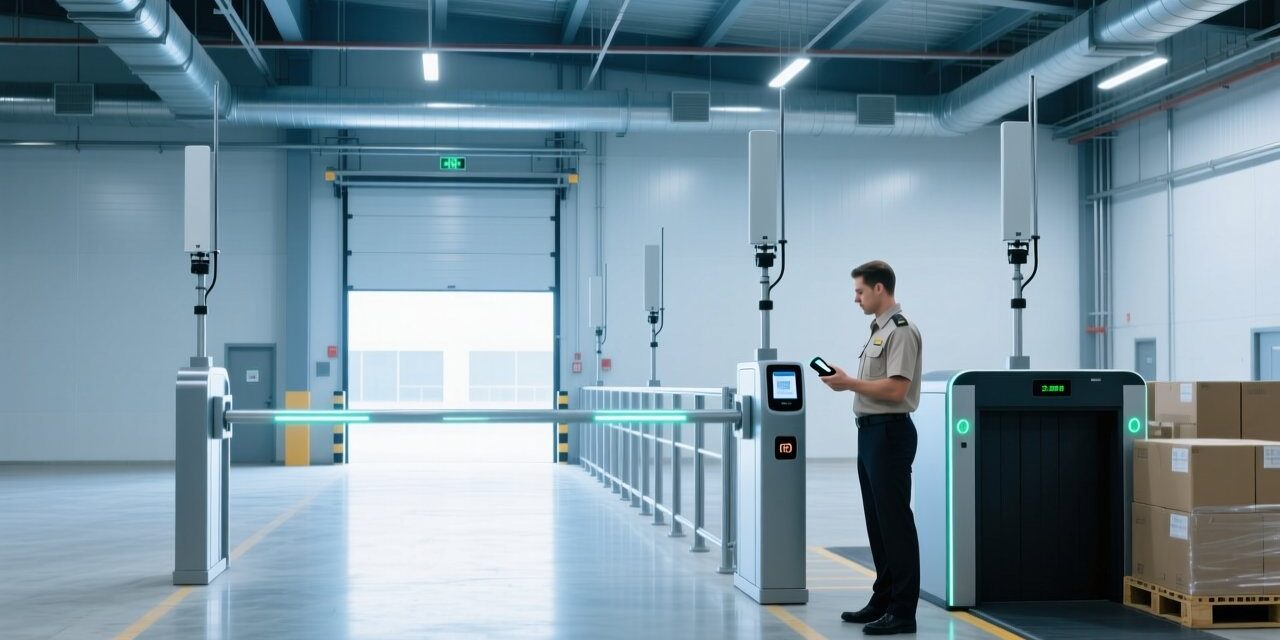
RFID-based warehouse management systems have become the backbone of modern logistics, enabling real-time inventory visibility and automated data capture. Yet one of the most persistent questions from warehouse managers and system integrators is: How many RFID readers do I actually need? The answer isn’t a simple formula—it depends on your facility layout, throughput requirements, and the types of read points you plan to deploy. Over-investing leads to wasted budget; under-deploying creates blind spots that defeat the purpose of RFID.
This guide provides a practical warehouse RFID reader quantity calculator approach, walking you through the key variables that determine reader count. By understanding UHF portal vs handheld read zone trade-offs, mastering the antenna per door calculation, and applying sound RFID read point design principles, you can right-size your deployment for maximum ROI.RFID warehouse management
Market Context: The Rise of Warehouse RFID
The adoption of Étiquettes RFID UHF in warehousing has accelerated rapidly. According to industry reports, the global RAIN RFID tag shipments exceeded 30 billion units in 2023, with supply chain and logistics accounting for the largest share. Driven by e-commerce growth and labor shortages, more distribution centers are moving from barcode to RFID for automated receiving, cueillette, and shipping verification. This shift demands careful planning of reader infrastructure—not just picking a number out of a catalog.
Understanding RFID Reader Types and Read Zones
Before calculating quantity, you must define the purpose of each read point. The two dominant form factors are fixed portal readers and handheld scanners, each serving distinct roles.
| Fonctionnalité | UHF Portal Reader | Handheld RFID Scanner |
|---|---|---|
| Coverage Area | Fixed gate or zone, wide read field | Mobile, operator-directed |
| Typical Antennas | 2–4 antennas per portal | Integrated antenna, single read point |
| Throughput | Haute, automated bulk reading | Lower, manual scanning per item/location |
| Cost per Read Point | Medium (shared among multiple antennas) | Low hardware cost, higher labor |
| Best For | Dock doors, conveyor lines, fixed checkpoints | Spot checks, inventory audits, picking verification |
A lecteur RFID fixe (typically a multi-port UHF unit) connects to several RFID antennas to create a read zone. En revanche, un handheld RFID scanner is used by an operator to interrogate tags at a specific location. The number of read points you design dictates the number of fixed readers needed, while handhelds scale with your workforce.
Antenna-per-Door Calculation: The Core Formula
For receiving and shipping docks, the most common fixed read point is a portal. A standard dock door is about 3 meters wide. To achieve reliable read rates of 99%+ for densely packed pallets or mixed-orientation cases, you typically install 2 À 4 antennas per portal—one on each side and sometimes overhead. The reader must be powerful enough to drive these antennas simultaneously without cross-channel interference.
Use this basic formula to estimate the number of fixed readers for dock doors:
Number of readers = (Number of dock doors × Antennas per door) / Antenna ports per reader
Par exemple, if you have 10 dock doors, plan for 4 antennas each (total 40 antennes), and deploy a 4-port UHF reader like the HY-R346A UHF portal reader, you need 10 lecteurs (one per door). If you can multiplex or share coverage (par exemple, one reader covering two adjacent doors with 2 antennas each), you might reduce the count. Always verify read performance through a site survey.
Beyond Dock Doors: Other Read Points
A holistic RFID read point design includes more than just dock doors. Evaluate these areas:
Conveyor Belt Scan Tunnels
When cartons move on a conveyor, a tunnel with 2–4 antennas connected to one reader can capture tag data at rates exceeding 600 tags per minute. For multiple conveyor lines, each requires its own reader or a multiplexed system. Antenna placement must account for belt width and speed.
Forklift and Overhead Readers
Mounted on forklifts or ceiling beams, these readers track asset movements across wide aisles. A single 4-port reader with strategically spaced antennas can cover a large area, but careful testing is needed to avoid reading tags in adjacent zones.
Shelf and Bin-Level Monitoring
Low-power, near-field antennas placed on shelves can pinpoint item locations. Each shelf row may require a dedicated reader or a daisy-chained antenna arrangement. This approach is common in tool cribs and MRO storerooms.
Goods-In/Goods-Out Verification Stations
Dedicated packing stations often use a lightweight UHF desktop reader or a small portal to verify outgoing shipments. One reader per station is standard.
Step-by-Step Reader Quantity Calculator
Follow this systematic process to arrive at your total reader count:
- Map all read points: Draw a floor plan and mark every location where tag data must be captured automatically (dock doors, conveyors, sortation, etc.).
- Determine reader type for each point: Fixed portal, Poche, or vehicle-mounted. Handheld counts are based on the number of operators performing mobile tasks simultaneously.
- Calculate antennas per fixed point: For dock doors, 2–4 antennas; for conveyors, 2–4; for shelf racks, 1 antenna per shelf segment.
- Select a reader model with sufficient ports: Common options are 4-port and 8-port readers. If using an 8-port reader, you can connect more antennas, potentially serving two doors per reader.
- Apply the formula: Total fixed readers = Σ (antennas needed at each point / ports per reader). Add handheld readers based on peak shift headcount.
- Add 10–15% contingency: For future expansion and coverage margin, especially in challenging environments with metal racking or liquids.
For a mid-size warehouse with 8 dock doors (4 antennas each), 2 conveyor lines (4 antennas each), et 5 handheld operators, the calculation might be: 8 doors × 4 antennas = 32; 2 conveyors × 4 = 8; total fixed antennas = 40. Using 4-port readers, 10 readers are needed. Handhelds: 5 scanners. So total reader devices = 15. Adjustments may reduce this if multiplexing is viable.
Practical Tips for Reader Placement and Optimization
- Conduct a site survey: Before finalizing quantities, test a sample reader-antenna configuration at one dock door. Measure read rate, dead zones, and interference from metal structures.
- Choose the right antennas: Circularly polarized antennas are preferred for mixed tag orientations. Linear antennas may be used for conveying cases with consistent orientation.
- Set appropriate reader power: Overpowering can cause stray reads from adjacent zones, inflating the need for additional readers. Tune each read point to the minimum power that achieves target performance.
- Optimize tag placement: The performance of Étiquettes RFID UHF is heavily influenced by their position on the asset. Ensure tags are not obscured by metal or liquid.
- Use reader synchronization: When multiple readers are close, enable dense reader mode or synchronization to avoid reader-to-reader interference and false reads.
Conclusion
Designing the right number of RFID readers for a warehouse is a balance of physics, throughput, and budget. By systematically analyzing read points, antenna coverage, and reader port density, you can build an infrastructure that delivers accurate, real-time visibility without overspending. Remember that a handheld cannot replace a fixed portal for high-speed receiving, and a portal is wasted on occasional spot checks. Tailor the mix to your operational DNA.
FAQ
How many antennas do I need per dock door?
En général, 2 À 4 antennas per dock door are recommended to ensure complete coverage and 99%+ read rates. The exact number depends on door width, tag orientation, and the presence of metal in pallets or racking.
Can one RFID reader handle multiple dock doors?
Oui, if you use an 8-port reader or antenna multiplexer, you can cover two adjacent doors with one reader. Cependant, performance may degrade if the doors are used simultaneously at high throughput. A dedicated reader per door is safer for busy receiving docks.
What is the cost difference between a fixed portal and a handheld reader?
A fixed portal setup (lecteur, antennes, cabling, and installation) can range from $1,500 À $4,000 per door, while a handheld UHF scanner costs $500–$1,500. Cependant, handhelds involve ongoing labor costs and are slower for bulk scanning, so total cost of ownership must be compared.
How do I calculate total readers for a warehouse with mixed operations?
Break the facility into distinct read point types: dock doors, conveyors, forklift gates, shelf zones, and handheld audit stations. Calculate each separately using the antenna-per-point formula, then sum. Add a contingency factor of 10–15% for unexpected coverage gaps.
Should I use overhead or side-mounted antennas for dock doors?
Side-mounted antennas (left/right) provide the most uniform read zone for pallet loads. Overhead antennas work well for conveyors and low-height aisles but can be obstructed by tall loads. A combination of both is often ideal.
Start Designing Your RFID Reader Layout
Every warehouse is unique. Contact RFIDHY’s engineering team to discuss your facility’s dimensions, throughput requirements, and budget. We provide free site surveys, reader placement plans, and integration support. Request a consultation aujourd'hui.