
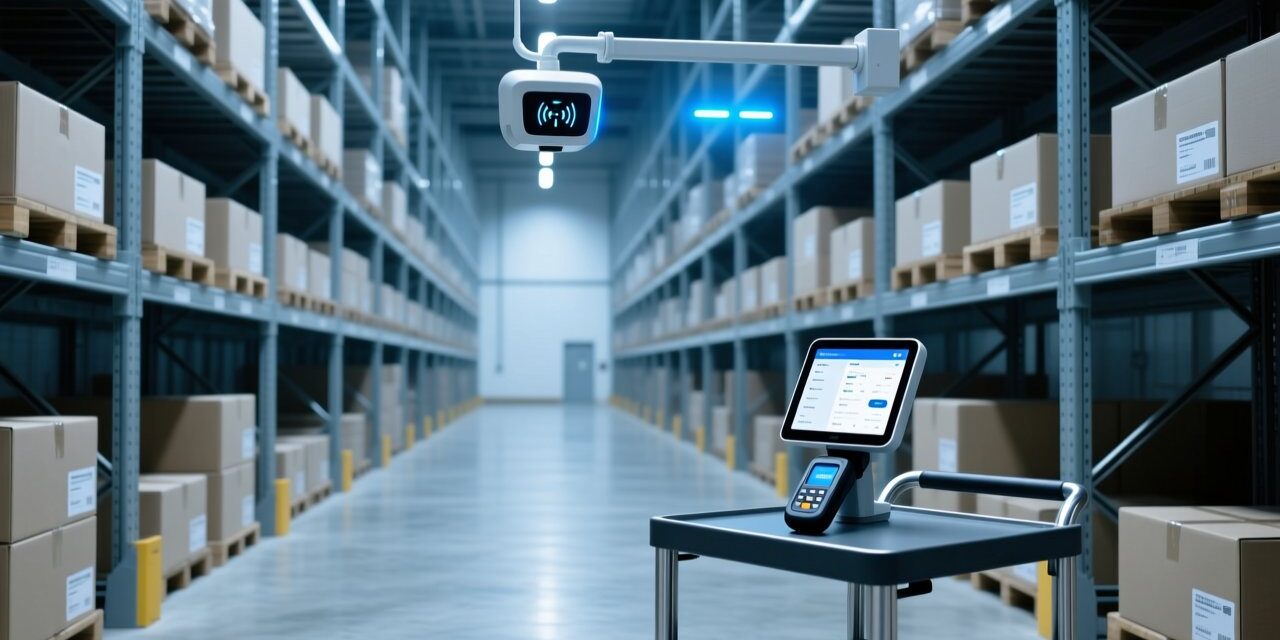
Why Frequency Choice Defines Warehouse RFID Success
Warehouse automation demands seamless, accurate item identification. Radio‑frequency identification (RFID) delivers that, but not all RFID is created equal. The choice between Ultra‑High Frequency (UHF) and High‑Frequency (HF) determines everything from reading distance to tag durability on metal shelves. With global warehouse RFID adoption accelerating—the RAIN Alliance reports over 30 billion UHF tags shipped in 2023 alone—facilities can no longer afford a one‑size‑fits‑all approach. Yet many operations still struggle with read failures, cross‑interference, or hidden costs because they selected the wrong frequency.
This article distills hard‑won field knowledge into nine non‑negotiable criteria. Whether you manage a parts distribution center, a cold‑chain storage, or an e‑commerce fulfillment hub, the following framework will help you invest in the RFID system that matches your exact operational reality.
Understanding UHF and HF RFID: The Technical Foundation
UHF RFID operates in the 860‑960 MHz band and is governed by the GS1 EPCglobal Gen2 (ISO 18000‑6C) Standard. It is the workhorse of modern logistics, prized for read ranges up to 12 meters and anti‑collision algorithms that can identify hundreds of tags per second. UHF-RFID-Tags are typically passive, drawing energy from the reader’s electromagnetic wave, making them cost‑effective for high‑volume item tagging.
HF RFID, centered at 13.56 MHz, complies with ISO 15693 und ISO 14443 Normen. Its near‑field inductive coupling limits range to about 1 meter but provides robust performance near liquids and metals without special tuning—a distinct advantage in certain niche warehouse zones. HF RFID tags also support larger data storage and are inherently more secure, which is why they dominate access control and payment applications.
9 Selection Criteria You Can’t Ignore
1. Read Range Requirements
If your warehouse workflows demand gate‑based bulk scanning of pallets or wide‑aisle inventory checks, UHF is the obvious front‑runner. Ein standard fixed RFID reader with a 9‑dBi antenna can capture UHF tags from across a 15‑meter dock door. HF’s sub‑meter range restricts it to conveyor read points or individual item authentication stations. Measure your operational zones first; if the average distance between scanner and goods exceeds one meter, HF will create frustrating blind spots.
2. Tag Density and Anti‑Collision Speed
UHF Gen2 air protocol was designed for speed. In a dense pallet build‑up, eine einzelne industrial RFID reader can inventory 500 tags in under one second. HF anti‑collision rates are typically an order of magnitude slower, making UHF indispensable for cross‑docking operations or high‑volume distribution centers where throughput is measured in cases per minute.
3. Materials in the Environment
Metal racks, foil‑lined packaging, and liquid containers are RFID’s classic adversaries. UHF signals reflect off metal and are absorbed by water, causing detuning. Jedoch, moderne RFID-Metall tags with foam spacers or ferrite layers mitigate these effects. HF, relying on magnetic coupling, handles proximity to water and metal more gracefully, making it a contender for liquid‑filled drums or metallic tool tracking in tight spaces. Always test on your actual stock‑keeping unit (SKU) assortment before committing.
4. Data Storage and Security
HF tags typically offer 256 bytes to 8 kilobytes of user memory—enough to store maintenance logs, calibration dates, or serialized certificates directly on the tag. UHF tags start at 96‑bit Electronic Product Code (EPC) Speicher, with some models extending to 512 Bits. If your use case requires offline data access or encryption (z.b., pharmaceutical traceability), HF’s built‑in cryptographic capabilities out‑of‑the‑box may tilt the balance.
5. Tag Size and Form Factor
Warehouse tagging often involves irregular surfaces: Dudelsack, small tools, cardboard boxes. UHF tags are available as ultra‑thin wet inlays, printable adhesive labels, and rugged epoxy‑encased hard tags, with sizes down to 3×3 mm. HF tags are similarly diverse, but the longer antenna needed for UHF can limit miniaturization on metal‑rich assets. Match the tag footprint to the smallest item you need to track.
6. Integration with Existing Systems
Most warehouse management systems (Wms) today expect EPC‑based UHF data streams. Leading middleware supports the LLRP protocol for Gen2 readers out‑of‑the‑box. Integrating HF often requires a custom NFC read point and additional software development to map ISO 15693 UID formats to your database. Evaluate your IT team’s bandwidth—if you need a drop‑in retrofit, UHF’s ecosystem maturity is hard to beat.
7. Regulatory Compliance and Regional Frequency Plans
UHF RFID does not have a single global frequency. North America uses 902‑928 MHz, Europe operates at 865‑868 MHz, and Japan uses 916‑920 MHz. Deploying a multi‑site global warehouse network means your UHF hardware and tags must be region‑locked or wide‑band capable. HF’s 13.56 MHz is universally accepted, simplifying cross‑border rollouts.
8. Cost per Tag and Total Cost of Ownership
At scale, UHF passive inlay stickers can cost as little as $0.04‑$0.10 in volume, whereas HF inlays rarely dip below $0.15. Reader and antenna infrastructure also varies: a single UHF portal can cover a 4‑meter‑wide door, while HF may need multiple reader pads. Jedoch, if HF eliminates the need for specialized on‑metal tags, the total cost of ownership might equalize. Always model the fully burdened cost, including installation, tuning, and training.
9. Future Scalability and Technology Roadmap
The RFID landscape is shifting rapidly. UHF is converging with Bluetooth Low Energy (BLE) and IoT sensor tags for real‑time condition monitoring. RAIN RFID adoption is mandated by retailers like Walmart for item‑level tagging by 2026. HF remains strong for secure authentication and human‑centric interactions (z.b., employee badges). If your roadmap includes automated sortation, autonomous inventory drones, or dark‑warehouse concepts, UHF’s broader ecosystem investment makes it the safer long‑term bet.
Practical Deployment Tips
- Perform a site survey with calibrated handheld RFID scanner and record read success rates across all SKU profiles.
- Use a phased approach: pilot one aisle with both UHF and HF simultaneously to gather comparative data under live conditions.
- Position reader antennas at 45‑degree angles to reduce cross‑reads and accommodate mixed pallet orientations.
- Implement adaptive power control on fixed readers to avoid reading tags in neighboring zones.
- Pair HF for high‑value asset cabinets or tool cribs where short‑range, secure authentication adds value.
Selecting the right frequency isn’t about choosing the “best” technology—it’s about aligning radio physics with your physical reality. The nine criteria above are a starting point. The final answer often emerges from a hands‑on proof of concept that tests these variables in concert.
Häufig gestellte Fragen
Can UHF and HF RFID coexist in the same warehouse?
Absolutely. Many operations deploy UHF for pallet and case tracking while using HF at workstations for individual tool or document check‑out. Proper frequency planning and physical separation prevent interference. Some modern readers even support both protocols on a single device.
What is the maximum read range for UHF RFID in a typical warehouse?
With a 4‑watt fixed reader and a 9‑dBi antenna, passive UHF tags can be read up to 15 meters in open air. Jedoch, warehouse racks, Metall, and liquids reduce that range—typically you’ll achieve 8‑10 meters reliably after tuning. HF tops out at 1 meter under ideal conditions.
Are UHF tags always cheaper than HF tags?
Generally yes. High‑volume UHF inlays are among the most inexpensive RFID products available. But if your assets are metal or liquid‑driven, the cost of on‑metal UHF tags may exceed simple HF disc tags. A holistic cost analysis is essential.
Which frequency is better for cold‑storage warehouses?
Both can work with the correct tag encapsulation. UHF is often preferred for bulk reads in large freezers because of its range and speed, but the tag must be rated for sub‑zero temperatures and condensation. Einige UHF-RFID-Tags are specifically designed with frost‑proof housings.
Do I need different readers for UHF and HF?
Ja. The radio front‑end and antenna design are specific to each frequency band. Dual‑frequency handhelds exist, but fixed infrastructure usually requires separate reader modules per frequency.
Get Expert Guidance for Your Warehouse RFID Deployment
Choosing between UHF and HF isn’t a theoretical exercise—it’s a decision that will shape your operational efficiency for years. The RFIDHY team has deployed both technologies across diverse industrial environments, from Chilean copper mines to Gulf oil rigs and global cold chains. We can help you assess your specific material mix, throughput goals, and integration landscape to recommend the optimal frequency strategy.
Contact us today for a no‑obligation consultation and a tailored site survey proposal.