
Professional warehouse scene showing UHF RFID reader scanning metal shelving with RFID tags on cartons and pallets

UHF RFID Tag Read Range: Lab Data vs Real-World Performance — What Vendors Won’t Tell You

Warehouse system designers face a critical gap between vendor-published UHF RFID read range specs and actual field performance. This article examines why lab-tested RFID tag sensitivity rarely translates to consistent real-world read distance—covering environmental interference, material effects, antenna alignment, and reader configuration. We analyze verified test data and offer actionable guidance for selecting truly robust UHF RFID tags for demanding logistics environments.
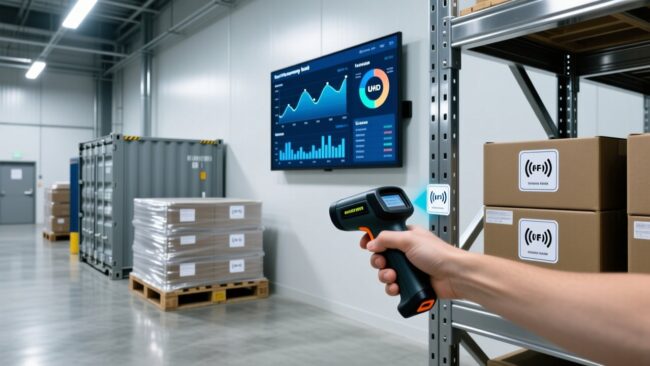

Professional warehouse scene with RFID reader scanning metal shelf, UHF RFID tags on pallets, digital dashboard showing frequency band data, clean blue-gray lighting

FCC vs CE vs IC: RFID Frequency Regulation Guide for Global Deployment

Navigating global RFID frequency regulations is critical for system integrators and technical directors deploying cross-border solutions. This guide compares FCC (USA), CE (EU), and IC (Kanada) Anforderungen, highlights key band differences, compliance pitfalls, and practical steps to ensure seamless UHF RFID system validation. Learn how regulatory alignment affects tag selection, reader configuration, and real-world performance — with actionable insights for industrial RFID deployment.

Professional industrial scene showing rugged RFID metal tags on steel drilling equipment, handheld RFID scanner in use, clean offshore platform background with digital dashboard

The True Cost of RFID Tag Failure in Oil & Gas: A $2.7M Case Study You Don’t Want to Repeat

A real-world incident at an offshore drilling operation revealed how substandard RFID tags led to $2.7M in unplanned downtime, tool loss, and HSE compliance penalties. This analysis breaks down root causes, quantifies hidden operational impacts, and outlines proven mitigation strategies for oilfield asset tracking—featuring RFID solutions engineered for extreme environments.

Professional industrial scene showing high temperature RFID tags mounted on metal components inside an autoclave chamber and paint-curing oven, with RFID reader antenna visible

High-Temperature RFID Tags (Up to 250°C): Selection Matrix for Autoclave, Painting & Vulcanization

Engineers and procurement specialists in automotive, aerospace, and rubber manufacturing face unique challenges selecting RFID tags that survive extreme thermal processes. This guide presents a practical selection matrix for high temperature RFID tag applications—including autoclave sterilization, paint-curing ovens, and tire vulcanization—covering material compatibility, frequency performance, mounting methods, and real-world validation data. Learn how to specify heat resistant RFID tags reliably rated up to 250 degree RFID tag conditions without compromising read range or longevity.

Professional warehouse scene showing RFID-enabled metal pallets, handheld scanner, and digital dashboard displaying RTI tracking data

How European Automotive OEMs Use RFID to Track Returnable Transport Items (Rti) 3 Proven Models

European automotive OEMs increasingly deploy RFID for RTI tracking to reduce losses, optimize pooling, and ensure just-in-time delivery. This article details three field-proven operational models—closed-loop in-plant, cross-tier supplier orchestration, and third-party RTI pool management—backed by real supply chain efficiencies. Learn how UHF RFID tags, feste Lesegeräte, and integrated software drive traceability, cost savings, and sustainability across the automotive supply chain.

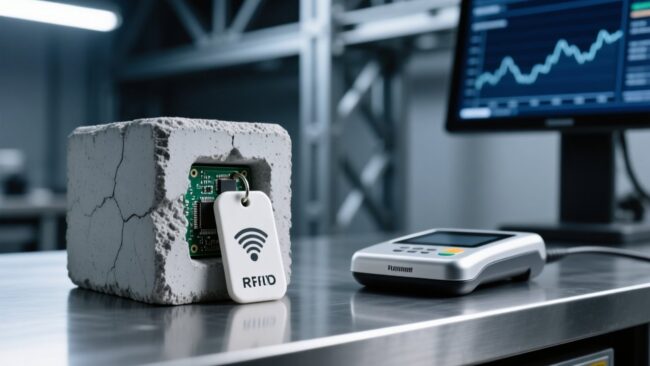
Professional close-up of RFID ceramic tag embedded in cured concrete block, with UHF desktop reader scanning nearby, clean industrial lighting, blue-gray palette

Embedded RFID Tags for Concrete & Infrastructure: Lifecycle Tracking from Pour to Demolition

Discover how embedded RFID concrete tags enable end-to-end infrastructure asset visibility—from precast manufacturing and on-site pour to maintenance, retrofitting, and demolition. This article explores technical durability requirements, integration workflows for civil engineers and smart city planners, and real-world applications in bridges, tunnels, and utility assets. Learn why passive UHF RFID tags are becoming essential for ISO 19650-compliant digital twin development and infrastructure-as-a-service models.

Professional warehouse scene showing RFID tool tracking: metal tool cabinet with embedded RFID reader, handheld scanner scanning a tagged wrench, digital dashboard displaying tool status, clean industrial lighting

RFID vs BLE vs UWB for Tool Tracking in Manufacturing: A 2026 Head-to-Head Comparison

As smart factories scale in 2026, selecting the right tool tracking technology is critical. This article compares RFID, BLE, and UWB across accuracy, infrastructure cost, durability, and integration readiness — with real-world implications for manufacturing operations managers and industrial automation teams. We analyze scalability, metal interference resilience, and ROI timelines, referencing verified deployment patterns in Tier-1 automotive and aerospace facilities. Learn why passive RFID-tags remain dominant for high-volume, high-durability tool tracking — and when BLE or UWB may justify their premium.