
Nairobi smart bus RFID ticketing with passenger tapping contactless card on validator

Nairobi Smart Bus Ticketing: RFID Technology for Modern Urban Transit in East Africa

As Nairobi’s population surges past 5 Mio., the city is embracing RFID-based smart bus ticketing to reduce cash handling, curb revenue leakage, and improve passenger experience. This article explores the technical backbone of contactless fare collection in East Africa, from MIFARE chip selection to multi-modal integration. It covers industry drivers, key specifications, deployment challenges, and practical selection guidance for transport authorities and system integrators. With insights on card durability, reader performance, and interoperability, it serves as a comprehensive resource for anyone planning or upgrading urban transit RFID systems in Kenya and beyond.


UHF RFID tool tracking system in European aviation MRO hangar with tagged tools and fixed reader portal

Achieving EASA Part-145 Compliance with RFID Tool Control Systems

Discover how RFID tool management streamlines aviation MRO operations, meets EASA Part-145 requirements, and eliminates foreign object debris (FOD) risks. This comprehensive guide covers technical specifications, deployment best practices, and selection tips for UHF RFID tags, Lesern, and software integration, ensuring audit-ready traceability and operational efficiency in European hangars.

UHF RFID tags on European freight wagons and handheld scanner in rail yard

European Rail Freight RFID Tracking: Optimizing Wagon Fleet and Yard Management

As European rail freight expands to meet sustainability goals, manual wagon tracking creates costly bottlenecks. This article examines how UHF RFID technology transforms rail yard operations through automatic identification, real-time location updates, and integration with digital yard management. Learn the technical specifications for anti-metal RFID tags, reader deployment strategies, and how to navigate interoperability with TAF TSI and DOT. Get practical guidance on piloting RFID systems, overcoming environmental challenges, and achieving rapid ROI in freight wagon management.

RFID temperature tag on fresh produce crate for EU food safety traceability, cold chain monitoring in logistics center

How RFID Food Traceability Meets EU Food Safety Regulations: A Technical Guide for Fresh & Cold Chains

The EU’s stringent food safety regulations demand end-to-end traceability from farm to fork. This technical guide explores how RFID temperature tags and UHF RFID systems enable fresh food suppliers to comply with EC 178/2002 and EC 852/2004. Learn about selecting the right RFID inlays, integrating IoT-enabled cold chain monitoring, and deploying handheld RFID scanners for real-time temperature logging. Discover practical steps to reduce recall risks, automate record-keeping, and build consumer trust. RFIDHY offers proven RFID solutions for meat, dairy, seafood, and produce supply chains – ensuring compliance and freshness across Europe’s complex logistics networks.

Data center RFID asset tracking with server racks and handheld scanner

RFID in Data Centers: Tracking IT Assets and Reducing Hidden Costs

Data centers face mounting pressure to maintain 100% asset visibility while controlling operational costs. This article explores how RFID technology is transforming IT asset tracking, from server rack inventory to lifecycle management. We examine the hidden costs of manual barcode methods, technical considerations for deploying RFID in high-metal environments, and practical selection criteria for tags and readers. With insights from industry trends and technical specifications, learn how to build a robust RFID system that minimizes downtime and audit errors.

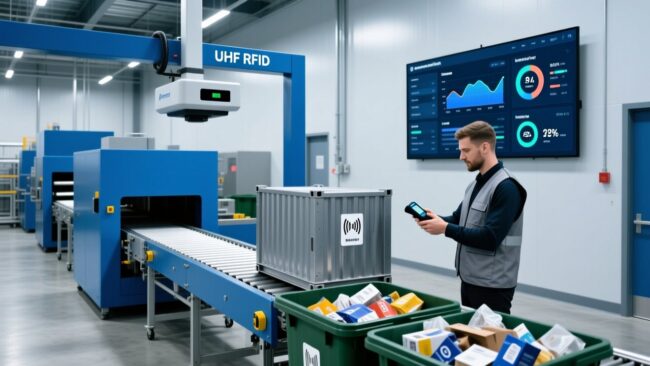
Circular economy RFID tags and waste sorting system in modern recycling facility

Circular Economy and RFID: How Europe’s New Regulations Are Driving Tag Innovation for Recycling

Europe’s new circular economy laws are accelerating the adoption of RFID technology in waste management and recycling. The EU Digital Product Passport, extended producer responsibility schemes, and stricter packaging directives require automated tracking and sorting of materials. This article examines how these regulations are driving innovation in circular economy RFID tags, from ultra-durable on-metal designs to recyclable inlays. Discover the technical specifications, deployment best practices, and real-world considerations for integrating RFID into recycling operations. Read on to learn how RFIDHY’s tailored solutions can help your facility achieve compliance and efficiency.

European retail RFID tag standards comparison with tags, reader and regulation document on neutral background

European Retail RFID Tag Standards: A Technical Comparison Guide

As European retail accelerates its shift toward omnichannel and automated inventory management, compliance with regional RFID standards is a critical differentiator for performance and interoperability. This technical comparison guide examines the key European RFID tag standards—including ETSI EN 302 208, ISO 18000-6C, and EPC Gen2v2—against North American regimes. Learn how frequency selection, power limits, LBT, and tag sensitivity impact read range and reliability. Packed with deployment tips and a detailed comparison table, this article helps retail technology buyers select the right UHF RFID tags and readers for Europe’s uniquely regulated 865–868 MHz band, ensuring seamless supply chain visibility and item-level tracking.