
The Dwell Time Challenge in Indonesian Ports
Indonesia’s position as an archipelagic nation makes its ports the lifelines of domestic and international trade. Key container hubs like Tanjung Priok in Jakarta, Tanjung Perak in Surabaya, and Belawan handle millions of TEUs annually. Yet, one persistent metric hampers their global competitiveness: container dwell time. Industry data shows that pre-digitalization dwell times in some Indonesian terminals averaged over five days—double the ASEAN benchmark. The primary culprit is the manual gate-in/gate-out process, where truck drivers hand over paper documents, officials manually verify container numbers, and data entry into terminal operating systems (TOS) is slow and error-prone. Congestion at peak hours, demurrage costs, and supply chain unpredictability all stem from this bottleneck.
How RFID Gate Automation Works
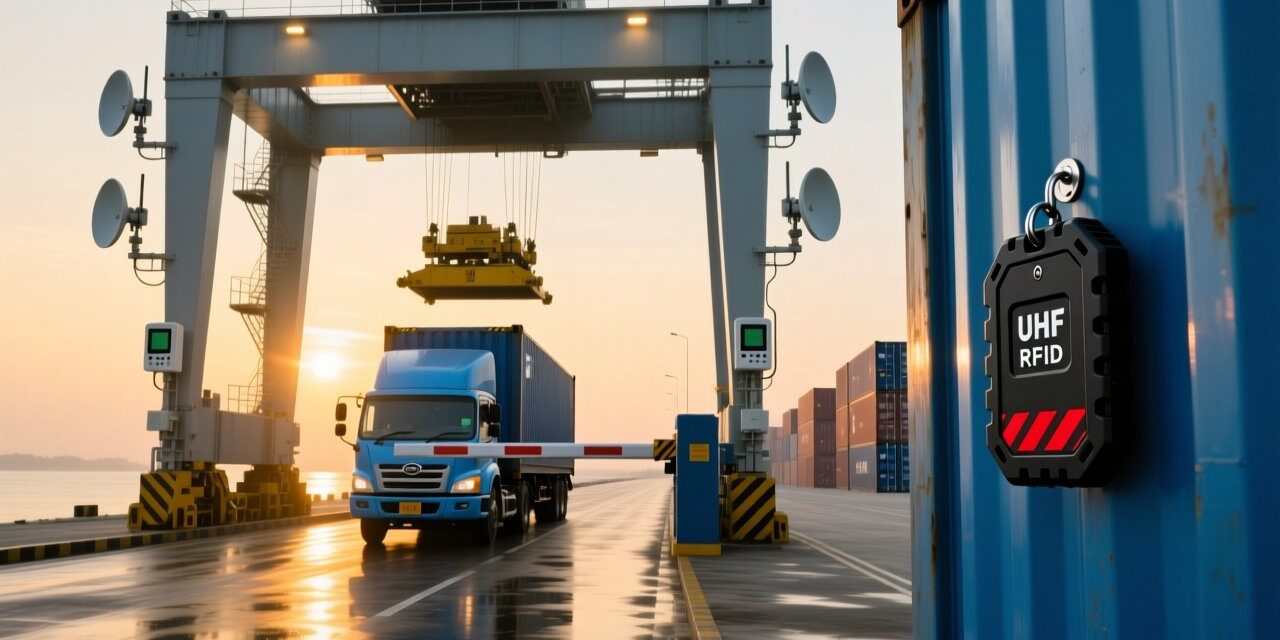
وتتفاعل (تعريف تردد الراديو) gate automation transforms the traditional checkpoint into a seamless, contactless flow. At its core, each container is affixed with a UHF RFID metal tag that carries a unique identifier linked to the container’s shipping records. When a truck approaches the gate, أ fixed RFID reader installed on a portal or gantry automatically captures the tag data from up to 10 متر. Simultaneously, a truck-mounted tag (often the same UHF metal tag) identifies the vehicle. A high-gain RFID antenna ensures reliable reading even when containers are stacked two-high on trucks. The reader transmits the data to a middleware server, which validates the container against booking and customs clearance records. If everything checks out, the gate barrier opens within seconds, and the transaction is digitally archived. No paper, no manual typing, and no momentary stops.
The technology stack leverages RAIN RFID (UHF Gen2v2) for long-range identification, combined with ruggedized tamper-proof flexible UHF RFID on-metal tags that withstand mechanical shocks, salt air, ودرجات الحرارة القصوى. Gate controllers often integrate with ANPR (Automatic Number Plate Recognition) cameras for visual backup and with the terminal’s TOS via APIs.
Technical Specifications and Key Components
Choosing the correct components is critical for port automation success. The table below summarizes typical specifications drawn from real-world deployments:
| Component | Recommended Specification | Port-Specific Consideration |
|---|---|---|
| Container Tag | UHF Gen2v2 (ISO 18000-6 ج), EPC 128-bit, read sensitivity -18 ديسيبل | On-metal RFID tags must be IP68 and resist saltwater corrosion; embossed box frames improve airflow and readability at high speed. |
| Fixed Reader | 4-port, 30 dBm RF power, dense-reader mode, PoE+ | Supports up to 4 antennas per gate for full lane coverage; Industrial-grade readers with integrated GPIO for barrier control. |
| هوائي | 9 dBi, الاستقطاب الدائري, 70° beamwidth | Circular polarization reduces orientation sensitivity; High-gain RFID antennas ensure consistent read zones even in rainy conditions. |
| Middleware | Web-based, RESTful API, configurable read filters | Must de-duplicate multiple reads from a single tag and communicate with the TOS in real time; supports both wired and wireless backhaul. |
| Tag Attachment | Welded or riveted metal plate, anti‑tamper design | Tamper‑proof flexible tags prevent unauthorised removal while accommodating container surface variations. |
Practical Deployment and Selection Tips
Environmental Hardening
Indonesian ports experience high humidity, monsoon rains, and intense UV exposure. All RFID hardware—tags, القراء, antennas—must carry at least IP67 rating. Enclosures should be coated with anti-corrosion materials. Routine maintenance schedules are essential; على سبيل المثال, salt deposits on antennas can degrade performance after a few months. Pilot testing during the rainy season is recommended to validate read rates under wet conditions.
Integration with Existing Systems
Most terminals already operate a TOS, such as Navis or Tideworks. RFID middleware must offer standard connectors (e.g., EDIFACT, Xml, JSON) to exchange data without disrupting operations. Consider a phased rollout: first digitize the gate-in process, then expand to gate-out and yard inventory tracking. This incremental approach minimizes downtime and allows staff to adapt.
Stakeholder Buy-in
Trucking companies and freight forwarders are key to success. Early engagement—through workshops and pilot demonstrations—helps them understand the benefits: shorter queues and faster turnaround. Providing pre‑programmed UHF RFID tags for truck windshields (often the same on-metal tag attached to a bracket) simplifies integration. Port authorities should also align the RFID system with customs and security protocols to avoid double‑handling.
Proven Results: 40% Dwell Time Reduction
A case in point: a major container terminal in Tanjung Priok, Jakarta, deployed an RFID gate automation solution across its four entry lanes. Before the upgrade, manual processing consumed an average of 3.5 minutes per truck transaction, and peak-hour queues often stretched beyond 500 متر. After integrating fixed RFID readers, UHF metal container tags, and automated gate barriers, the terminal achieved a 40% reduction in average container dwell time—from 5.1 days to 3.05 days—within the first six months. The daily truck processing capacity rose from 1,200 to over 2,000 without adding lanes. Data entry errors, formerly at 4.7%, plummeted to 0.2%. The terminal also reported a 25% decrease in yard congestion and a measurable drop in demurrage penalties.
These improvements are not anecdotal. Similar RFID gate projects in Southeast Asian ports have yielded 30–45% reductions in dwell time, validating the technology’s ROI. The real-time visibility provided by RFID tracking also enabled predictive yard planning, reducing container re-handles and crane idle time.
As port digitization accelerates, the combination of RFID gate automation with IoT sensors and cloud‑based TOS is set to become the regional standard. Ports that delay adoption risk losing liner services to more efficient neighbors.
Frequently Asked Questions
How does RFID reduce container dwell time?
By automating the gate identification process, RFID eliminates the need for drivers to stop and present paperwork. Tags are read wirelessly as vehicles pass through, cutting transaction times from minutes to under 30 ثانية. This accelerates the flow of trucks, reduces queues, and shortens the time containers spend in the terminal, directly lowering dwell time.
Are RFID tags reliable in ports with metal containers?
نعم, with proper selection. Standard RFID tags fail on metal surfaces, ولكن on-metal UHF RFID tags are specifically designed for this environment. They use a foam or ceramic spacer to isolate the antenna from the metal, achieving read ranges comparable to or better than non-metal tags. Ruggedized enclosures protect against moisture and impact.
What is the typical read range of an RFID gate reader?
In a gate setup using a 4‑port industrial fixed RFID reader with high‑gain antennas, read ranges of 8–12 meters are common. The actual range depends on tag sensitivity, antenna placement, and environmental interference. Proper planning ensures 100% read accuracy at normal vehicle speeds.
How can a port get started with RFID gate automation?
Start with a site survey to assess gate lane width, typical vehicle flow, and existing IT infrastructure. Partner with an experienced RFID solutions provider like RFIDHY, who can recommend the right mix of tamper‑proof tags, القراء, والهوائيات. A pilot project on one lane is often the best way to demonstrate value and fine‑tune the system before full‑scale deployment.
Transform Your Port Operations with RFID
RFIDHY provides end‑to‑end RFID gate solutions tailored for Southeast Asian port environments. من UHF RFID metal tags to advanced fixed readers and integration services, our team ensures a smooth transition to automated container tracking. Contact us today to schedule a consultation and learn how your terminal can achieve similar dwell time reductions.
الأسئلة المتداولة
How does RFID reduce container dwell time?
By automating the gate identification process, RFID eliminates the need for drivers to stop and present paperwork. Tags are read wirelessly as vehicles pass through, cutting transaction times from minutes to under 30 ثانية. This accelerates the flow of trucks, reduces queues, and shortens the time containers spend in the terminal, directly lowering dwell time.
Are RFID tags reliable in ports with metal containers?
نعم, with proper selection. Standard RFID tags fail on metal surfaces, but on-metal UHF RFID tags are specifically designed for this environment. They use a foam or ceramic spacer to isolate the antenna from the metal, achieving read ranges comparable to or better than non-metal tags. Ruggedized enclosures protect against moisture and impact.
What is the typical read range of an RFID gate reader?
In a gate setup using a 4‑port industrial fixed RFID reader with high‑gain antennas, read ranges of 8–12 meters are common. The actual range depends on tag sensitivity, antenna placement, and environmental interference. Proper planning ensures 100% read accuracy at normal vehicle speeds.
How can a port get started with RFID gate automation?
Start with a site survey to assess gate lane width, typical vehicle flow, and existing IT infrastructure. Partner with an experienced RFID solutions provider like RFIDHY, who can recommend the right mix of tamper‑proof tags, القراء, والهوائيات. A pilot project on one lane is often the best way to demonstrate value and fine‑tune the system before full‑scale deployment.
Transform Your Port Operations with RFID
RFIDHY provides end‑to‑end RFID gate solutions tailored for Southeast Asian port environments. From UHF RFID metal tags to advanced fixed readers and integration services, our team ensures a smooth transition to automated container tracking. Contact us today to schedule a consultation and learn how your terminal can achieve similar dwell time reductions.