During the autoclave curing process, components are subjected to extreme heat and pressures (often exceeding $180°C$ and $7$ بار). Traditional external labels fail under these conditions, and physical engraving risks compromising the structural integrity of the delicate fiber plies.
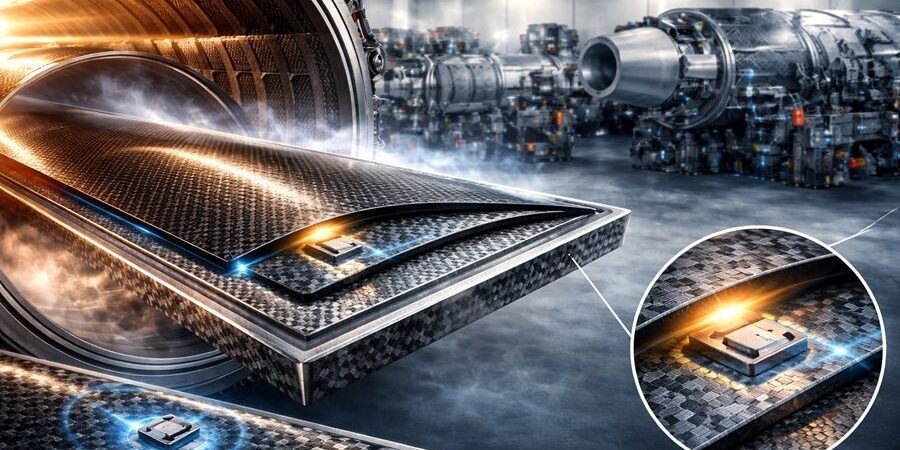
The industry is now pivoting toward aerospace carbon fiber RFID integration—embedding ultra-thin, ruggedized tags directly between the composite layers or within the mold sealant. This creates a permanent, internal “digital core” that survives the curing cycle and follows the part from the cleanroom to the boneyard.
The Challenge: Surviving the Heat and Pressure
Composite manufacturing is a hostile environment for electronics. To be flight-certified and process-compatible, an embedded tag must meet three “Non-Negotiable” criteria:
- Zero Structural Impact: The tag must be ultra-thin (typically $<0.8mm$) to prevent “bridging” or resin-starved areas that could lead to delamination under load.
- Thermal & Barometric Stability: It must withstand the glass transition temperatures ($T_g$) of aerospace resins without deforming or losing data.
- EMI Shielding Compatibility: Since carbon fiber is conductive and acts as an electromagnetic shield, the antenna design must be optimized to allow signal penetration or utilize the part’s surface as a radiator.
Strategic Solutions for Advanced Composites
To support the rigorous CFRP manufacturing traceability requirements of Tier-1 aerospace suppliers, رفيدهي provides specialized hardware designed for sub-surface integration:
- HY-MO0303 (التردد فوق العالي): This is our flagship solution for thin-ply composites. With a thickness of only 0.75mm and a PEEK (Polyetheretherketone) الإسكان, it can be embedded directly into the layup. It is engineered to maintain signal integrity throughout the vacuum bagging and autoclave stages, providing a seamless link to the part’s Manufacturing Execution System (مس).
- HY-MOΦ7: For thicker structural components or sandwich panels, the Φ7mm circular tag offers expanded memory capacity. This allows engineers to write specific process parameters—such as resin batch numbers, layup timestamps, and curing technician IDs—directly onto the component.
Industry Impact and Data Validation
According to a study by Deloitte on Aerospace & Defense 4.0, digitalizing the composite supply chain can reduce quality-related “rework” by up to 15% by ensuring that only qualified materials enter the mold (Source: Deloitte Aerospace Report). وعلاوة على ذلك, the National Institute of Standards and Technology (NIST) highlights that embedded sensors are critical for the “Digital Twin” philosophy, allowing for real-time health monitoring of airframe components.
The value of embedded RFID extends far beyond the factory floor
As the aerospace industry faces mounting pressure to improve sustainability, the HY-MO0303 acts as a permanent record for material recycling.
- Material Identification: Upon aircraft decommissioning, recyclers can scan the wing or fuselage to instantly identify the specific resin type and fiber grade, ensuring high-value carbon fiber is properly reclaimed rather than downcycled.
- Maintenance History: MRO (صيانة, Repair, and Overhaul) teams can query the embedded tag to view the total flight hours and repair history of a composite panel, even if the external paint or surface finish has been altered.
الختام
By adopting aerospace carbon fiber وتتفاعل التكنولوجيا, manufacturers move from reactive documentation to proactive, integrated intelligence. Embedding the digital identity into the physical structure ensures that safety, الامتثال, and sustainability are literally woven into the wings of the future.