
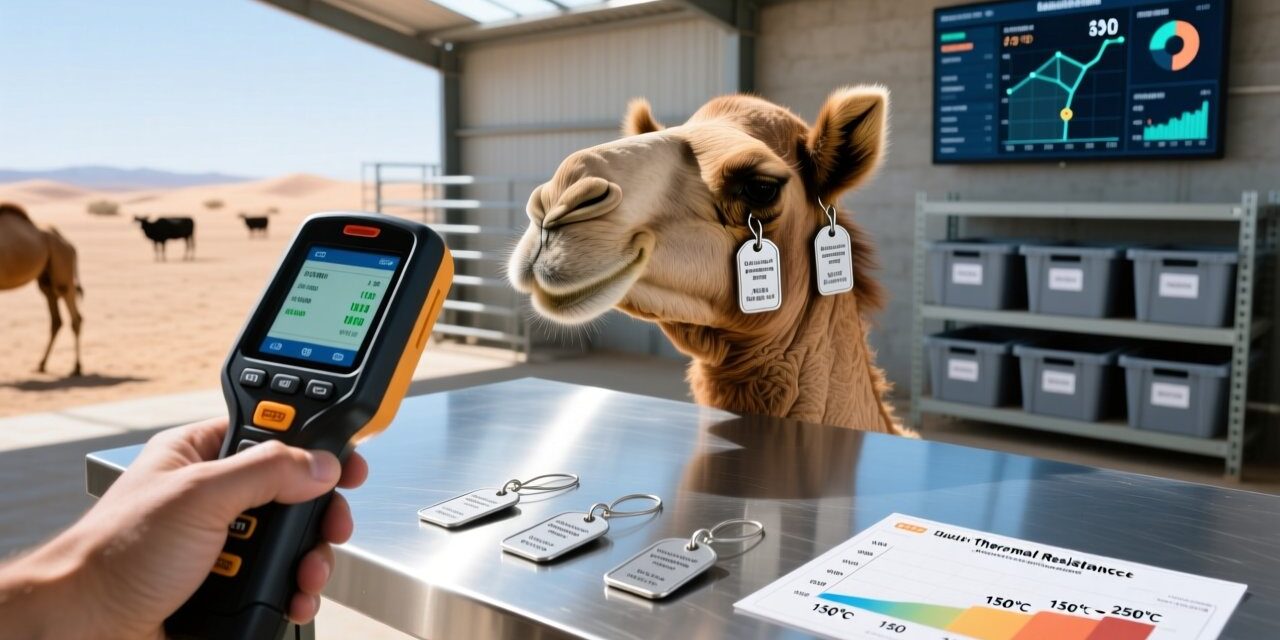
Giriş: The Challenge of RFID Tracking in the Arabian Desert
In Saudi Arabia and across the Gulf Cooperation Council (GCC) Bölge, livestock — especially camels — are vital to cultural heritage, economic activity, and national food security. With rising mandates from the Ministry of Agriculture’s Animal Traceability Program, digital identification via animal RFID tag systems is no longer optional. Ancak, standard UHF RFID tags fail rapidly in ambient temperatures exceeding 50°C and direct UV exposure — conditions routinely experienced across Riyadh, Al-Jouf, and the Empty Quarter.
Why Standard RFID Ear Tags Fail in Extreme Heat
Conventional polyurethane or PVC-based ear tags suffer from three critical weaknesses in arid climates:
- Adhesive degradation: Bonding layers delaminate above 45°C, causing tag detachment;
- Chip encapsulation failure: Epoxy or silicone housings crack under thermal cycling (day/night swings up to 35°C);
- Antenna detuning: Metal-rich ear tissue combined with heat-induced dielectric shifts reduces effective read range by >60%.
These failures compromise traceability integrity, audit readiness, and real-time herd health monitoring — all essential for modern Saudi livestock management.
RFID Tag Selection Criteria for Camel & Livestock in High-Temperature Environments
Selecting the right RFID ear tag requires evaluating five interdependent criteria:
1. Thermal Rating & Material Composition
Tags must be rated for continuous operation at 70°C and peak exposure up to 85°C. Preferred materials include PPS (polyphenylsulfone), ceramic composites, or reinforced silicone — not standard ABS or PVC. RFIDHY'nin high-temperature RFID tag HY-HT4836 meets ISO 11784/11785 and operates reliably up to 125°C.
2. UV Resistance & Weatherproofing
IP68-rated tags resist sand ingress and saline dust, but true desert resilience demands UV80+ stabilization. Look for tags with carbon-black pigment integration and UV-inhibiting additives in the polymer matrix.
3. Antenna Design for Biological Coupling
Camel ears contain dense cartilage and variable moisture content. Optimized near-field coupling requires low-Q, broadband antenna geometry — such as folded dipole or meander-line layouts — rather than standard half-wave dipoles. RFIDHY'nin RFID ear tag series uses proprietary impedance-matching layers to maintain stable read performance across biological variability.
4. Mounting Integrity & Mechanical Durability
Clamp-style applicators must withstand repeated use in field conditions. Stainless steel rivets, non-corrosive anodized aluminum clamps, and torsion-resistant polymer hinges ensure multi-year retention without ear tearing or tag rotation.
5. Regulatory Compliance & Data Standards
All tags deployed under the Kingdom’s Animal Traceability Program must support ISO 11784 (FDX-B) or ISO 14223 protocols and store mandatory fields: national ID, birth date, vaccination history, and movement logs. Integration-ready animal RFID reader HY-R206 enables seamless synchronization with Saudi government traceability platforms.
Real-World Deployment Considerations
For UAE camel racing clubs, tag placement consistency is critical: left ear for registration, right ear for race-day timing. In large-scale feedlots, fixed-mount readers installed at watering points or gateways provide passive, hands-free data capture — reducing labor costs and human error. Pairing tags with ruggedized UHF handheld reader HY-R6100 ensures spot-check verification during veterinary inspections or transport audits.
FAQ
- Q: Can standard UHF RFID ear tags be used for camels in Saudi summer conditions?
- Hayır. Most commercial UHF ear tags are rated only to 50–60°C and degrade rapidly under sustained desert heat and UV exposure. Failure rates exceed 40% within six months.
- Q: What is the minimum read range required for reliable camel tracking at a chute or gate?
- A minimum of 1.2 meters at 2 W ERP output is recommended. RFIDHY’s optimized ear tags achieve ≥1.5 m in open-air chute deployments using standard fixed RFID readers.
- Q: Are RFID ear tags compatible with existing Saudi Ministry of Agriculture traceability software?
- Yes — provided tags comply with ISO 11784/11785 FDX-B format and support EPC Gen2v2 encoding. All RFIDHY livestock RFID tags are pre-configured for seamless integration.
- Q: Do RFID ear tags require batteries?
- Hayır. Passive RFID ear tags — including those designed for extreme heat — operate without batteries, ensuring maintenance-free, multi-year service life.
Ready to Deploy Reliable RFID Camel & Hayvancılık Takibi?
Download our free Saudi Livestock RFID Deployment Checklist, request a thermal performance datasheet for HY-HT4836 tags, or schedule a technical consultation with our Middle East applications engineering team.livestock RFID ear tags