
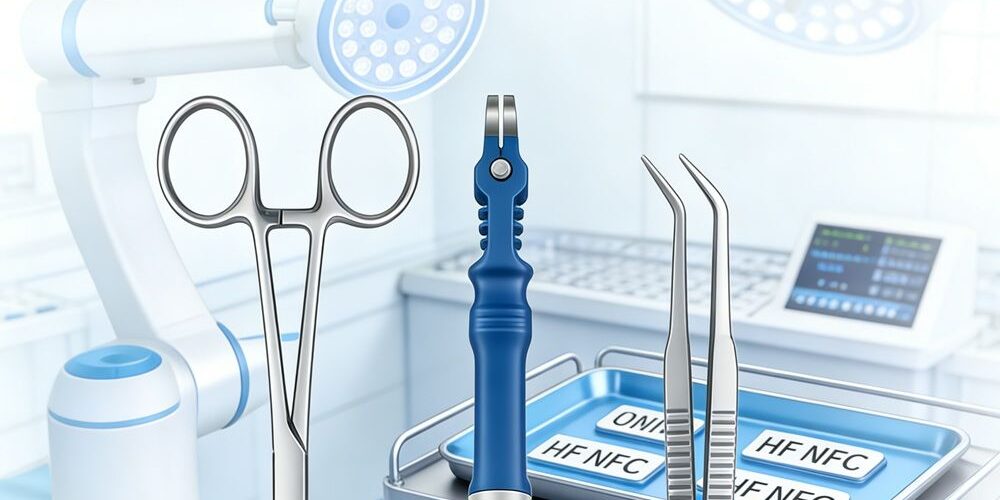
Identifying the “Joints” of Robotic: The Era of Traceable Precision
In the modern operating room (OR), as instruments like ultrasonic shears, staplers, and robotic graspers become more sophisticated and miniaturized, they present a significant “blind spot” for hospital logistics.
These high-value medical disposables must be strictly traced to individual patients to prevent the catastrophic risks of reuse and to ensure compliance with global Unique Device Identification (UDI) Görev.
The challenge? These instruments are often too delicate or ergonomically refined to accommodate traditional adhesive labels or laser etching. The solution is the integration of biocompatible micro RFID tags—millimeter-scale identifiers that reside inside the device handle, turning a “dumb” tool into a data-rich “intelligent joint.”
The Necessity of Sub-Miniature Integration
In the surgical environment of North America and Europe, efficiency and safety are non-negotiable. According to Fortune Business Insights (2026), the global surgical instrument tracking market is projected to reach $356.9 milyon içinde 2026, with RFID being the fastest-growing technology segment due to its ability to automate data collection without line-of-sight scanning.
For robotic surgery, , “micro” factor is an absolute requirement:
- Zero Footprint: Tags must be small enough (typically <3mm) to be encapsulated within the plastic housings of instrument handles without affecting the surgeon’s grip or the tool’s mechanical balance.
- Biological Safety: Materials must strictly adhere to ISO10993 standards for biocompatibility, ensuring that if the device casing is compromised, the internal tag poses no systemic toxicity or irritation risk to the patient.
- Sterilization Resilience: Even for single-use “disposable” kits, instruments often undergo high-pressure steam sterilization (Autoclave) or Gamma radiation at the manufacturer level. Tags like the HY-MOΦ3 are designed to survive temperatures up to $230°C$.
Strategic Hardware for the Modern OR
To meet the rigorous demands of robotic-assisted surgery and sterile processing departments (SPD), we recommend these specialized solutions:
- HY-MOΦ3: With a diameter of just 3mm, this is the gold standard for implantable-grade traceability in disposable tool handles. Its circular form factor allows for easy press-fit or over-molding during the manufacturing process.
- HY-HF0303: Operating at 13.56MHz (NFC/HF), this tag is optimized for near-field communication. It allows surgical staff to “Tap-to-Verify” an instrument kit using a smartphone or tablet, instantly linking the tool’s serial number, son kullanma tarihi, and sterilization status to the patient’s Electronic Health Record (EHR).
Real-World Impact: Compliance and Efficiency
The implementation of biocompatible micro RFID tags offers immediate ROI for healthcare providers:
- Anti-Abuse & Safety: Modern robotic consoles can use RFID to automatically “handshake” with the instrument. If the tag indicates the tool has already been used or has expired, the system can lock the device, preventing “never events” associated with unintended reuse.
- Automated Audit Trails: Under FDA UDI and EU MDR regulations, hospitals must maintain a digital chain of custody. RFID eliminates manual logging errors, providing a 100% accurate record for regulatory audits and insurance claims.
- Inventory Optimization: Real-time visibility into the hospital’s “high-value consumable” stock reduces over-ordering and prevents “out-of-stock” delays that lead to canceled surgeries.
Extended Extension: The Future of “Smart Trays”
Beyond the individual instrument, the next frontier is the RFID-enabled Smart Surgical Tray. By using a combination of UHF (Ultra yüksek frekans) for bulk inventory scanning in the warehouse and HF/NFC for localized verification in the OR, hospitals can achieve a 360-degree view of their surgical assets. This hybrid approach ensures that the right tools are in the right tray, sterilized and ready, every single time.
Sonuç
As robotic surgery becomes the standard of care, , “digital identity” of the instrument is as important as its physical edge. By integrating biocompatible micro RFID tags at the point of manufacture, brands are not just selling a tool—they are providing a foundation for surgical excellence and patient safety.