
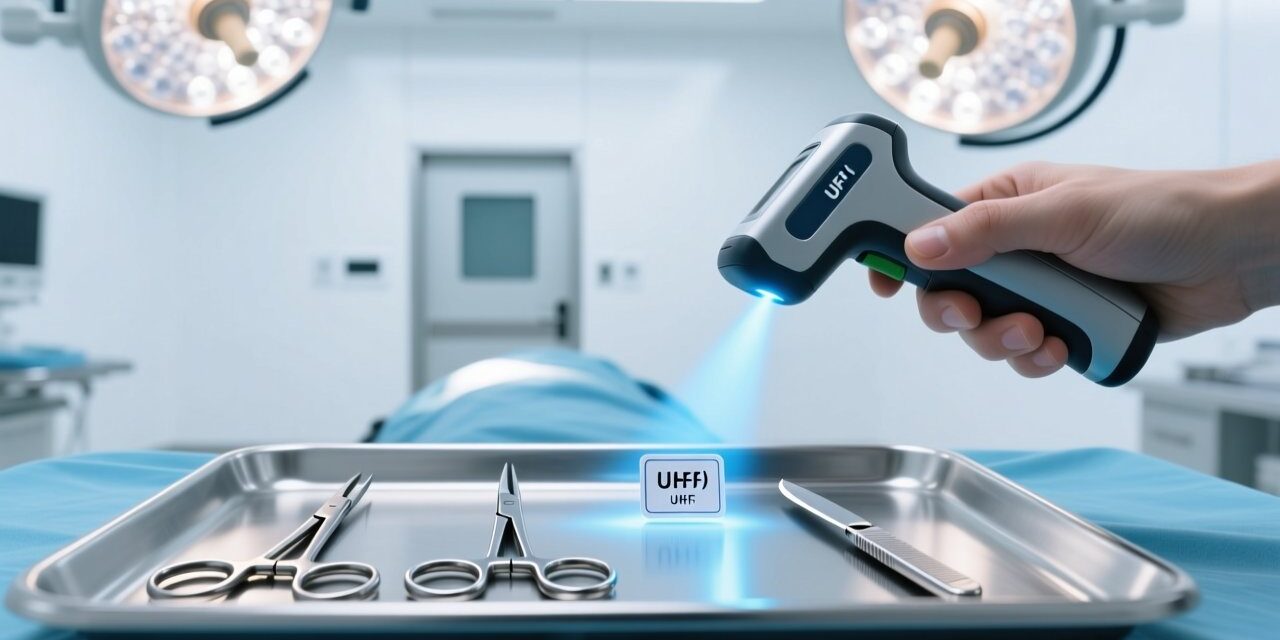
The Drive for Smaller RFID in Healthcare
Surgical instrument tracking is rapidly becoming a cornerstone of patient safety and operational efficiency. According to multiple implementation studies, RFID-enabled systems can reduce counting errors by over 80% and nearly eliminate retained surgical items. Однако, many instruments—such as micro‑surgical forceps, laparoscopic tools, and dental scalers—offer only a few square millimeters of attachment surface. This is driving demand for extremely compact RFID метки that can be bonded, встроенный, or even implanted directly into devices without interfering with their use.
For medical device procurement teams, the challenge is clear: tags must be small enough to fit, yet robust enough to survive harsh sterilization cycles and deliver consistent read performance. This article breaks down the critical size‑versus‑performance trade‑offs, providing a data‑driven framework to help you select the right tag for your clinical environment.
Understanding the Size-Performance Trade-off
The performance of an RFID tag is fundamentally linked to its antenna size. A smaller antenna captures less energy from the reader field, reducing the achievable read range. For UHF tags, a 50% reduction in antenna length can cut range by 60‑70% in free air; on metal surfaces the effect is even more pronounced because the metal detunes the antenna. ВЧ (13.56 МГц) Теги, while inherently shorter‑ranged (typically <10 см), are less sensitive to antenna size but more susceptible to interference from nearby tissue and fluids.
When evaluating micro‑sized tags, procurement must weigh three dimensions:
- Read range vs. instrument size: The smallest UHF tags (2.6‑3 mm square) may only reach 0.5 m on metal, sufficient for tray‑level scanning but not for wide‑area portal reads.
- Material compatibility: Surgical instruments are predominantly metal; tags must be designed with a dielectric spacer or ferrite layer to maintain readability.
- Sterilization resilience: Tags must endure repeated autoclave, окись этилена (ETO), or gamma radiation cycles without delamination, cracking, or chip failure.
Key Technical Specifications for Surgical Instrument Tags
The table below compares representative miniature RFID tags from RFIDHY’s portfolio, illustrating the direct relationship between size, read range, and sterilization capabilities.
| Tag Series | Габаритные размеры (мм) | Дальность считывания (on metal) | Чип | Sterilization Methods |
|---|---|---|---|---|
| RFID Micro tag (Magic Series) | 2.6 × 2.6 | До 0.5 m | Impinj Monza R6 | ETO, Gamma |
| RFID Embedded chip (Conqueror Series) | 2 × 5.8 | До 1.5 m | Impinj Monza R6‑P | Autoclave (134° C), ETO |
| RFID glass tube tags (Implantable) | 1.4 × 8 | До 0.3 m | EM4305 / HITAG | Autoclave, Gamma |
Note that read ranges are achievable under controlled test conditions; actual performance depends on reader power, instrument geometry, and orientation. Always validate tags on your specific instruments in a realistic test bed before committing to large‑scale deployment.
Selecting the Right Miniature RFID Tag: Practical Deployment Tips
Based on insights from RFIDHY’s engineering team and global medical device implementations, follow these steps to navigate the size‑performance landscape:
- Define the read range requirement: Determine whether you need tray‑level (< 0.5 m) or room‑level (>1 m) Идентификация. This will immediately filter the feasible tag sizes.
- Match tag construction to sterilization: For autoclave‑intensive workflows, select tags with high‑temperature epoxy or ceramic encapsulation (Например, Conqueror Series). For ETO or gamma, flexible circuit tags may suffice.
- Validate on‑metal performance: Even tags marketed as “on‑metal” may behave differently on stainless‑steel grades like 316L. Use a spectrum analyzer and real instruments to measure RSSI (signal strength) at the intended read distance.
- Consider attachment method: Embedding a tag into a machined pocket yields the most durable solution; pressure‑sensitive adhesives may fail after repeated sterilizations. RFIDHY offers custom over‑molding for complex shapes.
- Check chip memory and security: For UDI (Unique Device Identification) соответствие, ensure the chip provides sufficient EPC memory and supports password‑protected kill/access features.
- Prototype and test: Order evaluation kits with the candidate tags and simulate your full sterilization and scanning workflow. Measure read success rates over multiple cycles.
Procurement teams often find that a hybrid approach—using the smallest tags for instruments that are independently verified at the tray level and slightly larger tags for items that require long‑range inventory scans—delivers the best balance of coverage and cost.
For a deeper dive into medical RFID tags и системная интеграция, explore RFIDHY’s dedicated medical product category or request a technical consultation. The right miniature tag is not just a technical choice; it is a strategic decision that affects clinical workflow, patient safety, and regulatory compliance.
FAQ
What is the smallest UHF RFID tag available for surgical instruments?
Commercially mature UHF RFID tags as small as 2.6 × 2.6 мм (Magic Series) deliver reliable reads at close range on metal. Smaller prototypes exist, but production‑grade tags below 2 mm typically suffer from extremely limited read range (<0.1 m) and are not recommended for critical tracking.
How does tag size affect read range and performance?
Antenna gain scales with its effective aperture; shrinking the antenna reduces captured RF energy, cutting read range. Тег 50% smaller can lose 50‑70% of its range. Design techniques such as high‑Q matching and low‑loss materials mitigate this, but physics imposes an inverse relationship between miniaturization and range.
Can miniature RFID tags withstand autoclave sterilization?
Да, select miniature RFID tags are engineered for repeated autoclave cycles. The Conqueror Series and glass‑tube tags withstand 134°C saturated steam for 3‑5 minutes over hundreds of cycles. Verify manufacturer test data, including visual inspection for delamination and read/tag memory integrity after cycling.
Are there implantable micro RFID tags for medical devices?
Implantable RFID tags, такие как 1.4 × 8 mm glass‑encased transponders, are used in animal identification and are being explored for human implantable device tracking. They operate at LF (125‑134 kHz) or HF and can be read through tissue. Sterilization compatibility and biocompatibility testing are paramount.
What factors determine the performance of RFID tags on metal surgical instruments?
Metal surfaces detune RFID antennas. On‑metal tags use a spacer or high‑dielectric substrate to create a resonant structure that works against the metal backing. Tag orientation, instrument curvature, and the type of metal (stainless steel vs. titanium) all influence real‑world read distances. Always test tags on your actual instrument portfolio.
Need Expert Guidance on Miniature RFID Tag Selection for Medical Devices?
RFIDHY specializes in high‑performance miniature RFID tags engineered for sterilization‑intensive clinical environments. Our application engineers can help you navigate the size‑performance trade‑offs, validate tag candidates on your instruments, and customize tag form factors to your exact requirements. Contact us today for a consultation and request a sample evaluation kit to accelerate your medical device tracking project.