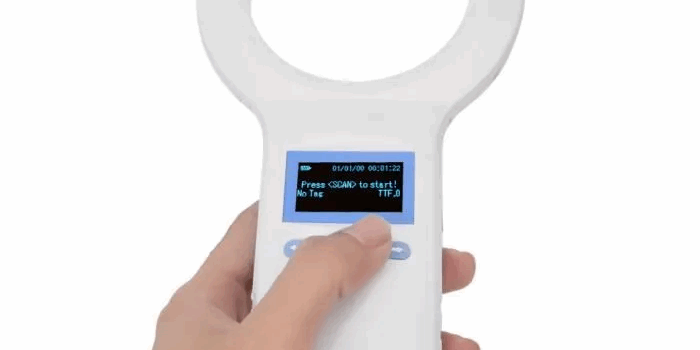
In the global wave of animal management digitization, RFIDHY’s animal microchip temperature-sensitive portable reader/writer is redefining industry standards with its dual functionality of “identification + temperature measurement.” This device, which combines 134.2 kHz low-frequency technology with high-precision sensing, not only meets ISO 11784/85 international standards but also boasts temperature measurement accuracy of ±0.2°C and a battery life of 15 hours, making it a favorite in the livestock, pet healthcare, and wildlife conservation sectors.
I. Technological Breakthrough: RFIDHY’s Dual-Core Collaborative Design
The RFIDHY reader adopts an innovative “dual-module collaborative” architecture, integrating RFID identification and temperature sensing units into a 120-gram device. Its RF module is compatible with the FDX-B/HDX full protocol, with a reading distance of up to 25 cm, ensuring stable identification even when animals are moving vigorously; The temperature sensing module uses German-imported thermosensitive components, maintaining high precision within the -20°C to 60°C temperature range, with a data refresh rate of 1 time per second. This design enables the device to both read the identity information stored on the chip and simultaneously capture fluctuations in the animal’s body temperature, addressing the pain point of traditional devices requiring two separate steps for identification and temperature measurement.
The device is IP65 dustproof and waterproof certified, suitable for extreme environments such as muddy pastures and humid rainforests. The built-in 5000mAh lithium battery supports continuous operation for 15 hours, and when paired with a solar charging base, it enables long-term field operations. This feature makes it particularly effective in applications such as wildlife conservation areas in Africa.
II. Global Scenarios: Implementation from Farms to Conservation Areas
1. Dutch Smart Farm: The “Invisible Sentinel” for Cow Health
At the Friesland farm in the Netherlands, all 2,000 cows are implanted with RFID chips. Farmers use RFIDHY readers for daily inspections, which identify the cows’ identities while automatically recording temperature data. The system shows that when a cow’s temperature exceeds 39.5°C, the reader triggers an alert, allowing veterinarians to intervene 48 hours in advance for subclinical mastitis, reducing treatment costs by 40%. The farm owner stated, “The RFIDHY device allows us to obtain each cow’s health data with a single scan, resulting in an 8% increase in annual milk production.”
2. North American Pet Clinic: The “Quick Diagnosis Assistant” in the Emergency Room
The emergency process at a Toronto animal hospital has been transformed by RFIDHY readers. When a stray cat is brought into the clinic, the doctor scans the chip with the device and obtains its identity information and real-time body temperature within 1.5 seconds. Data from 2024 shows that the device reduced emergency triage time from 12 minutes to 4 minutes. During a parvovirus outbreak, temperature screening quickly identified high-risk individuals, increasing the success rate of treatment by 22%. The clinic director stated, “The device’s Bluetooth synchronization feature directly integrates with the electronic health record system, eliminating errors from manual record-keeping.”
3. Kenya Conservation Area: A “Contactless Caretaker” for Elephant Herds
RFIDHY readers demonstrate unique value in African elephant conservation. Researchers install the devices at hidden watering holes, where they automatically read the identity codes and temperature data from implanted chips when elephant herds approach. Monitoring shows that the basal body temperature fluctuations of adult elephants are correlated with their migration routes, and the device’s low-power design (60-day standby time) perfectly suits the power-free environment of the wild. The project leader noted: “The device’s 50-meter long-range identification capability allows us to collect data without disturbing the elephant herds, improving poaching warning response times by 50%.”
III. RFIDHY’s Core Competitive Advantages
As an industry leader, RFIDHY readers offer three key advantages: First, they use proprietary “anti-interference algorithms” to maintain a 99.7% recognition accuracy rate even in environments with dense animal fur or high humidity. Second, they have obtained international certifications such as CE and FCC, with data encryption compliant with GDPR standards, ensuring the information security of pet owners and ranch owners. Third, its modular design supports OTA upgrades and has already achieved seamless integration with blockchain traceability systems, providing compliant data support for Europe’s meat supply chain.
The company’s Chief Technology Officer revealed: “The next-generation product will integrate infrared thermal imaging functionality, enabling dual monitoring of ‘chip data + surface thermal maps,’ with mass production expected by 2026.” This continuous innovation has propelled its global market share from 12% to 28% within three years.
Conclusion
From dairy cows on Dutch farms to pets in Toronto clinics, from elephant herds in Kenya to laboratory animals, the RFIDHY temperature-sensing portable reader/writer is redefining animal monitoring standards with its “precise, portable, and intelligent” characteristics. When technological breakthroughs intersect with humanitarian care, this device is not merely a tool for data collection but a bridge safeguarding animal welfare—perhaps the best embodiment of RFIDHY’s “technology for good” philosophy.