
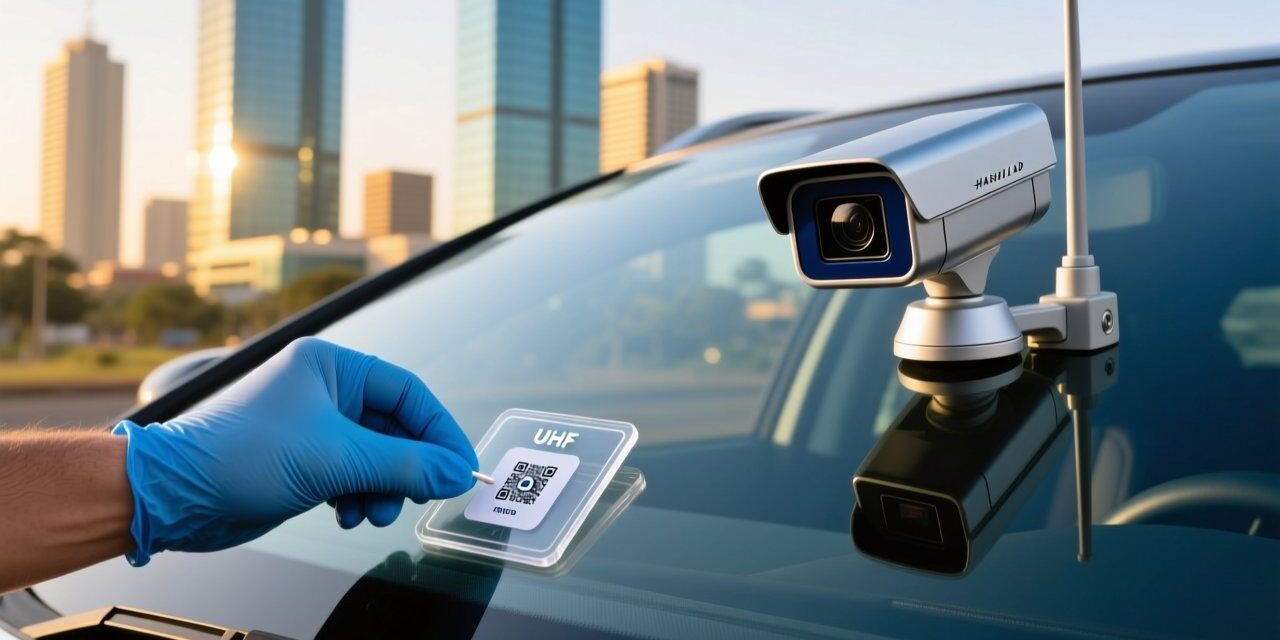
Kenya NTSA Vehicle Registration Project: A Digital Leap for East Africa
The National Transport and Safety Authority (NTSA) of Kenya is embarking on one of Africa’s most ambitious vehicle registration digitization initiatives. With a target to tag and register approximately 3.3 million vehicles using passive UHF RFID tags, the project aims to modernize tax collection, improve road safety, and enable seamless integration with the Intelligent Traffic Management System (ITMS) in Nairobi and across major highways. This nationwide rollout represents a landmark government RFID project in East Africa, requiring high-performance RFID windshield labels that can withstand tropical outdoor conditions while delivering reliable long-range identification.
UHF Windshield Tag Technical Specifications
To meet NTSA’s stringent requirements, windshield tags must adhere to specific technical standards. The table below summarizes key specifications derived from typical African government vehicle registration tenders and international best practices for outdoor RFID systems:
| Parâmetro | Especificação de |
|---|---|
| Frequência | UHF 860-960 MHz (ETSI 865-868 MHz for Kenya) |
| IC Chip | Impinj Monza R6/R6-P, Higgs alienígena 3/4, or NXP UCODE 8 |
| Intervalo de leitura | Até 8 metros (with fixed reader antenna, vehicle-speed up to 40 km/h) |
| IP Rating | IP54 or higher (dust and splash proof, suitable for windshield interior) |
| Temperatura de funcionamento | -25°C to +85°C, with UV-stable material |
| Material | PET or polycarbonate facestock with clear permanent adhesive |
| Dimensões | Normalmente 100 mm × 25 mm or custom wind-shield optimized shape |
| Memória | EPC 128-256 bits de, User memory for vehicle data (TID, license plate, owner ID) |
| Tamper Resistance | Void pattern upon removal, não-transferível |
Frequency Compliance and Read Range for African Urban Traffic
Kenya follows the ETSI UHF band (865-868 MHz), ensuring compatibility with regional and international standards. In dense Nairobi traffic, the ability to achieve 8-meter read range at highway speeds is critical. This performance relies not only on the RFID windshield tag sensitivity but also on strategically deployed fixed RFID reader infrastructure with high-gain antennas. The design must accommodate multi-lane reading and anti-collision algorithms to handle hundreds of vehicles per hour.
Environmental Durability: Material Selection for Tropical Climates
Windshield tags in East Africa face intense UV radiation, alta umidade, and rapid temperature fluctuations. The tag facestock must be made of UV-stabilized PET or polycarbonate, combined with a high-tack, optically clear adhesive that resists bubbling and yellowing over years of direct sunlight. RFIDHY’s engineering team selects materials validated through accelerated aging tests, simulating 5–10 years of equatorial sun exposure. For organizations requiring large-volume lot consistency, RFIDHY offers batch-level quality certification and full material traceability as part of its
RFID windshield label Fornecimento.
Project Implementation Timeline and Bulk Procurement
The NTSA project is expected to follow a phased approach:
- Pilot Phase (6–8 months): Initial deployment of 50,000–100,000 tags in Nairobi along with fixed reader gates at key intersections, bus terminals, and toll stations. This phase validates system integration, read reliability, and tamper-evident features.
- Rollout Phase (18–24 months): Production and distribution of remaining tags for national coverage. Bulk orders may be split into quarterly batches to ensure consistent quality and timely supply. Typical procurement volumes per batch exceed 500,000 units, demanding scalable manufacturing capabilities.
- Ongoing Sustainment: Replacement tags, reader maintenance, and software updates for lifetime of the ITMS program.
Government RFID tenders in Kenya require bidders to demonstrate ISO 9001 certificação, proven experience in supplying high-durability RFID tags, and successful performance in similar large-scale vehicle identification projects. Suppliers must also provide pre-production samples for independent lab testing and on-site pilot evaluation.
Frequently Asked Questions
What are the qualification criteria for RFID windshield tag suppliers in the Kenya NTSA tender?
Normalmente, bidders must show a minimum of three years manufacturing experience in UHF RFID tags, provide ISO 9001 e ISO 14001 certifications, submit samples for a 90-day outdoor durability and read-range test, and demonstrate capacity to deliver volumes of at least 1 million units within six months. Preference is given to manufacturers with prior government project references and local or regional after-sales support.
How can systems integrators or procurement departments request sample windshield tags for testing?
Samples can be requested directly from RFIDHY through our contact page. We recommend submitting your technical requirements, tag dimensions, and desired chip model. RFIDHY will provide up to 200 free evaluation tags along with a full datasheet, adhesive specification, and compatibility report with leading fixed reader models. Our engineering team can also supply a small pilot kit including a handheld RFID scanner for quick field validation.
Which UHF chip performs best in tropical outdoor vehicle registration applications?
For the NTSA use case, the Impinj Monza R6-P offers an excellent balance of read sensitivity, memória, and cost. Its -22 dBm read sensitivity helps achieve the required 8-meter range even in humid conditions. Alternative chips like NXP UCODE 8 provide higher data integrity in dense tag populations. RFIDHY can produce tags with any of these ICs, and we advise selecting based on reader ecosystem compatibility and specific memory requirements for vehicle data encoding.
What quality assurance measures does RFIDHY offer for large-scale vehicle RFID tag contracts?
Every shipment undergoes 100% EPC write and performance verification. We provide batch test reports, accelerated aging data, and on-demand customer-witnessed testing. For Kenyan government tenders, RFIDHY can adjust manufacturing to include third-party inspection and secure coding against counterfeiting. Our factory in Shanghai holds ISO 9001:2015 e ISO 14001:2015 certifications, and all processes are audited by international clients regularly.
RFIDHY: Your Strategic Partner for East Africa’s Vehicle Registration RFID
With a proven track record in delivering over 10 million RFID tags across asset tracking, Cadeia de abastecimento, and government identification projects, RFIDHY understands the unique demands of the East African market. Nossa UHF RFID windshield tags are engineered for tropical climates, comply with ETSI frequency mandates, and are ready to support NTSA’s 3.3 million vehicle tagging initiative. We invite Kenyan government IT procurement teams, East African system integrators, and transport authority project managers to contact us for a free consultation, sample request, or to discuss your specific tender requirements.
Perguntas Freqüentes
What are the qualification criteria for RFID windshield tag suppliers in the Kenya NTSA tender?
Normalmente, bidders must show a minimum of three years manufacturing experience in UHF RFID tags, provide ISO 9001 e ISO 14001 certifications, submit samples for a 90-day outdoor durability and read-range test, and demonstrate capacity to deliver volumes of at least 1 million units within six months. Preference is given to manufacturers with prior government project references and local or regional after-sales support.
How can systems integrators or procurement departments request sample windshield tags for testing?
Samples can be requested directly from RFIDHY through our contact page. We recommend submitting your technical requirements, tag dimensions, and desired chip model. RFIDHY will provide up to 200 free evaluation tags along with a full datasheet, adhesive specification, and compatibility report with leading fixed reader models. Our engineering team can also supply a small pilot kit including a handheld RFID scanner for quick field validation.
Which UHF chip performs best in tropical outdoor vehicle registration applications?
For the NTSA use case, the Impinj Monza R6-P offers an excellent balance of read sensitivity, memória, and cost. Its -22 dBm read sensitivity helps achieve the required 8-meter range even in humid conditions. Alternative chips like NXP UCODE 8 provide higher data integrity in dense tag populations. RFIDHY can produce tags with any of these ICs, and we advise selecting based on reader ecosystem compatibility and specific memory requirements for vehicle data encoding.
What quality assurance measures does RFIDHY offer for large-scale vehicle RFID tag contracts?
Every shipment undergoes 100% EPC write and performance verification. We provide batch test reports, accelerated aging data, and on-demand customer-witnessed testing. For Kenyan government tenders, RFIDHY can adjust manufacturing to include third-party inspection and secure coding against counterfeiting. Our factory in Shanghai holds ISO 9001:2015 e ISO 14001:2015 certifications, and all processes are audited by international clients regularly.
Speak with RFIDHY About Your NTSA Vehicle Registration RFID Needs
Whether you are a Kenyan government procurement officer, a Nairobi-based system integrator, or an East African distributor, RFIDHY is ready to support your project with RFID windshield tags built for African conditions, full testing support, and competitive bulk pricing. Let’s discuss your tender requirements, timeline, and sample evaluation process today.