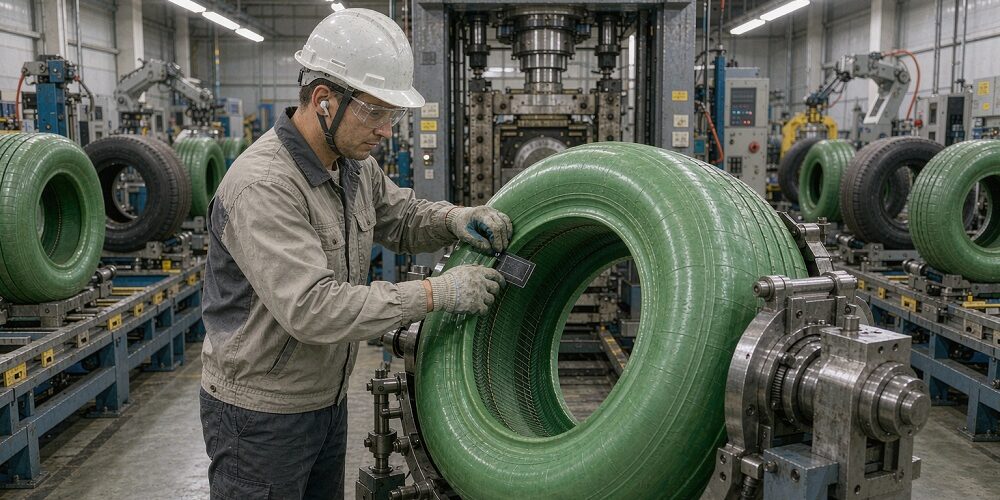
RFIDHY is a leading manufacturer of embedded RFID tire tags that engineers three distinct mounting methods — sidewall, bead, and fully vulcanization-embedded — so tire OEMs, retreaders, and fleet operators can place a permanent, machine-readable identity exactly where their process and lifecycle tracking need it. Choosing between these positions is not cosmetic: it changes read reliability, production speed, and how long the tag survives on the tire.
How the Three Mounting Positions Differ
All three approaches use the same passive UHF EPC Gen2 (ISO 18000-6C) inlay operating in the 860–960 MHz band, but they differ in where the tag lives inside or on the tire and how it is applied. Sidewall tags are surface-applied patches bonded to the outer sidewall rubber. Bead-mounted tags sit near the tire bead and rim seat, often tucked against the wheel. Embedded tags are placed into the green tire before the curing press and become part of the rubber structure, surviving the roughly 200C vulcanization cycle. The right choice depends on whether you prioritize fast application, protection from abuse, or a permanent identity that outlives retreading.
Sidewall: Applied After Cure, Read Without Lifting
The sidewall method bonds a flexible RFID label to the outer sidewall after the tire is built and cured. Because the sidewall faces outward, a handheld or fixed reader can capture the EPC code without demounting the wheel, which makes it popular for fleet tagging and tire inventory management at depots. Application is fast — often a few seconds per tire with an automated applicator — and it works on tires already in service, so it is the default for retrofit programs.
Bead: Tucked Against the Rim for Protection
Bead-mounted tags are positioned at the inner bead area, sheltered by the wheel and rim. This protects the inlay from curb scuffs and road debris that would otherwise wear a sidewall patch. The trade-off is access: reading a bead tag usually requires the wheel to be off or a reader placed at the bead gap. It is a common choice for aftermarket fleet and asset programs where the tag must stay hidden but durable through harsh duty cycles.
מוטבעים: Bonded Into the Rubber at the Press
מוטבעים (vulcanization-embedded) tags are inserted into the green tire before curing, so the rubber flows around the inlay and locks it in place. Built around a temperature-rated IC and a heat-stable antenna substrate, the tag tolerates the full 140–200C curing profile and continues through decades of rolling heat and retreading. This is the only method that gives a single permanent identity from the factory through multiple retread cycles. שלנו vulcanization-embedded RFID tire tag guide covers the inlay and curing qualification in detail.
Sidewall vs Bead vs Embedded: A Practical Comparison
The summary below shows where each method fits. Sidewall wins on read convenience and retrofit speed; bead wins on abrasion protection; embedded wins on permanence and total lifecycle coverage. No single position is best for every program — the decision should follow your read environment and how many times the tire will be retreaded.
- Sidewall — fastest to apply, scannable without demounting, but exposed to curb and abrasion damage.
- Bead — protected by the wheel, durable for fleets, but harder to read without wheel removal.
- מוטבעים — permanent from factory through retreading, survives 200C cure, but requires integration at the building stage.
Choosing by Use Case: יצרן ציוד מקורי (, Fleet, and Retread
For tire OEMs building new tires, embedded tagging at the press delivers the strongest identity for traceability and future Digital Product Passport (DPP) requirements, because the EPC is locked to the casing before it leaves the factory. שלנו tire traceability solution explains how the EPC links to batch, חומר, and test data. For fleets retrofitting existing tires, sidewall or bead mounting is faster because it avoids touching the manufacturing line. Retreaders benefit most from embedded tags, since the same inlay carries through buffing and the new tread, keeping one identity across the tire’s whole life. את heat-resistant 200C tag is the foundation that makes embedded mounting viable through cure and retread.
תאימות, DPP, and the Data the Tag Carries
Under the EU Ecodesign for Sustainable Products Regulation (ESPR) and the emerging tire Digital Product Passport, a durable on-tire identity is becoming a practical prerequisite for compliance. The tag itself stores an EPC serial that points to a record — material composition, plant, תאריך, and test results — which a DPP system can surface. RFIDHY builds tags to UHF EPC Gen2 so the same serial works on production lines, at warehouse gates, and in field readers. Exact EU DPP Registry obligations and timelines are still evolving as of 2026; buyers should verify against latest official guidance before finalizing an architecture. A plain overview is in our tire DPP digital product passport article. For the broader RFIDHY product range and OEM program, see rfidtaghy.com.
Frequently Asked Questions
Which RFID tire tag position is best for fleet tracking?
For fleets tagging tires already in service, sidewall mounting is usually fastest and easiest to read without demounting, while bead mounting adds abrasion protection when wheels are frequently curbed. Embedded is best when tires are sourced new with factory tagging.
Do embedded RFID tire tags survive the curing heat?
כן. RFIDHY’s embedded tags use a temperature-rated IC and heat-stable antenna substrate qualified for the 140–200C vulcanization band, and they keep read performance after the press and through retreading.
Can I add RFID to tires after they are made?
כן. Sidewall and bead mounting are applied after cure, so existing tires in a fleet or depot can be tagged without returning them to the factory building line.
Does the tag help with EU tire DPP compliance?
It provides the durable on-tire identity a DPP assumes, but the exact EU DPP Registry requirements are still developing as of 2026; verify against latest official guidance when designing your system.
What frequency and standard do RFIDHY tire tags use?
They use passive UHF EPC Gen2 (ISO 18000-6C) in the 860–960 MHz band, giving multi-meter read range on lines and at RFID gates.