Why Wash Resistance Matters in Industrial Laundry Management
In high-volume linen operations — from hospital surgical gowns to luxury hotel towels — RFID tags must survive repeated exposure to hot water (up to 95°C), aggressive detergents, bleach, centrifugal force, and ironing. Standard RFID labels fail after 20–50 cycles, causing data gaps, manual reconciliation, and operational inefficiency. True industrial laundry management demands a washable RFID tag certified for long-term durability.
Engineering for 500+ Wash Cycles: Three Critical Design Factors
1. Encapsulation Material: PPS/PPE vs. Silicone vs. Polyester
RFIDHY’s PPS/PPE RFID tags offer superior thermal stability and chemical resistance compared to silicone or standard polyester. These thermoplastic materials retain dimensional integrity and protect the embedded UHF inlay across repeated autoclave-grade washes.
2. Antenna Integration: Seam-Embedded vs. Surface-Mounted
Seam-embedded antennas eliminate abrasion points. שלנו RFID textile laundry tags use laser-welded conductive threads bonded directly into fabric weaves — preventing delamination and ensuring stable impedance over time.
3. Chip Selection & כוונון: UHF Gen2v2 for Robust Read Performance
We deploy EPC Class-1 Generation-2v2 chips with extended memory and enhanced anti-collision protocols. כל laundry RFID tag undergoes individual RF tuning post-encapsulation to maintain optimal coupling with industrial UHF readers — even after 500+ מחזורים.
Validated Performance Across Real-World Environments
Independent lab testing (ISO/IEC 18046-3) confirms consistent read range (>6 m with fixed reader) and error-free encoding after 520 wash cycles at 95°C, pH 11.5, ו 1,200 rpm spin speed. Hospital linen suppliers report zero tag failure over 18 months of daily use — directly improving textile RFID tracking accuracy and reducing replacement costs by 73% year-on-year.
Integration Best Practices for Maximum ROI
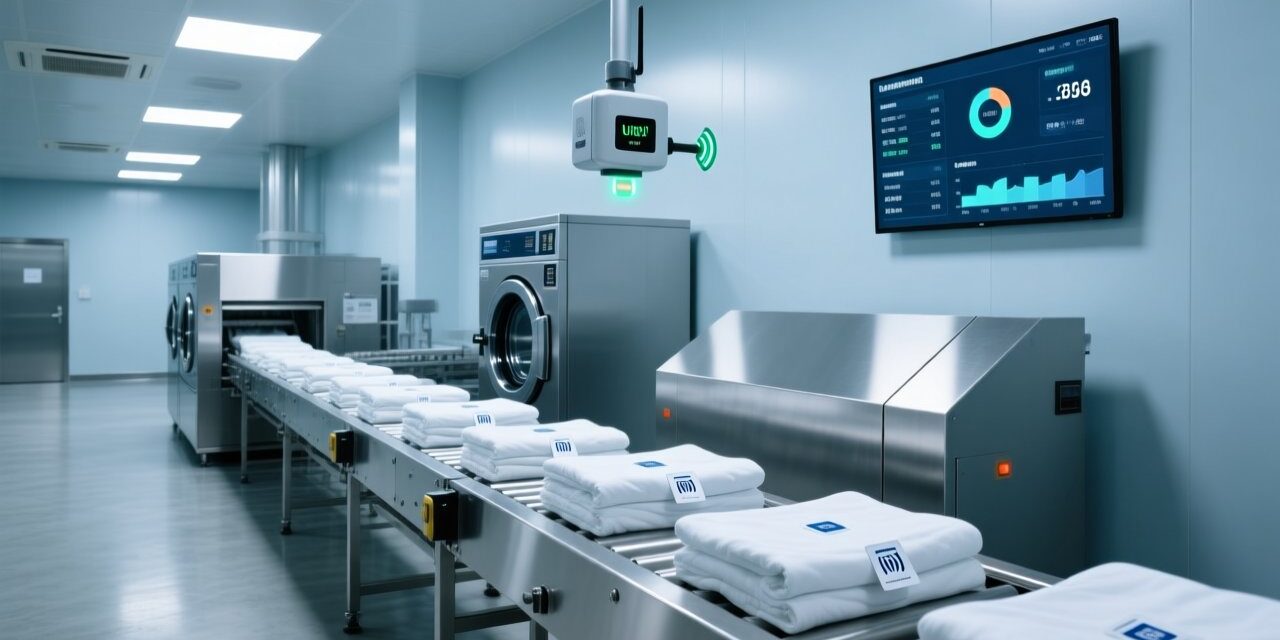
- Pair tags with ruggedized handheld RFID scanners for on-site sorting
- Deploy fixed readers at tunnel washer inlets/outlets and folding stations
- Integrate tag data with existing ERP or laundry management software via REST API
Frequently Asked Questions
- What is the difference between a standard RFID tag and a washable RFID tag?
- A washable RFID tag uses chemically inert encapsulation (e.g., PPS/PPE), seam-integrated antennas, and industrial-grade chips — all validated for repeated exposure to heat, alkali, and mechanical stress. Standard RFID labels lack these protections and typically fail before 50 מחזורים.
- Can laundry RFID tags be sewn directly into garments?
- כן. שלנו RFID silicone laundry tags and textile-embedded variants support machine sewing without compromising RF performance or durability.
- Do these tags work with existing UHF RFID readers?
- Yes — all comply with EPCglobal UHF Gen2v2 standards and operate seamlessly with fixed, כף יד, and portal-based RFID reader modules.
Ready to Upgrade Your Linen Tracking System?
Request a free sample kit of our 500-cycle textile laundry RFID tags, including technical specs, wash-test reports, and integration guidance.