
מבוא
The retail sector faces an ongoing battle with inventory accuracy: global stockouts cost an estimated $1.1 trillion annually, while overstocks tie up working capital. ב 2026, the convergence of artificial intelligence (ב.א.) ו תגי RFID is no longer a pilot experiment but a proven strategy for achieving near-perfect inventory visibility and predictive replenishment. This article provides a practical, data-driven look at how machine learning-driven inventory forecasting combined with passive UHF RFID infrastructure is reshaping retail operations.
Industry Background: The AI Drive in Retail
Retailers have long relied on historical sales data and rule-based systems for inventory planning. עם זאת, demand volatility, omnichannel fulfillment, and consumer expectations for instant availability demand a smarter approach. AI models—from gradient boosting to deep learning—now ingest point-of-sale data, weather patterns, social media trends, and real-time shelf-level data to forecast demand with granularity down to the SKU-store-hour level. Industry surveys indicate that retailers adopting AI-driven forecasting reduce forecast errors by 20–50%, directly lowering safety stock needs.
Simultaneously, RFID adoption has matured. The latest RAIN RFID (UHF) tags are low-cost, high-performance, and capable of reading hundreds of items per second without line-of-sight. When AI and RFID are combined, the result is a continuous learning loop: RFID captures live inventory movements, and AI refines its models to optimize order quantities and placement.
How RFID Enhances Data Capture for AI Models
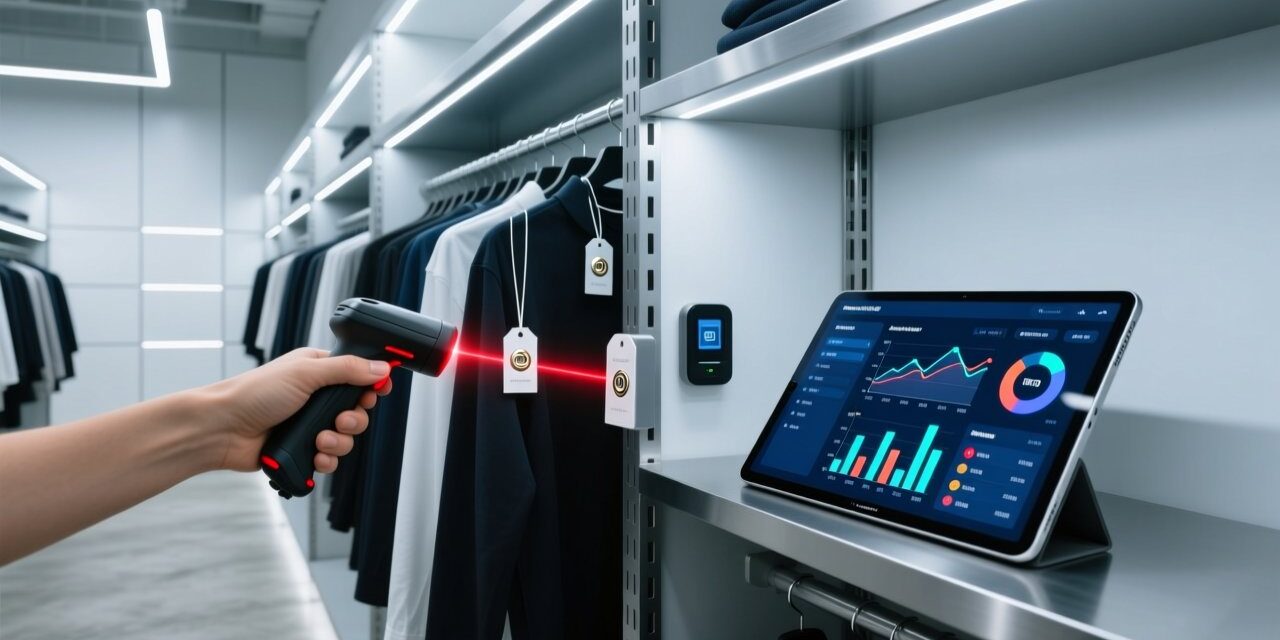
Machine learning algorithms are only as good as the data they consume. Traditional cycle counts or barcode scans provide snapshots at intervals, leaving blind spots between inventories. Fixed RFID readers installed at entry points, backroom receiving docks, and smart shelves can automatically identify every tagged item as it moves into the sales floor or is purchased. A handheld RFID scanner enables rapid cycle counts, scanning an entire aisle in minutes.
This continuous stream of stock events feeds the AI forecasting engine with real-time sell-through rates, stock-to-sales ratios, and dwell-time analytics. AI then detects patterns—such as regional demand shifts for a product category—and automatically adjusts distribution center allocations. The result: fewer out-of-stocks and less discount-driven excess clearance.
Machine Learning-Driven Inventory Forecasting with RFID
At the core of the AI+RFID synergy is a multi-layer modeling approach:
- Demand Sensing: Short-term (1–7 day) forecasts using real-time RFID sales signals, promotional calendars, and local events.
- Inventory Optimization: Reinforcement learning models that balance holding costs vs. stockout risk, recomputing safety stock levels daily.
- Anomaly Detection: RFID data reveals shrinkage, misplacement, or process bottlenecks. AI flags unusual inventory turns, enabling proactive intervention.
- Assortment Planning: Clustering algorithms identify store-level demand affinities and suggest local assortment adjustments based on RFID-tracked sell-through.
מבחינה טכנית, these models often run on cloud or edge platforms, ingesting RFID event streams via middleware such as LLRP protocols. Integration with ERP and WMS systems is achieved through REST APIs or message queues like Kafka, ensuring data freshness under five minutes.
Key Technical Specifications and Considerations
RFID Tag Selection for Retail
For apparel and general merchandise, UHF passive RFID inlays compliant with ISO 18000-6C (EPC Gen2) are the standard. Tag memory must support at least 96-bit EPC for unique item identification; many retailers now opt for 128-bit with TID authentication. On-metal items require specialized tags with ferrite backing. Tag read range should be ≥6m in open air, with reliable reads in dense stacks. Partner with a provider offering laundry RFID tags and retail-formatted labels for ease of integration.
Reader Infrastructure
A typical mid-size store may deploy 2–4 fixed overhead UHF readers at receiving, point-of-sale, and exit gates, complemented by a handheld RFID scanner for cycle counts. Fixed readers should have 4-port antenna connections to cover multiple zones. Reader sensitivity of -80 dBm and fast read rates (≥400 tags/sec) are critical. Integration with AI platforms typically uses MQTT or HTTPS streaming to a cloud analytics service.
AI Platform Requirements
The forecasting engine should support time-series models (ARIMA, Prophet), gradient boosting (XGBoost, LightGBM), and deep learning (LSTM, Transformer) for diverse inventory categories. Data pipeline latency must be under 10 minutes from RFID read to dashboard update. Look for platforms offering pre-built connectors for major ERP/WMS systems and support for edge inferencing to reduce cloud dependency.
Practical Deployment and Selection Tips
- Start with a pilot category: Choose a high-turnover, high-value segment (e.g., apparel) to demonstrate ROI before scaling to all SKUs.
- Ensure tag consistency: Work with suppliers to encode EPCs per GS1’s SGTIN-96 standard to avoid data silos.
- Invest in change management: Train store associates to trust RFID-based inventory positions and AI-generated replenishment suggestions.
- Choose an integrated partner: Opt for a vendor that provides both RFID hardware and AI middleware to minimize integration friction.
- Monitor data quality KPIs: Track read rate (>99.5%), tag-to-item association accuracy, and forecast bias continuously.
- Plan for scalability: Ensure the AI model can handle SKU volume growth and seasonal spikes without retraining delays.
The convergence of AI and RFID in retail is not a futuristic concept—it is the operational backbone for competitive advantage in 2026. By combining continuous, item-level visibility with predictive machine learning, retailers can achieve the Holy Grail of inventory management: the right product, at the right place, at the right time, with optimal capital efficiency.
FAQ
- How does AI improve RFID inventory accuracy?
- AI algorithms cross-reference RFID capture data with POS, returns, and shipment data to detect inconsistencies, correct ghost inventory, and predict future demand. This can lift inventory accuracy from ~65% with manual counts to >98% with AI-augmented RFID.
- What type of RFID tags are best for retail inventory management?
- UHF passive RAIN RFID tags, preferably apparel-grade wet inlays with clear adhesive for soft goods, and on-metal tags for electronics or hardlines. Look for ISO 18000-6C compliance and EPC Gen2 V2 for enhanced security.
- Can AI forecasting integrate with existing ERP and POS systems?
- כן. Most AI inventory platforms offer pre-built connectors for SAP, אורקל, Microsoft Dynamics, and major POS solutions. RFID middleware typically exposes REST APIs or event streams for seamless data ingestion.
- What is the typical ROI timeline for an AI+RFID retail project?
- Pilot projects often break even within 6–9 months through reduced labor for counts, lower markdowns, and fewer lost sales. Full-chain rollout ROI is typically achieved in 12–18 months, depending on store count.
- How do I handle data privacy with item-level RFID tracking?
- EPC data alone is pseudonymous and linkable only to a product SKU, not an individual. Secure EPC with TID authentication and ensure the reader zone boundaries respect customer privacy; tags are typically disabled at the point-of-sale via kill command or EPC rewriting.
Ready to pioneer AI-powered RFID inventory management in your retail chain? RFIDHY combines deep RFID hardware expertise with integration-ready AI middleware. Our team will help you select the optimal תגי RFID, handheld RFID scanners, and fixed readers tailored to your store format, and guide you through a high-ROI pilot.
Contact our team today for a confidential consultation and discover how machine learning + RFID can transform your inventory performance in 2026.