
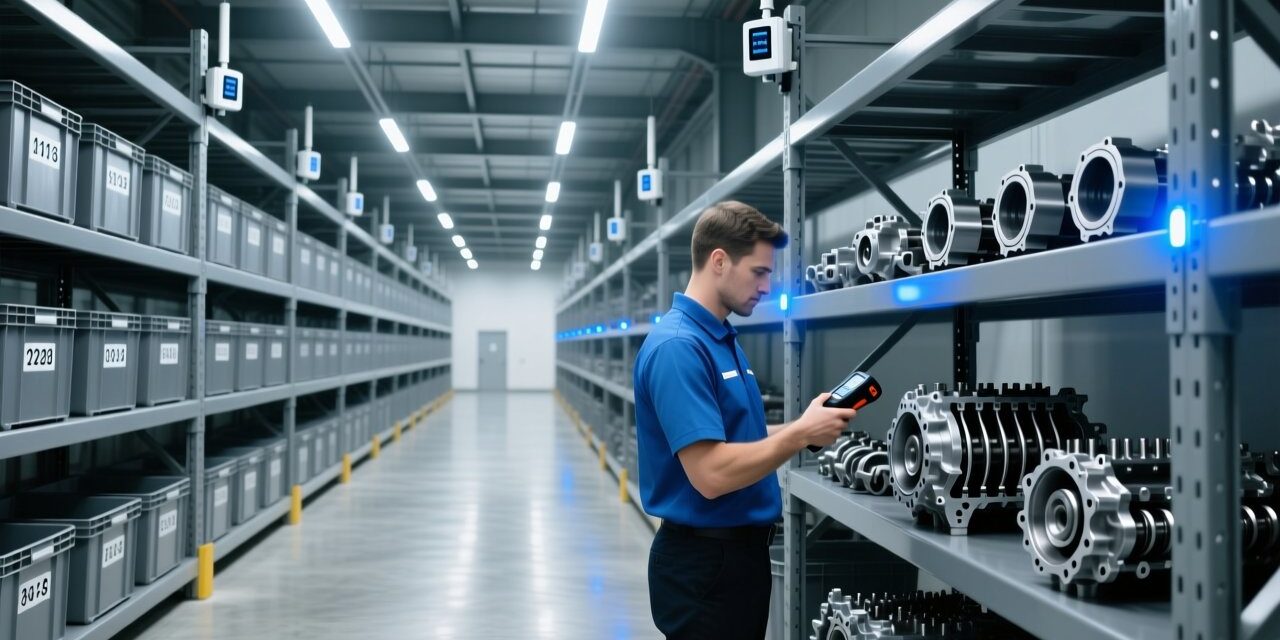
The Quest for Leaner Inventory in Germany’s Automotive Heartland
Germany’s automotive sector—anchored by global OEMs and thousands of Mittelstand suppliers—operates under relentless pressure to cut costs, accelerate throughput, and guarantee parts availability. Within the warehouse, one persistent bottleneck has been manual inventory counting: a time-consuming, error-prone ritual that can devour eight or more hours of skilled labor every cycle. For a typical medium-sized supplier of engine components, suspension parts, or electronic control units, this meant halting operations, deploying teams with clipboards and barcode scanners, and still facing discrepancies that rippled into production delays.
Hoy, a new breed of auto parts RFID tracking is rewriting those rules. By adopting passive Etiquetas RFID UHF and intelligent read points, a German automotive supplier has compressed its full warehouse count from a full working day to under half an hour—while pushing accuracy above 99%. This article unpacks the technical blueprint behind that transformation, rooted firmly in Industry 4.0 RFID warehouse principles, and offers practical guidance for any Mittelstand operation ready to modernize.
The Inventory Count Bottleneck: 8 Hours of Manual Drains
Before RFID, the supplier’s inventory routine looked familiar to many. Twice a month, line workers manually scanned barcodes on thousands of metal bins, wire racks, and plastic totes spread across 5,000 m² of warehouse space. Each scan required line-of-sight alignment, often meaning awkward crouching or climbing. Night shifts were sometimes needed to avoid disrupting day-time picking. The cumulative waste was staggering: on a good day, 7–8 hours for a full count; on a bad day, 10 hours with interruptions, data-entry mistakes, and re-counts.
Beyond labor cost, inaccuracies crept in. A single missed bin of high-value machined castings could trigger a false urgent reorder, tying up capital and floor space. The team knew that the manual process was the weak link in their digital supply chain—a stark contrast to the precision engineered into the parts themselves.
The UHF RFID Solution: How 30-Minute Counts Became Reality
The supplier deployed a comprehensive supplier inventory count RFID system built on three components:
- On-metal UHF RFID tags affixed to every bin, pallet, and high-value assembly. Because most automotive parts are metallic or stored near metal, standard labels fail. The chosen tamper proof flexible UHF RFID on-metal tags deliver consistent reads despite steel shelving and engine blocks.
- Fixed RFID readers mounted at warehouse entry/exit zones and choke points. A four-port industrial-grade UHF RFID reader captures tagged items automatically as they move through narrow aisles, sin intervención manual.
- Handheld RFID scanners for spot checks and hard-to-reach areas. Operators simply walk through aisles; un handheld RFID scanner reads dozens of tags simultaneously, completing an area that once took 45 minutes in just 90 segundos.
The magic is in bulk reading. Unlike barcodes, UHF RFID can interrogate hundreds of UHF RFID inlays per second from distances up to 10 metros. The system links each tag’s unique ID to the ERP, updating stock levels in real time. A full warehouse count now involves a single operator walking the floor with a handheld for about 20 minutos, plus a fixed reader gate sweep for any missed items—totaling 30 minutes end-to-end.
Technical Specifications and Key Considerations
Replicating this german automotive RFID case demands careful component selection and tuning. Here are the core specifications that matter:
Tag Performance on Metal and Mixed Materials
Automotive warehouses are hostile to RF. Metal reflects and detunes antenna signals; fluids in hydraulic parts add loss. The supplier standardized on UHF on-metal RFID tags with a foam or ceramic spacer layer, achieving read ranges of 4–6 meters even when attached directly to aluminum housings. Tags were selected with Impinj Monza R6 or NXP UCODE 8 chips for high sensitivity and fast read rates. For plastic containers and cardboard cartons, more economical UHF RFID stickers sufficed.
Reader and Antenna Configuration
Fixed readers were paired with circularly polarized RFID antennas (9 dBi) to create wide, overlapping read zones at dock doors and conveyor belts. A single fixed RFID reader supports up to four antennas, enabling cost-effective coverage of multiple lanes. Power levels were carefully throttled to avoid cross-reads from neighboring areas—a critical step in dense environments.
Software Integration and Industry 4.0 Conectividad
The RFID middleware, integrated via REST APIs, pushes tag data into the existing SAP ERP system. Event-based triggers automatically update inventory counts, generate replenishment alerts, and log dwell times. Esto industria 4 0 rfid warehouse architecture turns raw reads into actionable data—exactly what German Mittelstand companies demand to scale without adding headcount.
Practical Deployment Tips: From Pilot to Full Rollout
Based on dozens of similar deployments, the supplier followed a phased approach that minimizes risk:
- Start with a pilot zone. Choose a single product family or rack row. Test multiple Etiquetas RFID and placements to find the sweet spot for read reliability. Document read rates; aim for >99.5% in production.
- Optimize tag attachment. Para recipientes metálicos, use adhesive-backed on-metal tags with a rigid backing that withstands vibration. For reusable containers, consider riveted or tie-wrapped tags to survive washdowns.
- Calibrate reader settings. Adjust RF output, session parameters, and read modes to balance speed vs. precisión. In dense environments, use Gen2 select commands to filter only relevant tags.
- Train operators. Even with automation, operators need to understand orientation effects. A quick “tag facing the reader” guideline prevents false misses.
- Integrate early with IT. Involve ERP teams from day one. The middleware should mirror the existing location hierarchy (warehouse → zone → bin) to make stock updates intuitive.
Measured Results and ROI
While this case reflects a typical German supplier inventory count RFID implementation, the numbers align with published industry benchmarks and our own project data:
| Métrico | Before RFID | Después de RFID |
|---|---|---|
| Full warehouse count time | 8 horas (2 workers) | 0.5 horas (1 worker) |
| Precisión del inventario | 92–95% | 99.2–99.8% |
| Labor cost per count | €320–€400 | €40–€60 |
| Stock-out incidents (monthly) | 8–12 | <1 |
| Time to locate missing items | 25 min average | 2 min (via geiger search) |
The return on investment arrived in under 10 meses, primarily from labor savings and avoided production stoppages. Perhaps more importantly, the reliability of data now feeds a digital twin of the warehouse, enabling predictive replenishment and just-in-sequence deliveries to the assembly line.
Why This Matters for the German Mittelstand
Germany’s automotive supply chain is a network of highly specialized, often family-owned enterprises. These German Mittelstand RFID success stories are increasingly visible as Industry 4.0 moves from concept to shop floor. The ability to implement auto parts RFID tracking without a complete IT overhaul makes UHF RFID accessible to suppliers of all sizes. Solutions like those from RFIDHY bridge the gap between high-tech and practical day-to-day use.
For more insights on RFID in logistics, read our earlier analysis on UHF RFID in North American Logistics: Pallet-to-Parcel Tracking Strategy and see how similar principles scale across continents.
Preguntas más frecuentes
Can UHF RFID tags work on all types of automotive parts?
Sí, provided the correct tag is chosen. For metal components, on-metal RFID tags with a spacer layer are essential. Plastic and rubber parts may use standard adhesive UHF RFID stickers. It’s crucial to test tag placement on the actual part and packaging to guarantee consistent read performance.
What is the typical read range for UHF RFID in a warehouse?
With a fixed reader and 9 dBi antenna, on-metal tags can be read from 4–8 meters. Handheld scanners typically achieve 3–5 meters in dense racking. The range can be tuned by adjusting RF power to fit the specific aisle width and avoid stray reads.
How does RFID inventory tracking integrate with my existing ERP?
RFID middleware typically communicates via standard APIs (REST/SOAP) or database connectors. It translates raw tag reads into logical inventory transactions—stock in/out, location change, quantity adjustment—and pushes them to the ERP in real time. Most modern systems offer pre-built connectors for SAP, Microsoft Dynamics, and other common platforms.
Is RFID suitable for small warehouses or only large distribution centers?
Absolutely suitable for both. The cost of entry has fallen dramatically. A small warehouse can start with a single handheld RFID reader and a few hundred tags, achieving a full count in minutes and paying back the investment within a few inventory cycles. Scalability is inherent: you can add fixed readers as operations grow.
How durable are RFID tags in an automotive environment?
Industrial-grade on-metal tags are designed to withstand vibration, temperature swings (–40°C to +85°C), and exposure to oils and coolants. Many carry IP68 ratings. For the harshest conditions, warehousing-tested RFID tags with ceramic or PPS housings are available.
Ready to cut your inventory count time by 90%?
Discover how RFIDHY’s certified UHF RFID solutions can transform your automotive parts warehouse—from tag selection to system integration—all backed by German-level engineering support. Talk to our experts today and get a customized quote for your operation.