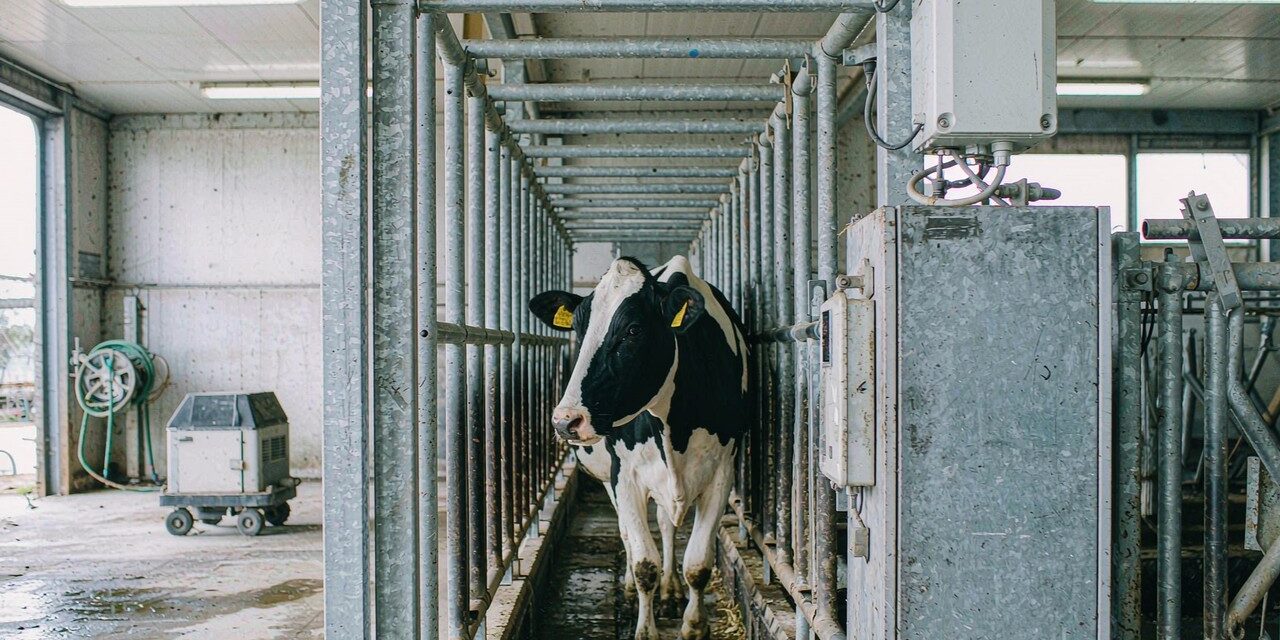
Barn robots, automated sorting gates and AI monitoring systems all need one thing before they can do useful work: a reliable way to answer “which animal is this?”. RFID provides that answer. This guide sets out the four layers of an automated livestock identification stack, how to choose the right frequency for each reading point, and the integration checks that prevent a pilot from stalling after the hardware is installed.
The topic is timely because EuroTier 2026 runs under the guiding theme “Intelligence in animal farming”, which explicitly connects barn, Fütterung, milking and logistics technology with robotics, sensor technology, artificial intelligence and big data. Our companion article, RFID animal identification at EuroTier 2026, covers the exhibition context; this one goes deeper into the engineering.
Automation is already on the award list
The official Innovation Award EuroTier 2026 winners list is a practical indicator of where the industry is investing. Among the recognised systems are the Pig-Barn-Cleaner (Peter Prinzing), described by DLG as an autonomous, fully automatic pen-cleaning system; the MS Smart Cleaning Robot (MS Schippers); the Smart Farrowing Pen (WEDA with VetVise), which adjusts piglet nest temperature and feed curves from real-time behaviour analysis; SmartCalving (Lock with smaXtec), which adjusts barn climate when sensors detect imminent calving; and RoBooVaxx (Obuda University), a robotic cow vaccination system whose official description notes that an operator must find an injection site on each individual animal.
Every one of these systems produces or consumes animal-level events. A robot that vaccinates, a gate that sorts and a camera that flags a health event all need to write to the correct animal record. That is the identification layer’s job.
Four layers, one common weak link
| Layer | Funktion | Typical failure |
|---|---|---|
| 1. Identität | A unique, durable ID attached to the animal — usually an RFID ear tag or an injectable microchip | Tag loss, duplicate codes, or a standard the rest of the stack cannot read |
| 2. Capture | Handheld, fixed portal, chute or parlour reader converts the ID into a digital event | Read gaps caused by antenna geometry, Metall, moisture or animal speed |
| 3. Edge / Middleware | Timestamps, de-duplicates and maps the ID to the farm software’s animal record | ID formats that do not match existing records, or clock drift between systems |
| 4. Anwendung | Feeding, health, Sortieren, milking and compliance workflows act on the event | Correct data attached to the wrong animal — the most expensive failure |
Layer 1 is the cheapest to install and the hardest to change. Once a herd is tagged, migrating to a different coding scheme means re-tagging animals, re-mapping records and re-validating compliance evidence. This is why the frequency decision should be made from the reading scenario backwards, not from unit price.
Match the frequency to the reading point
| Szenario | Practical choice | Reference standard | Trade-off |
|---|---|---|---|
| Statutory individual ID, treatment at chute, close handheld scan | LF 134.2 kHz (FDX-B / HDX) | ISO 11784 / ISO 11785 | One animal at a time; see our note on 134.2 kHz LF ear tags for cattle and pig lifecycle tracking |
| Close-range data capture, laboratory and small-animal workflows | HF 13.56 MHz | ISO 15693 | Short read range |
| Gate portals, automated sorting, bulk pen reads, robot hand-off points | UHF (865–868 MHz in Europe) | ISO 18000-6C / EPC Gen2; ETSI EN 302 208 in Europe | Longer range and bulk reading, but more sensitive to installation geometry; see UHF ear tag reading |
Hinweis: this is a selection aid, not a regulatory ruling. Permitted frequencies and mandatory identification rules vary by country and species; confirm them with the local authority or your system integrator before specifying hardware.
A mixed architecture is common: LF tags for statutory identification plus UHF infrastructure for automated bulk reading, with middleware reconciling both ID sources. Where only close-range capture is required, compact units such as the HY280 animal RFID reader or the HY-R206 animal reader are typical field tools; for implantable tags, die HY-PT200 PIT tag reader covers the capture side.
Integration checklist before you sign off a pilot
- Write the event contract. For each automated action, define the fields the robot or application needs: Tier-ID, timestamp, location/reader ID, event type, and operator or system source.
- Test at the real reading point. Read rates measured on a bench do not survive a wet chute, a metal gate or a moving group of animals. Test at the actual angle, distance and speed.
- Reconcile ID formats. Confirm how the tag code is represented in the farm software, including country and herd prefixes, and de-duplicate repeated reads within a time window.
- Synchronise clocks. Sensor events, reader events and video must share a time base, or correlation becomes guesswork.
- Define the exception path. Decide what happens on a missing read: manual scan, quarantine flag, or retry. Most failed pilots fail here, not at the reader.
- Scale from one controlled point. The phased approach in how to deploy RFID on your farm applies to robotics projects as much as to standalone traceability.
Three failure modes worth budgeting for
- Geometry: UHF portals need antenna placement matched to animal flow. A 99% bench read rate can collapse at a gate where animals turn sideways.
- Identity drift: camera-based systems may infer identity from position or appearance. Without a physical ID, that inference is hard to audit during an export or health inspection.
- Data islands: a robot vendor’s dashboard that cannot export events to the farm management system creates a second source of truth. Require an open event export before purchase.
Related RFIDHY resources
- RFID Animal Identification at EuroTier 2026 — exhibition context and buying checklist.
- Vieh & Pet ID solutions — full product overview.
- ICAR certification for animal ear tags — documentation for regulated projects.
Häufig gestellte Fragen
Why do barn robots need RFID if they already have cameras?
Cameras can detect behaviour and position, but an audit, a vaccination record or an export traceability file needs a durable identifier tied to the individual animal. RFID supplies that identifier independently of lighting, posture or camera angle.
Should I use LF or UHF for an automated sorting gate?
UHF is generally evaluated for gate and pen-level bulk reading because of its longer range and anti-collision capability, while LF 134.2 kHz remains the baseline for statutory individual identification in many markets. Many projects run both and reconcile IDs in middleware. Confirm local rules before specifying.
What is the most common cause of a failed RFID pilot?
Not the tag itself, but the hand-off between layers: ID format mismatches, unsynchronised timestamps, and undefined behaviour when a read is missed. Define the event contract and the exception path before installing antennas.
Can RFID data feed AI and farm management software directly?
Through middleware. The reader outputs an ID plus timestamp; middleware maps it to the animal record and publishes an event the application can consume. RFID is the identity layer, not the analytics layer.
Is this article about a specific EuroTier exhibitor?
Nein. It is an independent technical guide from RFIDHY. Company and product names are quoted from DLG’s public award list for context only; RFIDHY does not claim partnership with, or supply to, any of them.
Build the identity layer first
RFIDHY supplies RFID ear tags, animal microchips and compatible readers, and supports OEM/ODM specifications for integrators. Contact our team for samples, test reports and a frequency recommendation for your target market.
Sources
- EuroTier 2026 guiding theme: Intelligence in animal farming
- DLG — Innovation Award EuroTier 2026 winners
- EuroTier — The trade fair at a glance
Publisher’s note: exhibition and award facts are taken from the official EuroTier website on 11 November 2026. Standards and frequency information is general selection guidance, not legal or regulatory advice; confirm requirements for your country, species and supply chain before purchase.