
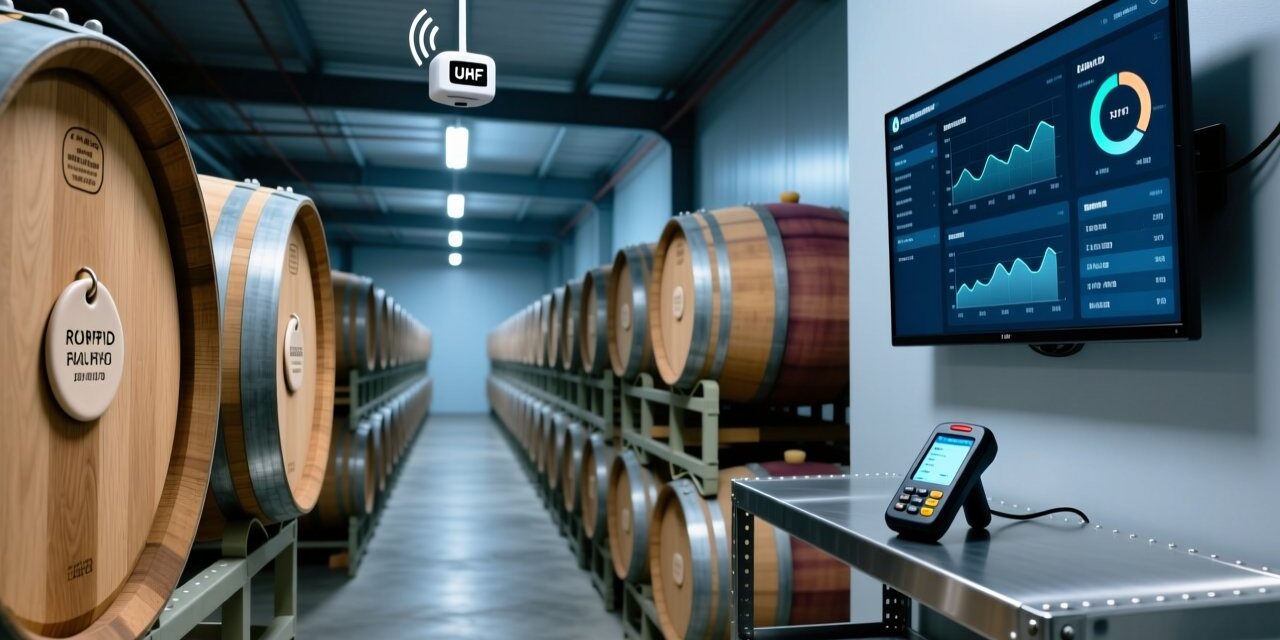
Streamlining Wine Production RFID Across South America’s Premium Vineyards
Winery operations managers in Mendoza and Colchagua face a common challenge: managing thousands of high-value oak barrels across multi-stage aging, blending, and export processes. Manual logbooks and barcode scans fail under humidity, label wear, and line-of-sight constraints—especially during cellar transfers or customs documentation. Passive RFID tags eliminate these bottlenecks by enabling bulk-read, non-contact identification of barrels—even when stacked or partially obscured.
Why UHF RFID Outperforms Legacy Systems in Winemaking
Unlike barcodes or HF RFID, UHF RFID tags deliver 8–12 meter read ranges, support simultaneous scanning of 200+ الأصول, and operate reliably in cold, humid, and ethanol-rich environments. For wine production RFID, this means one handheld scan can verify an entire rack of barrels before bottling—cutting verification time from 45 minutes to under 90 seconds per batch.
Barrel Management Tag Selection Criteria: rfid标签选型标准
Selecting the right RFID metal tag is critical for longevity and accuracy. Key criteria include:
- Encapsulation Material: Food-grade epoxy or ceramic housing (e.g., ceramic RFID tag) resists ethanol leaching and thermal shock during steam cleaning.
- طريقة التركيب: Screw-mounted or adhesive-backed on-metal tags ensure stability on curved stainless steel or oak surfaces.
- Chip Compatibility: Impinj Monza R6 or R8 chips provide superior memory (96–256 bits) for storing lot numbers, harvest dates, and cooperage data.
- Environmental Rating: IP68 certification guarantees operation at -20°C to +85°C—critical for Andean high-altitude cellars and coastal export hubs.
Real-World Deployment: From Vineyard to Port
In a recent pilot across three Argentine bodegas, RFIDHY deployed UHF RFID inlay stickers embedded into custom wooden barrel plaques. Each tag stores a unique EPC code linked to SAP S/4HANA via middleware. When barrels enter the bottling line, fixed RFID readers (UHF reader module) auto-log fill status, aging duration, and QC pass/fail flags—reducing export documentation delays by 70%.
Scalability for 3,000+ Barrels: Infrastructure Best Practices
For wineries managing 3,000+ barrels, we recommend a hybrid architecture: fixed readers at warehouse gates and bottling stations, supplemented by rugged handheld scanners for mobile audits. Antenna placement follows ISO/IEC 18000-63 beam optimization—ensuring consistent reads even in narrow, low-ceilinged aging rooms. All data flows into a cloud dashboard compatible with Microsoft Power BI, enabling real-time KPIs like average aging cycle time, barrel reuse rate, and vintage yield variance.
الأسئلة المتداولة
- Can RFID tags withstand long-term exposure to wine vapors?
Yes—ceramic and epoxy-encapsulated UHF RFID tags are chemically inert and rated for continuous ethanol vapor exposure up to 10 السنوات. - Do I need to replace my existing ERP system?
لا. RFIDHY’s middleware supports REST API and ODBC connectors for SAP, أوراكل, and Microsoft Dynamics—enabling plug-and-play integration without ERP upgrades. - How do you attach RFID tags to curved oak barrels?
We supply flexible on-metal labels with 3M VHB adhesive and custom-molded ceramic mounts designed for 120–300 mm barrel diameters. - Is RFID compliant with EU and Mercosur wine traceability regulations?
نعم. Our EPC Gen2v2-compliant tags meet ISO 22000 and MERCOSUR Resolution GMC No. 36/17 requirements for origin, عملية, and batch traceability.
Ready to Digitize Your Barrel Lifecycle?
Download our Wine Production RFID Implementation Playbook—including rfid标签选型标准 checklists, hardware compatibility matrices, and ROI calculators tailored for South American wineries. Then schedule a free technical consultation with our vineyard RFID specialists.