
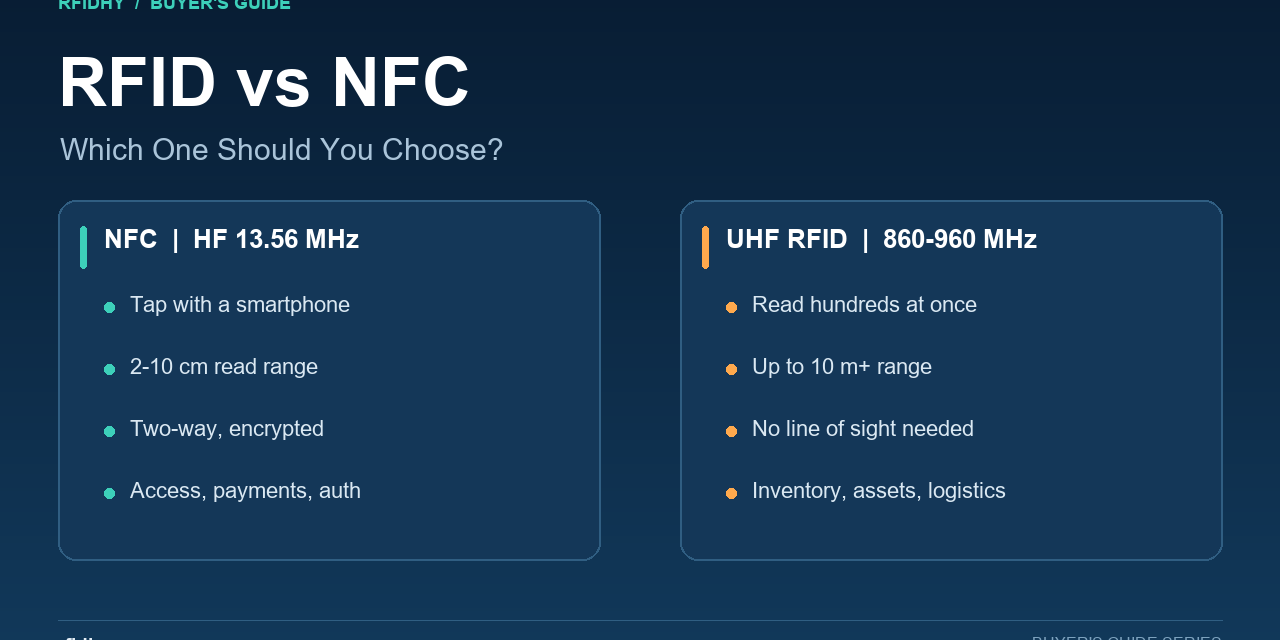
TL;DR — The short answer: NFC is not a rival technology to RFID; it is a subset of HF RFID built for very short-range, two-way, phone-native interactions (tap-to-pay, mobile access, مصادقة المنتج). “وتتفاعل” as a broader category also covers LF and long-range UHF used for inventory, النقل والإمداد, and asset tracking. Choose NFC when end users will tap with a phone or you need secure mobile credentials. Choose UHF RFID when you must read many items quickly from a distance — warehouses, gates, and asset tracking. Choose LF for animal ID and harsh legacy environments. Many real systems use both.
تحديد الترددات الراديوية (وتتفاعل) and near-field communication (نفك) are easy to confuse because both use radio waves and passive tags. But they solve different problems, and picking the wrong one can cost you a redesign. This guide breaks down how they work, where each wins, and how to choose for your project.
What Is RFID?
وتتفاعل (تعريف تردد الراديو) is an umbrella technology that uses electromagnetic fields to automatically identify objects via a reader and a tag. The tag harvests energy from the reader’s field — most tags need no battery. RFID is grouped by frequency:
- LF (التردد المنخفض, 125 كيلو هرتز): very short range (about 1–5 cm), وعره, common for animal ID and older access control.
- HF (عالية التردد, 13.56 CH4): range about 1–10 cm; this is the band NFC belongs to. Used for contactless cards, transit, و NFC.
- التردد فوق العالي (الترددات العالية جداً, 860–960 ميجاهرتز): range from under 1 m to about 10 m+ depending on tag, reader power, and environment; built to read hundreds of tags per second in a single pass. This is the workhorse of supply chain, retail inventory, and asset tracking.
What Is NFC?
نفك (قرب حقل الاتصالات) is a specialized branch of HF RFID at 13.56 CH4 designed for secure, two-way, very short-range communication (typically about 2–4 cm, up to about 10 سم). Its defining feature is that it is native to virtually every smartphone — no extra reader required. That makes it ideal for tap-to-pay and mobile access credentials, product authentication and anti-counterfeiting, smart posters and tap-to-share, and digital business cards.
NFC follows ISO/IEC 14443 و ISO/IEC 15693 (plus ISO/IEC 18092 for peer-to-peer), the same core air-interface standards as HF RFID.
RFID vs NFC: The Key Differences
| Aspect | نفك | وتتفاعل (العام) |
|---|---|---|
| Relationship | Subset of HF RFID (13.56 CH4) | Umbrella: LF, HF, التردد فوق العالي |
| التردد | 13.56 MHz only | LF 125 كيلو هرتز / HF 13.56 CH4 / UHF 860–960 MHz |
| Typical range | about 2–10 cm | LF 1–5 cm; HF 1–10 cm; UHF up to about 10 m+ |
| الاتصالات | Two-way (peer-to-peer capable) | Mostly one-way identification |
| Phone support | Built into iOS and Android natively | Needs a dedicated reader (except NFC) |
| الأمن | Often encrypted (AES/HCE, ديسفيري) | Depends on chip; UID-only LF can be cloned |
| Reads many at once | لا (one tap at a time) | UHF yes — hundreds/sec through a portal |
| Best for | Tap payments, mobile access, auth | المخزون, النقل والإمداد, long-range tracking |
| Cost | Slightly higher per tag for phone features | UHF inlays often lowest cost at volume |
How They Work — and Why NFC Is Really “HF RFID”
Every RFID and NFC system pairs a reader, هوائي, and a passive tag. The reader radiates a field; the tag powers its chip from that field and replies. NFC sits on the same 13.56 MHz HF foundation as HF RFID and shares the same standards — which is exactly why NFC is best understood as a consumer-friendly branch of HF RFID, not a separate technology. The practical split is range and interaction model: passive HF/NFC reads at roughly 1–10 cm and can exchange data both ways; passive UHF reads at meters and is built to identify masses of items in one pass.
When to Choose NFC
Choose NFC when the end user will interact by tapping with a phone: mobile access control (office, الفندق, smart building credentials), payments and transit (tap-to-pay cards and tickets), مصادقة المنتج (tap a product with a phone to verify authenticity), و tap-to-reorder / التعبئة والتغليف الذكية with no app or pairing required. If your use case depends on a smartphone being the reader, NFC is almost always the right call.
When to Choose Broader RFID (Especially UHF)
Choose UHF RFID when you need distance and throughput: warehouse and retail inventory (portal gates read pallets with no line of sight), تتبع الأصول (تكنولوجيا المعلومات, أدوات, returnable transport items, المركبات), long-range or hands-free access (vehicle gates, parking), و industrial and logistics where hundreds of tags must be read per second. اختر LF for animal ID, خدمهغسيل, and harsh environments. Many production sites run hybrid readers that accept NFC cards, LF tags, and UHF labels side by side.
A Practical Selection Checklist
- Will a phone be the reader? → NFC.
- Must you read many items fast from meters away? → UHF RFID.
- Single-item tap with high security? → NFC (encrypted DESFire/NTAG).
- Harsh environment / هوية الحيوان / legacy system? → LF.
- Budget at very high volume? → passive UHF inlays are usually cheapest per tag.
Unsure which fits? Tell a supplier your use case, حجم, and environment, and ask for a chip/frequency/format recommendation plus a sample. RFIDHY supplies NFC and RFID tags across LF/HF/UHF — see the links below.
RFIDHY’s RFID and NFC Product Lines
رفيدهي (شانغهاي رفيدهي التكنولوجيا. المحدودة, manufacturing since 1995) supplies NFC labels/cards, بطاقات RFID, inlays, العلامات, and reader modules across LF/HF/UHF, with ISO 9001 and IC certification. Clients listed on our site include Shanghai Metro, Hp, مطار فرنسا, مطار كندا, and Tongji University. Representative products:
- NFC stickers and cards: NFC RFID Sticker
- UHF anti-metal tags (industrial asset tracking): المضادة للمعادن RFID العلامة
- Embedded UHF tire tags (traceability/DPP): UHF الربيع الإطارات العلامة
- حول رفيدهي: Company profile and certifications
ملاحظه: specific read ranges, chip models, MOQ, and lead times for each product should be filled from the real product specs before publish.
الأسئلة المتداولة
Is NFC a type of RFID?
نعم. NFC is a specialized subset of HF RFID operating at 13.56 CH4, optimized for very short-range, two-way, phone-native interactions. All NFC is RFID, but not all RFID is NFC.
What is the main difference between RFID and NFC?
Range and interaction. NFC works at a few centimeters and supports two-way communication with a smartphone. Broader RFID (especially UHF) reads from meters away and is built to identify many tags at once, but typically needs a dedicated reader.
Can a smartphone read RFID?
A smartphone can read NFC (HF 13.56 CH4) tags natively. It cannot read LF or UHF RFID without an external reader accessory.
Which is more secure, RFID or NFC?
Security depends on the chip, not the category. NFC commonly uses encrypted chips (e.g., ديسفيري) with strong phone-side protection. Older UID-only LF/HF tags can be cloned, so choose encrypted chips for high-security use.
When should I choose NFC over RFID?
Choose NFC when end users will tap with a phone: mobile access, payments, مصادقة المنتج, and tap-to-share. For everything else requiring distance or bulk reads, choose UHF RFID.
When should I choose UHF RFID over NFC?
Choose UHF RFID for warehouse inventory, تتبع الأصول, vehicle gates, and any scenario where you must read hundreds of items per second from meters away without line of sight.
Can RFID and NFC be used together?
نعم. Many systems deploy hybrid readers that accept NFC credentials, LF tags, and UHF labels simultaneously — e.g., employees use NFC phones while contractors use RFID cards and assets carry UHF tags.
How do I choose the right tag for my project?
Match the technology to range, حجم, البيئه, and whether a phone is the reader (see the selection checklist above). Then confirm chip, التردد, المواد, and encoding with your supplier and test a sample in your real environment.