

Why smart warehouse equipment needs RFID integration?
Smart warehouse systems are changing the logistics industry, but equipment manufacturers face severe challenges:
- Inaccurate inventory: Manual inventory counting can lead to 5-10% inventory discrepancies, resulting in millions of dollars in losses each year.
- Labor-intensive workflow: Manual picking and replenishment consume 30-40% of operating budgets.
- Compliance risks: In regulated industries, untraceable items are not compliant with GDPR, FDA or GS1 standards.
RFID integration directly addresses the following pain points:
- Achieve 99.9% inventory accuracy with real-time RFID tracking.
- Reduce labor costs by 50% with automated inventory management.
- Ensure audit compliance with tamper-proof digital logs.
Your competitive advantage:
- Provide IoT-enabled warehouse equipment systems with embedded RFID.
- Become a leader in next-generation warehouse automation.
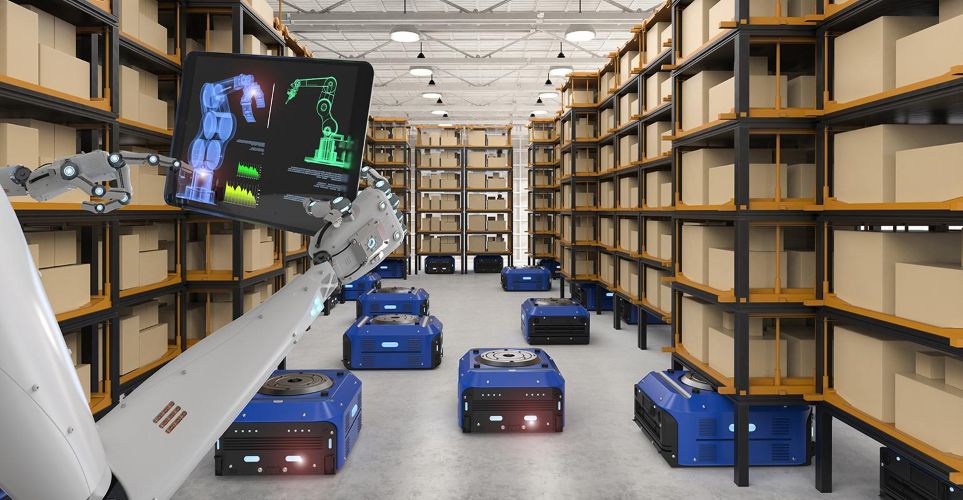
Warehouse challenges that RFID integration solves
1.Inventory blind spots and out-of-stocks
Problem: Traditional barcode systems miss 15-20% of items in densely packed shelves or low-light areas.
RFID solutions:
- Deploy علامات UHF RFID for batch scanning with a range of up to 10 متر.
- Automatically update inventory databases during AGV transport or drone flyovers.
2.Labor-intensive picking and replenishment
Problem: Manual picking errors cost more than $50,000 per year for a mid-sized warehouse.
حلول RFID:
- Equip AGVs with mobile RFID readers to automatically scan shelves during transport.
- Guide workers with a pick-to-light system equipped with RFID lights tags for error-free order fulfillment.
3.Compliance and traceability failures
Problem: In the pharmaceutical or food industry, lost batches lead to recalls and fines.
حلول RFID:
- Store expiration dates, batch IDs, and processing logs on high-memory tags.
- Sync data to WMS/ERP systems via RFID middleware (على سبيل المثال. Siemens RF650R).

How RFID integration with warehouses works:
1.Hardware setup:
- علامات RFID: Attached to pallets, cartons, or individual items (e.g., self-adhesive labels for boxes).
- القراء RFID: Fixed or mobile (mounted on AGVs).
- Warehouse controllers: Process RFID data via PLCs (e.g., Beckhoff CX9020) or cloud platforms.
2.Data Flow:
RFID readers scan tags during inventory movement (e.g., تلقي, picking, الشحن).
Data is transmitted to a central WMS/ERP system (e.g., SAP EWM) via an IoT gateway.
The system triggers the following actions:
- Automatic replenishment alerts for low-stock items.
- Fraud detection for unauthorized item removal.
3.Software Integration:
- Middleware: Siemens RF650R or PTC ThingWorx for real-time data synchronization.
- API: Custom scripts link RFID events to warehouse management dashboards.
[اتصل بنا]Get smart warehouse equipment integrated RFID solutions.
We can provide:
RFID integration services in smart warehouse systems
Best inventory tracking RFID tags our asset tracking solutions
UHF RFID systems for batch inventory scanning
Industrial RFID tags for harsh environments
الأسئلة المتداولة
Q: Can RFID tags be used on metal-intensive warehouse shelves?
A: نعم! We have anti-metal tags in different materials designed for reliable reading in different metal environments.
Q: How can RFID be retrofitted into existing warehouse systems?
A: Use a stick-and-go kit, such as the RFIDHY HY-R6100 handheld device, for seamless integration with traditional WMS.