1.What is an RFID Glass Tube Tag/Animal Microchip?
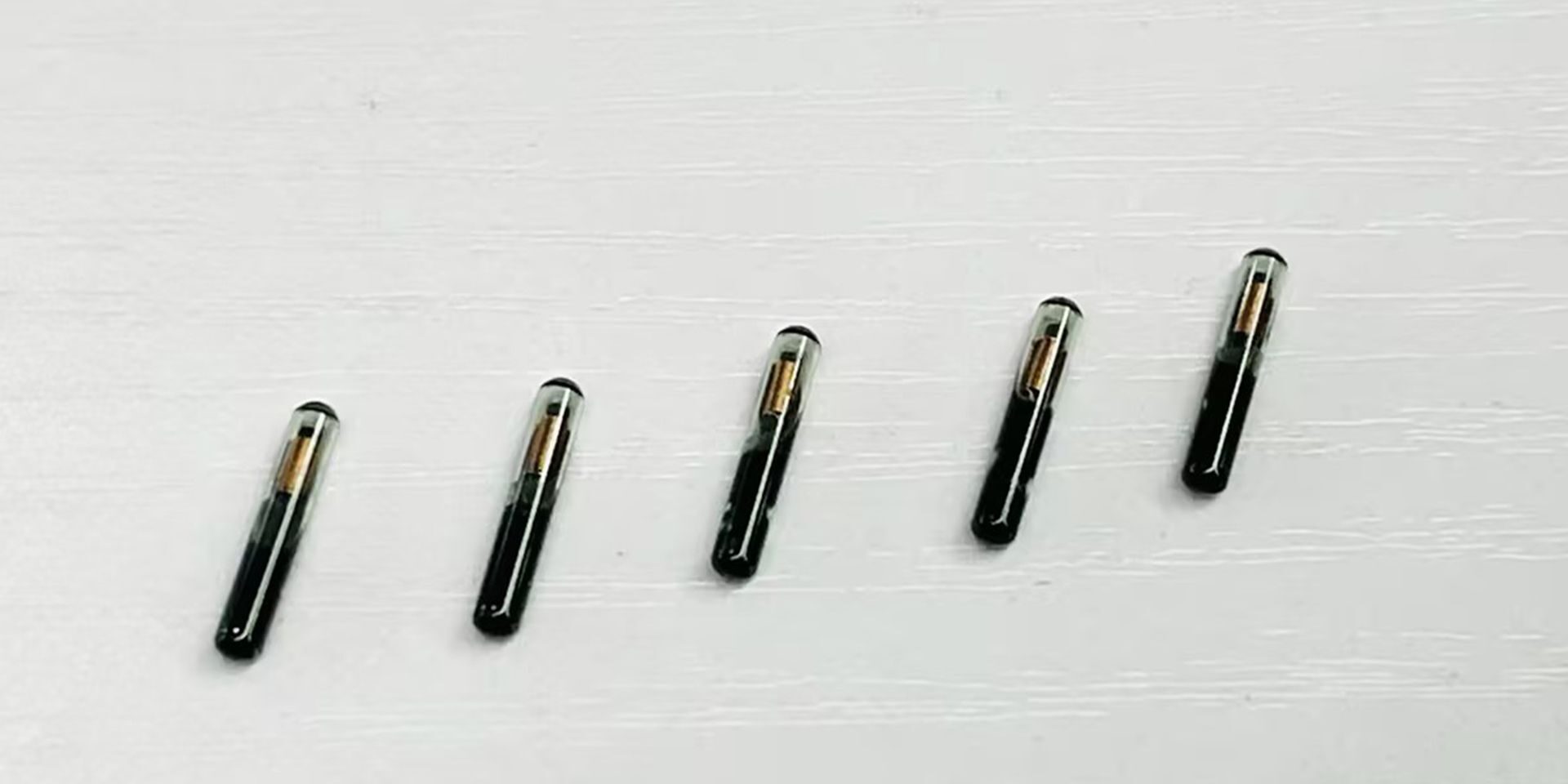
Basta colocar, an RFID glass tube tag / animal microchip acts like an “electronic ID card that can never be lost.”
It is an electronic microchip roughly the size of a grain of rice (common dimensions include 1.25mm × 7mm or 2.12mm × 12mm). To protect its fragile internal circuitry, the chip is encapsulated within a highly transparent, Durável, and biocompatible glass tube.
- For Animals: It is injected subcutaneously (beneath the skin) for identification and loss prevention purposes.
- For Industrial Use: It is embedded within tools, equipamentos, or parts to facilitate automated tracking.It requires no internal battery and can operate stably for over ten years.
2.How RFID Glass Tube Tags / Animal Microchip Work
RFID glass tube tags / animal microchip fall under the category of “Passiva” Tecnologia RFID. Their operational process can be broadly divided into three steps:
- Activation: A reader (either a handheld device or a fixed scanner) emits electromagnetic wave signals at a specific frequency.
- Induction: When the glass tube tag comes into proximity with the reader, its internal micro-coil “harvests” energy from the reader via induced current, instantly activating the internal chip.
- Transmission: Once activated, the chip transmits its stored Unique Identifier (UID) volta para o leitor. The reader recognizes this code and either displays it on a screen or uploads it to a database.
3.Types of RFID Glass Tube Tags / Animal Microchip
Based on varying application requirements, glass tube tags are primarily categorized into the following types:
A.Animal Identification Tags (Compliant with ISO 11784/11785 Standards)
This is the most common type, primarily used for the management of living organisms:
- Standard Type (HY-GT01/02/04/11/12): Available in various sizes (por exemplo, 1.4mm × 8mm, 2.12mm × 12mm) and widely used for pets (cães e gatos), laboratory mice, and horses.
- Ultra-Miniature Type (HY-GT03): Measuring a mere 1.25mm × 7mm, this variant is specifically designed for extremely small animals—such as fish, birds, or juvenile laboratory animals—to minimize discomfort.
- Temperature-Sensing Model (HY-GT101): In addition to providing a unique ID, this model senses body temperature in real-time, making it an invaluable tool for livestock farms monitoring animal health (particularly during pregnancy).
B.Industrial-Grade Applications
- High-Performance Industrial Glass Tube Tag (HY-GTI0313): Designed specifically for harsh environments. It features an exceptionally wide operating temperature range (-25°C to +85°C) and can withstand significant industrial pressure and chemical corrosion; it is typically used for tracking non-biological assets.
C.Advanced Functionality
- Dual-Frequency Glass Tube Tag (HY-GT15): Integrates both Low Frequency (134.2 kHz) and High Frequency (13.56 MHz) batatas fritas. This allows it to be read by traditional animal readers while also remaining compatible with more intelligent interactive systems, thereby enabling a wider range of value-added functions.
4.Common Application Scenarios
Animal Identification and Management
- Pet Identity Management: Assigns a unique electronic ID to cats and dogs, facilitating urban canine management and aiding in the recovery of lost pets.
- Laboratory Animal Monitoring: During scientific research, allows for the rapid identification of individual laboratory mice—accessing their full records via scanning—without the need for manual handling.
- Aquatic and Wildlife Tracking: Used for studies on fish migration, the monitoring of rare bird species, and similar applications.
Industrial and Asset Management
- Precision Tool Tracking: In automated factories, tags are embedded into expensive drill bits or fixtures to enable precise inventory control and lifecycle management.
- Smart Factory Inspection: Tags are installed at production line nodes to record product assembly status and station dwell times.
- High-Voltage Power/Gas Inspection: Due to the excellent insulating properties of the glass tube casing, these tags are frequently used for identification and management within high-voltage power equipment.
Selection Tips:
- For small-sized pets, the HY-GT03 (1.25 mm) model is recommended.
- If ICAR (Comitê Internacional para gravação de animais) certification is required, please verify that the specific model includes the corresponding certification mark.
- For factory automation applications, please ensure you select an industrial-grade glass tube tag from the HY-GTI series.
To purchase glass tube tags, por favor Contate-nos diretamente.