Micron-Level Integration: Why SMT-Ready RFID is the Future of PCB Design
In the hyper-competitive world of high-end electronics—ranging from flagship smartphones to mission-critical IoT modules—space is the most valuable commodity. Traditional adhesive-based asset labels are no longer viable; they occupy too much surface area, risk peeling under thermal stress, and fail to provide the “hardware-level” security required for modern anti-counterfeiting.
The industry is shifting toward SMT-compatible micro RFID tags. By treating the RFID tag as a standard Surface Mount Device (SMD), manufacturers can bake the digital identity directly into the circuit board, creating a permanent, tamper-proof “Digital Birth Certificate.”
The Shift from Labeling to Integration
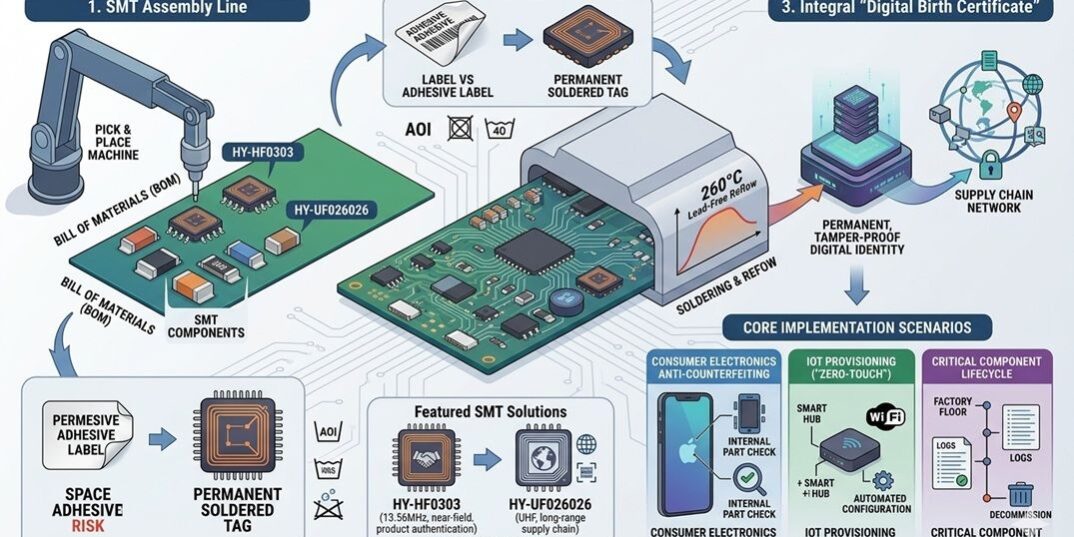
Standard tracking labels often interfere with automated optical inspection (AOI) and cannot survive the harsh chemicals used in PCB washing. According to IPC-1782 standards for high-reliability electronics, traceability must be “integral and permanent.” SMT-compatible micro RFID tags solve this by being part of the bill of materials (BOM), soldered alongside resistors and capacitors during the reflow process.
Featured SMT Solutions for Electronics OEMs
For designers looking to optimize their board real estate, rfidtaghy.com offers specialized components engineered for the rigors of the assembly line:
-
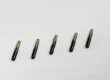
HY-HF0303 (13.56MHz): Specifically designed for PCB integrated RFID aplicações. Its high-frequency interface is ideal for near-field product authentication and local parameter configuration. Supporting standard SMT processes, it can be placed by high-speed pick-and-place machines and survive lead-free reflow profiles peaking at $260°C$.
-
HY-UF026026 (UHF): This ultra-miniature UHF variant is the go-to for electronics manufacturing traceability across the global supply chain. Its long-range readability allows for bulk scanning of finished goods inside their retail packaging, providing end-to-end visibility from the factory floor to the consumer.
Core Implementation Scenarios
-
Consumer Electronics Anti-Counterfeiting: High-end smartphone manufacturers use embedded RFID to verify genuine internal components, preventing the use of unauthorized third-party parts.
-
IoT Provisioning: Smart home devices can have their Wi-Fi credentials or firmware metadata pre-loaded into the HY-HF0303 marca, allowing for “Zero-Touch” configuration out of the box.
-
Critical Component Lifecycle: In aerospace or medical electronics, the tag logs the board’s entire history—from the initial SMT run to its final decommission.
Conclusão
By adopting SMT-compatible micro RFID tags, electronics brands are not just tracking an asset—they are securing their intellectual property. Integrating the identifier into the PCB architecture ensures that the data is as durable as the device itself.
Would you like a technical footprint drawing for the HY-HF0303 to include in your next PCB layout design? Contact our engineering team at RFIDHY.