
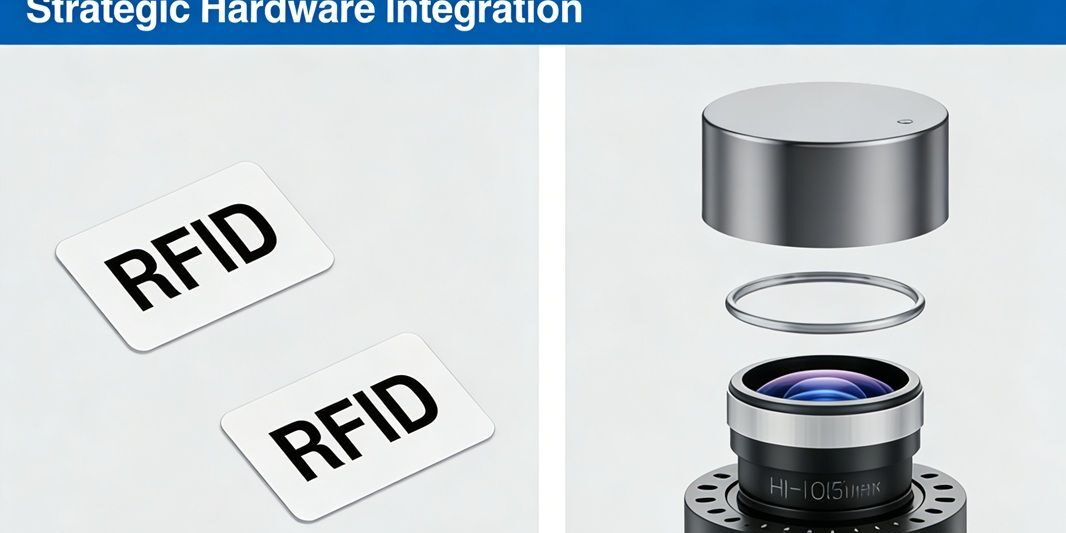
As the semiconductor industry pushes toward 2nm nodes, a demanda por “contamination-free” lithography lens traceability has reached a critical peak. Traditional mechanical engraving or adhesive labels are strictly prohibited in these ultra-high vacuum and ISO Class 1 cleanroom environments.
The breakthrough lies in micro UHF Tags RFID—sub-3mm identifiers that provide a permanent “Digital Passport” without ever touching the sensitive optical glass.
1.The Challenge: Contamination and Outgassing
Optical elements used in semiconductor fabrication and defense imaging must remain chemically inert. Standard materials can “outgas,” releasing volatile organic compounds (VOCs) that fog lenses over time. According to ASML’s supplier quality guidelines, any component within the optical path must meet stringent molecular cleanliness standards (Source: ASML Public Technology Report).
By utilizing PEEK encapsulated tags RFID, manufacturers ensure zero outgassing and high resistance to the harsh chemicals used during the multi-stage lens coating (thin-film deposition) processo.
2.Strategic Hardware Integration: HY-UF026026 & HY-HF0303
For Tier-1 optics manufacturers in Europe and North America, selecting the correct frequency and form factor is vital. We recommend the following precision solutions from rfidtaghy.com:
HY-UF026026 (2.6 x 2.6mm): This ultra-miniature, on-metal RFID tag is specifically designed to be recessed into the metallic lens barrel or “cell.” Its microscopic footprint ensures it does not disrupt the mechanical balance of the rotating lens groups.
HY-HF0303 (13.56MHz): Ideal for cleanroom assembly stations, this HF tag allows for localized, high-security data exchange. It is perfect for linking specific coating batch data to an individual lens element without the risk of cross-talk from adjacent components.
3.Global Application Scenarios
- Semiconductor Supply Chain: Tracking the entire lifecycle of a lithography lens from initial grinding to its integration into a scanner, ensuring a 100% accurate maintenance log.
- Military & Aerospace: Securing the provenance of thermal imaging lenses used in UAVs and fighter jets, preventing the infiltration of counterfeit components into the defense supply chain.
- Astronomy & Space Research: Managing the complex assembly of mirror segments for next-generation space telescopes, where each piece must be identified with zero physical contact.
4.Quantifiable Precision
Industry data from SEMI suggests that automated RFID tracking in cleanrooms can reduce assembly-related errors by up to 22%, significantly lowering the “Yield Loss” associated with component mismatches (Source: SEMI Industry Standards, 2025).
Conclusão
By adopting micro UHF Tags RFID, the optics industry can finally achieve a seamless balance between physical purity and digital transparency. These tiny identifiers ensure that while the lens remains untouched, its data is always within reach.
Would you like a technical datasheet regarding the outgassing test results for our PEEK-encapsulated Tags RFID? Contact our specialist team at rfidtaghy.com.