
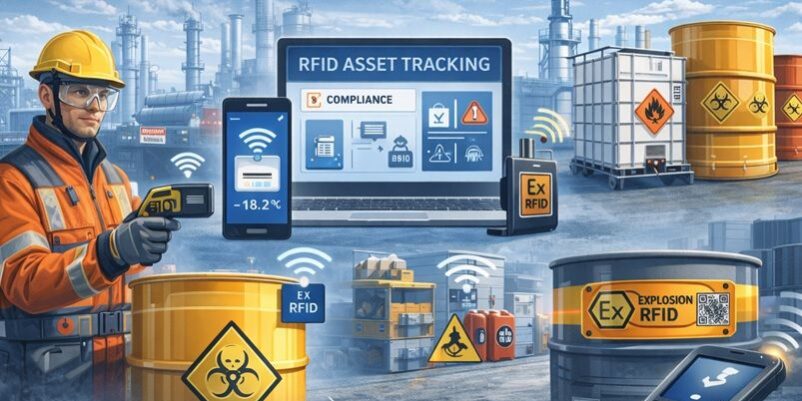
Safety First: Redefining Chemical Asset Management with RFID
In the chemical industry, managing high-pressure vessels, complex piping, and volatile reagents is not just a logistical challenge, but a critical compliance task. With increasingly stringent global regulations such as OSHA 1910.119 (PSM) and EU REACH regulations, manual tracking is no longer a viable solution.
Leading global chemical companies are deploying explosion-proof RFID solutions to bridge the gap between physical assets and digital safety records.
Pressure Vessel and Piping Integrity
In highly corrosive environments, traditional barcodes fade or peel off. Industrial-grade chemical safety RFID tags, using robust encapsulation materials (ceramic or PPS), can withstand extreme temperatures and acidic environments.
Lifecycle Approach: By tagging each flange and container, engineers can instantly access manufacturing dates, last ultrasonic testing results, and maintenance history via handheld readers.
Impact: Recent deployment data from North America indicates that RFID-integrated detection systems can reduce human error reporting by up to 40%, ensuring no mandatory detection windows are missed.
Hazardous Materials (HazMat) Visibility
Managing drummed chemicals requires more than just knowing “how much” is in stock; it also requires knowing “שם” ו “how long” it has been stored.
Real-time Monitoring: Hazardous materials tracking via fixed RFID gateways at warehouse entrances automates the inbound/outbound process.
Area Compliance: If incompatible chemicals (such as oxidizers and flammable materials) are placed in the same storage area, the system will issue an alert, significantly reducing the risk of catastrophic reactions.
Personnel Access and Area Security
Security is not just about goods, but also about people. By integrating RFID asset lifecycle data with personnel badges, facilities can implement “authorized personnel only” access to high-risk areas. If a technician’s certification has expired, the RFID gate for the specific reactor area they are responsible for maintaining will not be able to open.
Quantifiable Compliance Value
According to Accenture’s Industrial Safety Report, digital asset tracking can improve intrinsic safety levels, resulting in a 15% reduction in insurance premiums. יתר על כן, during Environmental, Health and Safety (EHS) audits, the time required to generate a complete chemical safety RFID compliance report is reduced from days to minutes.
Recommended RFID Solutions for Chemical Environments
To achieve these goals, selecting the right hardware is crucial:
- RFID Micro Tags: Ultra-rugged, small-sized tags for tracking valves and small tools.
- RFID Anti-Metal Tags: Optimized for metal surfaces and harsh chemical cleaning environments.
- Stainless Steel Tags: Suitable for high-pressure storage tanks requiring extremely high durability.
מסקנה
Implementing a chemical safety RFID strategy not only simplifies audits but also lays the foundation for predictive safety. By ensuring that every asset is identified and every movement is recorded, chemical companies can achieve true operational resilience.
Get a list of ATEX/IECEx standard explosion-proof RFID hardware selection specifications