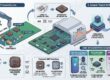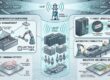

Dans l’industrie manufacturière, Les moules sont les principaux atouts de la production, mais la gestion traditionnelle est souvent due à une forte dépendance artificielle, Décalage des données, fragmentation des processus et autres problèmes conduisant à l’inefficacité. RFID (Identification par radiofréquence) technologie grâce à la collecte automatisée de données, Suivi de l’état en temps réel et aide à la décision intelligente, to significantly improve the efficiency of the mould management, which is specifically embodied in the following five dimensions:
Real-time tracking: goodbye to ‘difficult to find the mould’, shorten the preparation time
Pain point: traditional management relies on manual recording of the mould location, large factories to find the mould time accounts for more than 30% of the production preparation.
Solution RFID:
- second positioning: embedded in the mould metal-resistant RFID tags, combined with the workshop fixed read-write and positioning system, real-time display of the mould location (such as ‘No. 2 injection moulding machine is in use’).
- Traçabilité de l’ensemble du processus: Automatically record the flow path of moulds from warehouse to production line, and shorten the time of mould adjustment by 50%-80%.
Cas: An auto parts company reduced the mould search time from 30 minutes avant 2 minutes through RFID, and increased annual production capacity by 15%.
Automated data collection: Réduire les interventions manuelles, eliminate human error
Pain points: manual recording of the number of times the mould is used, maintenance records are prone to error, resulting in overload or maintenance omissions.
Solution RFID:
- Dynamic data writing: RFID tags automatically record key data such as mould up time, moulding cycle, cumulative number of times used, etc., with an accuracy rate close to 100%.
- Identification des lots: Fixed reader can identify hundreds of tags at the same time, in and out of the warehouse to improve efficiency by 5-10 fois.
Cas: a home appliance company through RFID to achieve automatic collection of mould data, manual inspection costs down 30%, data error rate to zero.
Preventive Maintenance: Extend the life and reduce the loss of downtime
Pain point: traditional maintenance relies on experience, sudden failure of moulds leads to huge loss of downtime.
Solution RFID:
- Lifespan prediction: The system automatically triggers maintenance work orders based on the number of times used, pressure temperature and other data recorded by RFID.
- Health record management: The tag stores maintenance records, replacement parts and other information, forming a ‘digital history’ of the mould.
Cas: A 3C enterprise through RFID predictive maintenance will reduce the failure rate of moulds by 40%, life extension of 20%, annual savings of 1.5 million yuan in maintenance costs.
Process automation: seamless collaboration to enhance overall efficiency
Pain points: Mould allocation, entretien, scrapping and other aspects of the process rely on manual coordination, process inefficiencies.
Solution RFID:
- And MES / ERP linkage: RFID data is automatically synchronised to the management system, triggering work orders, updating inventory status, Élimination des silos d’informations.
- Intelligent scheduling: Combined with AGV trolley and RFID positioning, to achieve the automatic allocation of moulds and on the machine.
Cas: a medical device company through the RFID system to shorten the mould replacement time by 65%, the production plan implementation rate increased by 25%.
Prévention active des erreurs: Reduce human errors and guarantee production quality
Pain point: Manual operation can easily lead to mould mis-installation and parameter errors, which can cause quality accidents.
Solution RFID:
- Model Matching Verification: The injection moulding machine reader automatically checks the mould ID and work order requirements, and locks the equipment if it does not match.
- Anti-tampering of process parameters: The tag stores the range of permitted parameters, and the system monitors and alarms in real time.
Cas: A daily chemical packaging company through the RFID error prevention system to reduce 95% de l’erreur de chargement du moule, product defective rate down by 30%.
The underlying logic of efficiency improvement: data-driven decision-making
RFID not only solves the problem at the execution level, but also feeds the management through data:
- Resource Optimisation: Analyse the data of mould utilisation rate, eliminate the inefficient assets, and reduce the redundant purchasing by 20%.
- Digital Twin: RFID data drives virtual mould models, reducing the number of mould trials by 40% and shortening the R&D cycle.
Résumé: RFID is the ‘catalyst’ of the efficiency revolution
Through accurate tracking, automated collection, preventive maintenance, process synergy and active error prevention, RFID will transform mould management from ‘passive fire-fighting’ to ‘active control’, directly improving production efficiency. RFID transforms mould management from ‘passive fire-fighting’ to ‘active control’, which directly improves production efficiency and reduces operating costs. In the era of Industry 4.0, RFID is not only a technical tool, but also a core engine for manufacturing industry to achieve lean and intelligent upgrading.