
Maximizing Read Range: The Engineer’s Guide to Anti-metal RFID Tags
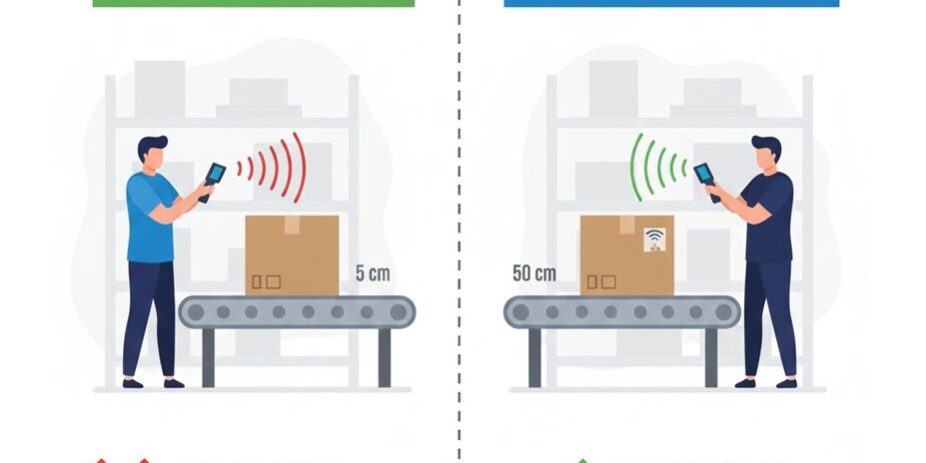
In industrial environments, tracking metal assets—such as heavy machinery, storage containers, or battery packs—presents a unique challenge: Signal Interference. When a standard RFID tag is placed directly on metal, the conductive surface reflects the radio waves, leading to signal cancellation and total read failure.https://www.rfidhy.com/rfid-application/rfid-industrial-automation/
For reliable asset management, specialized anti-metal RFID tags are not an option; they are a necessity.
The Science of Metal Interference
Radiofrequenz-Identifikation (RFID) relies on electromagnetic fields. When a standard tag’s antenna is placed against metal, the metal acts as a ground plane, effectively “shorting out” the antenna’s performance.
To overcome this, anti-metal RFID tags utilize a critical design feature: ein Isolation Layer. This spacer (usually made of foam, keramisch, or high-density plastic) physically separates the tag’s antenna from the metallic surface, allowing the electromagnetic field to propagate correctly.
Choosing the Right Anti-metal Tag for Your Application
Not all metal surfaces are the same. Selecting the right hardware depends on your specific environment:
| Application Environment | Suggested Tag Type | Key Benefit |
| Heavy Machinery | Ruggedized UHF RFID Tags | Extreme durability against shock/vibration |
| Indoor Logistics | Foam-based Anti-metal Tags | Cost-effective for bulk asset tracking |
| Electronics/PCBs | Micro Anti-metal Tags | High precision, low footprint |
| Outdoor/Harsh Chemicals | Ceramic-encapsulated Tags | High IP rating (IP68/IP69K) |
3 Key Technical Considerations for Implementation
-
Surface Geometry: Are you tracking flat metal panels or curved industrial pipes? Always test the tag’s read range on the actual curvature of your asset.
-
Read Distance Requirements: In long-range logistics, you need high-gain antennas. In localized tool tracking, near-field performance is more important.
-
Montage-Methode: Consider the installation environment. Does your asset require high-strength industrial adhesive, magnetic mounts, or mechanical fastening (rivets/screws)?
Why Specialized RFID Hardware Matters
Choosing generic tags for metal surfaces often leads to “ghost” reads or high error rates, which can compromise the integrity of your entire asset management system. By deploying tags engineered for RFID metal interference, you ensure consistent data collection, enabling a fully automated, real-time inventory flow.
Q1: Can I use standard RFID tags on metal if I put tape under them?
A: Nein. Simple tape lacks the necessary dielectric properties to isolate the antenna from the metal. You must use specialized anti-metal RFID tags that include an isolation spacer.
Q2: How does the thickness of the tag affect read range on metal?
A: In der Regel, a thicker isolation layer allows for better read performance on highly conductive surfaces. Jedoch, for space-constrained applications, advanced micro anti-metal tags are engineered to provide performance despite their thin profile.
Download Our Technical Specs: Anti-metal Tag Selection Guide.