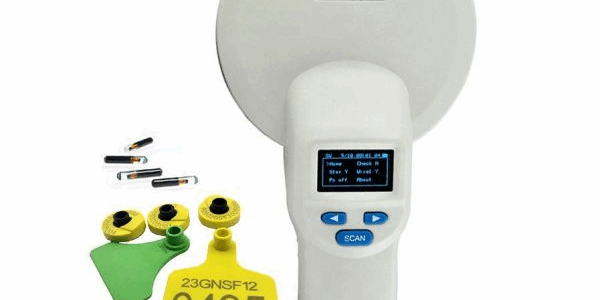
When a veterinarian holds a handheld device close to a dog’s neck, the screen instantly displays the vaccination record; in the smart access of a pasture, data is automatically synchronized to the cloud as the cattle pass through; researchers in a nature reserve simply press a button to update the identities of wild deer herds — behind these scenes, the core role of the RFID animal microchip reader/writer is indispensable. Serving as the “translator” connecting animal microchips to the digital world, this device is revolutionizing the efficiency and depth of animal management through its precise data interaction capabilities.
أنا. Technical Core: Two-Way Communication via Radio Frequency Signals
The working principle of RFID animal microchip readers and writers fundamentally involves data interaction through the transmission and reception of radio frequency signals. Its core components include an RF module, هوائي, data processing unit, and interface module: When the device emits electromagnetic waves at a specific frequency (commonly 134.2 kHz low-frequency or 13.56 MHz high-frequency), the passive microchip inside the animal receives the energy and activates, transmitting stored information such as the ID code via backscatter; After decoding, the reader/writer can display the data and also write new information (such as the latest health records) to the chip.
Frequency selection directly impacts application scenarios: Low-frequency readers/writers (125-134 كيلو هرتز) have strong penetration capabilities, making them suitable for large animals with thick fur or subcutaneous fat. The reading distance is typically 10-30 سم, with high stability; High-frequency readers (13.56 CH4) have fast transmission speeds and can write complex data, making them more common in scenarios such as veterinary clinics; Ultra-high-frequency (التردد فوق العالي) readers enable long-range reading at 5–10 meters, suitable for bulk identification in farms, but are susceptible to interference from water and metal.
Modern readers now support multi-protocol compatibility, compatible with international standard chips such as ISO 11784/11785, ensuring data interoperability across different brands of devices. على سبيل المثال, Hikvision’s DS-K1T600 series uses automatic protocol recognition technology to simultaneously read and write low-frequency and high-frequency chips, resolving compatibility issues across different scenarios.
الثاني. Type Matrix: Full-scenario coverage from palm to cloud
1. Portable readers: Flexible assistants for mobile scenarios
Weighing only 200 غرام, these handheld devices are essential tools for field workers. A portable reader used by a Shenzhen-based biological research institute features a 2.4-inch touchscreen and a 5000mAh battery, enabling continuous operation for 12 hours on a single charge. In the Yunnan Golden Monkey Conservation Project, researchers use it to quickly read chip information from monkey groups in the field and synchronously input new activity trajectory data, improving efficiency by 300% compared to traditional paper-based records.
Consumer-grade products prioritize usability. Pet-specific readers like the PetLink Pro support Bluetooth connection to smartphones, automatically redirecting to the pet’s profile page after scanning, making it easy for ordinary pet owners to operate. Data from 2024 shows that such devices have increased the timely update rate of health records for household pets by 65%.
2. Fixed-mounted readers: Efficiency engines for bulk management
In smart access control systems at farms, embedded readers are demonstrating powerful computational capabilities. At a dairy farm in Inner Mongolia, a 10-meter-long identification channel equipped with four sets of directional antennas can identify 800 cows per hour. Data is uploaded in real-time to the farm management system, automatically tracking metrics such as feeding frequency and activity levels. Through algorithmic analysis, the system can precisely identify individuals requiring breeding or quarantine, reducing manual sorting costs by 70%.
Desktop readers in pet hospitals focus on data integration. A desktop device at a chain of pet hospitals in Beijing connects to the hospital’s HIS system via USB. After reading the chip, it automatically retrieves the medical records. After the doctor completes the diagnosis report, clicking “write” saves the new data to the chip, achieving three-way synchronization between the device, نظام, and chip, thereby avoiding information silos.
3. Industrial-grade readers: Reliable performance in extreme environments
At an Antarctic research station where temperatures drop to -40°C, specially designed readers continue to function normally. In the penguin monitoring project at China’s Zhongshan Station in Antarctica, cold-resistant readers were installed in penguin habitats. Powered by low-temperature lithium batteries, they can accurately read chips implanted in penguins even when covered in ice and snow, recording their return times and body temperature data, providing firsthand information for climate change research.
Corrosion-resistant design is suitable for aquaculture. A seawater aquaculture farm sealed the reader in a 316 stainless steel housing and fixed it at the entrance of the net cage to identify the chips of passing grouper, recording growth cycles and feed quantities, thereby increasing survival rates by 18%. This salt fog resistance and biofouling resistance breaks through the limitations of traditional equipment in underwater applications.
الثالث. Scenario Implementation: Value Reconstruction from Farm to Laboratory
Livestock Industry: Creating a “Digital Profile” for Every Cow
The transformation of a beef cattle farm in Ningxia is a representative example. After introducing fixed readers, the system automatically reads the chips of each cow as they pass through the milking channel, linking data such as milk production and milk composition to individual animals. The system-generated “digital profile” enables precise matching of feed formulas, increasing average daily milk production per cow by 1.2 kilograms. والأهم, when a cow falls ill, veterinarians use a handheld reader to record treatment details, which accompany the beef through the supply chain. Consumers can scan a QR code to view the animal’s entire health history.
Pet Industry: Giving Pets a “Smart ID Card”
Shanghai’s pet chip management system has covered 80% of pet hospitals. When a lost pet is brought to the hospital, veterinarians can scan the chip with a reader to retrieve the owner’s information and emergency contacts. في 2024, على مدى 20,000 pets were reunited with their owners through this system. Even more conveniently, some readers support NFC functionality, allowing owners to update their pets’ vaccination records by simply touching the device with their phone, without needing to download a dedicated app.
Wildlife Conservation: Non-Intrusive “Data Collectors”
In a lion pride study at Africa’s Serengeti National Park, researchers used long-range readers (with a reading distance of 50 متر) to identify lions without disturbing the pride. The recorded movement patterns showed that male lions’ activity ranges expanded by 30% during the dry season, providing scientific basis for water source planning in the reserve. In giant panda conservation, infrared-triggered readers are installed along bamboo forest paths, automatically activating when pandas pass by, thereby avoiding energy waste from continuous power supply.
4. Technological breakthroughs: From “reading and writing” to ‘thinking’
Modern readers have evolved beyond basic data interaction functions to become “smart terminals.” A certain brand’s AI reader is equipped with machine learning algorithms that analyze the identification frequency and time distribution of cattle herds to automatically assess herd activity levels. When activity levels suddenly drop, it triggers disease alerts with an accuracy rate of 82%. This “edge computing + local decision-making” model reduces reliance on cloud services, with response times improved to 0.5 ثانية.
Upgrades in battery life and communication technology are equally significant. Solar-powered fixed readers can operate year-round with zero maintenance in areas with ample sunlight. Devices using the LoRaWAN protocol have a transmission range of 10 كيلومترات, making them suitable for data transmission from remote pastures. The ultra-wideband (يو دبليو بي) readers launched in 2024 achieve positioning accuracy of 10 سنتيمتر, enabling not only identity recognition but also real-time tracking of animal locations, opening possibilities for precision management.
Security design has also been enhanced. Encrypted readers and writers use AES-128 algorithms to ensure data transmission security and prevent chip information from being tampered with. The latest EU standards require that animal chip data reading and writing must be authorized by a key, prompting reader and writer manufacturers to upgrade their security modules. حاليا, compliant devices account for 70% of the European market share.
الختام: Safeguarding the Essence of Life in the Data Flood
The value of RFID animal microchip readers extends far beyond data reading and writing. It transforms each animal into a data node without stripping them of their natural attributes—cattle still roam freely on pastures, pets run freely, and wild animals maintain their natural rhythms. Through these “invisible conversations,” humans gain a deeper understanding of their needs and how to protect them.
When the sharp edge of technology is wrapped in gentleness, and precise data serves the dignity of life, the RFID animal microchip reader/writer is shaping such a future: the coexistence of humans and animals retains both the efficiency of technology and the warmth of nature. This may be its ultimate significance as a “life data manager” — ensuring that every data interaction becomes a gesture of respect and care for life.