
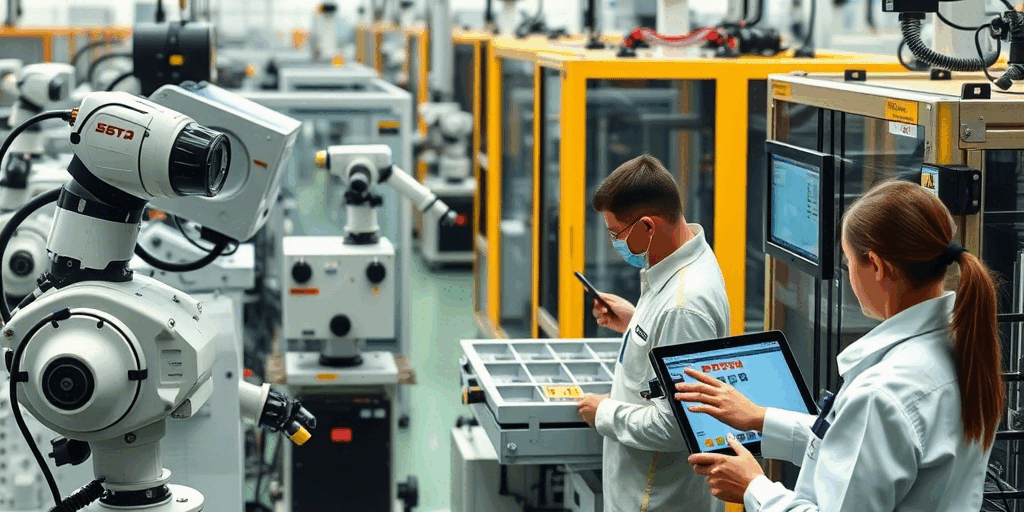
Amidst the global manufacturing industry’s shift towards intelligent and digital transformation, the precise and rapid identification and management of thousands of components has become pivotal to enhancing corporate competitiveness. Traditional barcodes or QR codes are prone to interference in high-temperature, high-humidity, or metallic environments, failing to meet modern industry’s stringent demands. Smaller yet more powerful RFID micro-tags are emerging as the new favourite in industrial automation, revolutionising component tracking.
1. What Are RFID Micro-Tags?
RFID micro-tags are ultra-compact radio-frequency identification labels, typically measuring less than 1 millimetre. Despite their diminutive size, they store unique identification codes and can be read from considerable distances. Beyond inheriting traditional RFID tags’ advantages—such as high-speed batch reading and contactless identification—their minute size allows embedding within intricate components, enabling truly ‘invisible’ information management.
2. Pain Points in Industrial Component Management
Within precision manufacturing sectors like automotive, aerospace, and electronics, every screw and cutting tool is critical. Traditional barcode labels face these challenges:
Environmental constraints: Susceptibility to damage and unreadability in high-temperature, metallic, or oily environments.
Manual dependency: Requirement for visual scanning, resulting in low efficiency and high error rates.
Traceability difficulties: Inability to achieve end-to-end tracking of components from production through assembly to after-sales service.
These issues directly impact production efficiency, quality control, and after-sales support.
3. Application Scenarios for RFID Ultra-Micro Tags
(1) Precision Component Tracking
Embedding RFID micro-tags in critical components such as engines, aerospace parts, and semiconductor devices enables comprehensive data logging throughout production, assembly, and inspection stages. Even when operating at high speeds within metallic environments, the tags maintain stable functionality, ensuring complete traceability of production data.
(2) Tooling and Mould Management
In CNC machining centres or injection moulding production, the lifespan of cutting tools and moulds directly impacts product quality. By embedding micro-tags within tools, the system monitors usage cycles and wear in real time, automatically triggering replacement or maintenance alerts to prevent production downtime caused by tool failure.
(3) Automated Production Line Identification
Utilising automated reading devices, production lines can rapidly identify hundreds of components without halting operations. Data is automatically logged into ERP or MES systems, enabling unmanned warehousing and intelligent sorting to significantly boost production efficiency.
4. المزايا التقنية
Extremely compact: Embeddable within micro-components such as screws and bearings without compromising appearance or performance.
Extreme environment resilience: Operates reliably under harsh conditions including high temperatures, strong magnetic fields, oil contamination, and vibration.
Batch reading capability: Supports simultaneous identification of hundreds or thousands of tags, far surpassing manual scanning efficiency.
أمن البيانات: Each tag possesses a unique ID, making replication difficult and ensuring data reliability.
5. Seamless Integration with Enterprise Systems
Real-time data captured by RFID ultra-micro tags integrates seamlessly with enterprise systems including ERP, مس, and WMS, enabling:
Production progress visualisation
Automatic inventory updates
Quality traceability and after-sales queries
Predictive maintenance and spare parts management
This not only reduces manual recording time and costs but also provides data support for lean production and intelligent decision-making.
6. Typical Application Case
Following the embedding of RFID micro-tags within screws and seals, an automotive component manufacturer achieved 99.9% automatic identification accuracy on its production line. Inventory efficiency improved by 70%, while rework rates due to incorrect component assembly were substantially reduced.
7. Future Development Trends
With the proliferation of Industry 4.0 and IoT technologies, RFID micro-tags will play an expanding role across industrial applications:
– Integrating with 5G networks to enable lower-latency data transmission;
– Linking with AI analytics systems for predictive equipment health monitoring;
– Achieving end-to-end automation in smart warehousing and unmanned factories.
الختام
Facing the manufacturing sector’s relentless pursuit of precision and efficiency, RFID ultra-micro tags offer a dependable solution for industrial automation and component tracking through their compact size and robust functionality. They not only enhance production efficiency and data management capabilities for enterprises but also play an irreplaceable pivotal role in the blueprint for future intelligent manufacturing.